Why Software Architecture Diagrams Fail and How to Fix Them
Brijesh ShahAugust 5, 2026
Share this article


Let AI highlight what matters.
Every engineering team creates software architecture diagrams. Very few create diagrams that people immediately understand, remember, and share. I have sat in architecture reviews where a 47-component AWS system architecture diagram was presented for 20 minutes, and when it was over, nobody in the room could explain what the system actually did. The diagram was technically accurate. It was completely uncommunicative.
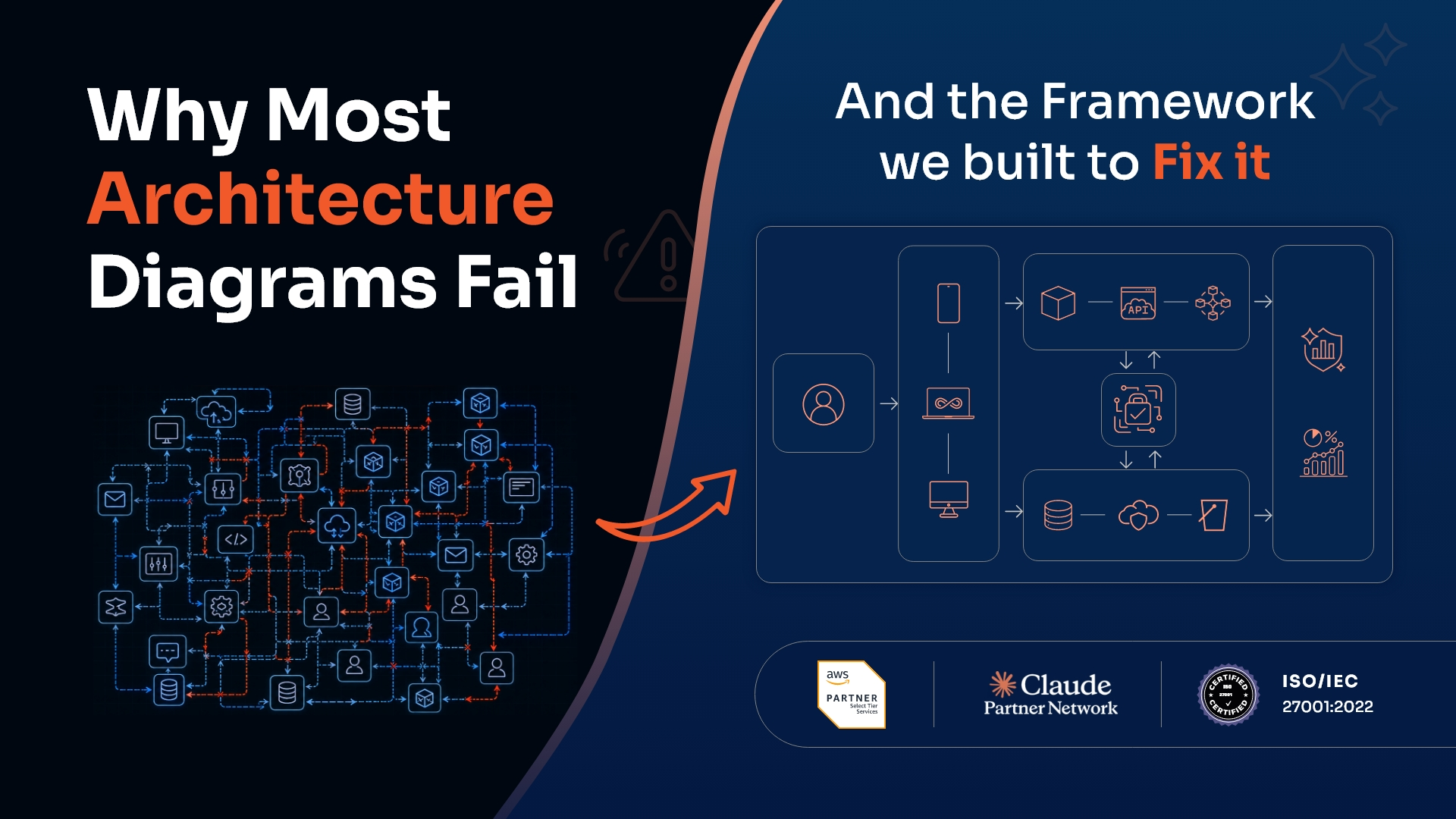
That’s the default state of engineering communication at most organizations today, and it’s getting worse. As AI agents development, large language models, vector databases, orchestration frameworks, and multi-agent systems become standard components of production architecture, the complexity of what we’re building has increased dramatically, but the way we communicate that complexity hasn’t kept up. At NextGenSoft, we built a five-question framework called the Engineering Narrative Canvas to close that gap, and this post walks through exactly how it works.
“Most architecture diagrams document a system. Very few explain it.”
Before the framework itself, one idea has to be established, because it changes how you approach every architecture diagram you create: a beautiful diagram is not necessarily an effective one. The objective is not to impress the reader with technical complexity.
The objective is to reduce cognitive effort while preserving engineering accuracy. Every architecture diagram should simplify understanding, not simplify the system. This distinction matters more than any design tool, template, or visual style you’ll ever use, and it’s the single most important software architecture best practice underneath everything that follows.
Engineering communication has evolved alongside software engineering itself, but unevenly. Each era demanded more of a diagram than the last, and most organizations are still communicating with the wrong era’s toolkit.
1. The Evolution That Created This Problem: Engineering communication has evolved alongside software engineering itself. But the evolution has been uneven.
2. Traditional Software Era: Diagrams documented components and infrastructure. Complex enough to need docs. Simple enough to communicate.
3. Cloud-Native Era: Expanded to distributed services, APIs, event-driven flows. Complexity increased. Readability began to suffer.
4. AI-First Era: Must now explain reasoning, orchestration, memory, agent collaboration. Not just infrastructure.
This is exactly why a cloud-native architecture diagram, a microservices architecture diagram, and an application modernization roadmap each need a different communication strategy, not just a different set of icons. A diagram that explains a legacy-to-cloud application modernization plan to a CIO has a different job than one that explains agent orchestration to an engineering team, and using the same diagramming instincts for both is where most system architecture diagrams quietly fail.
“Most organizations are still using Traditional Era thinking to communicate AI-First Era systems. That gap is where architecture communication breaks down.”
The most common reason architecture diagrams fail is that engineers start with the diagram itself. They open Figma, Canva, or draw.io and start placing boxes. Components get added, connectors get drawn, and the diagram grows until it feels complete, but there’s no story, only a picture of a system.
The Engineering Narrative Canvas is the tool we use at NextGenSoft to fix that. It’s five questions that must be answered before any design tool is opened:

1. Why?:- Why does this system or diagram need to exist? What problem is it solving for the reader?
2. What?:- What is the system, platform, or capability being described?
3. Who?:- Who or what are the components, services, or agents involved?
4. How?:- How do those components work together to deliver the outcome?
5. Remember?:- What’s the one takeaway the reader should still remember a week later?
“The Golden Rule: Story first. Architecture second. Visual design last. When this sequence is followed, architecture diagrams become explanations rather than illustrations.”
To show how the canvas works, here’s how we applied it to our AWS AI Engineering Stack post, which reached over 1,000 organic impressions:
Why? Many engineering teams evaluate AWS AI tools individually, making it difficult to understand how they work together as one integrated platform.
What? The New AWS AI Engineering Stack 2026.
Who? Kiro. Amazon Q. AWS DevOps Agent. AWS Continuum. A2A Protocol.
How? Each component supports a different stage of the AI engineering lifecycle, from specification to deployment to cross-agent communication, operating as one connected ecosystem.
Remember? Modern AI engineering is evolving into an integrated platform where specialized AI services collaborate throughout the software delivery lifecycle.
Only after completing this canvas did we choose the Hub and Spoke pattern and the Framework Card layout. The visual became a natural expression of the narrative, not the other way around.
Once the Engineering Narrative Canvas is complete, the next decision is which storytelling pattern best communicates that narrative. These are not visual templates, they’re communication strategies, and one of them (Hub and Spoke) is already shown in the applied example above.

“Architecture patterns are not visual templates. They are communication strategies. Select the pattern that communicates the engineering narrative, not the one that looks most impressive.”
Knowing which pattern to use matters. Knowing which mistakes to avoid matters equally, if your architecture diagram does any of the following, your readers are guessing, not learning.

Architecture storytelling is a repeatable process, not a creative exercise. Here’s the exact workflow we follow at NextGenSoft for every system architecture diagram, application architecture diagram, and enterprise architecture framework document we produce:
1. Define the engineering problem
2. Complete the Engineering Narrative Canvas
3. Select the primary storytelling pattern
4. Apply information hierarchy, primary message, supporting components, relationships, context
5. Choose the NVPS layout
6. Create the architecture diagram
7. Run the engineering review (the six questions below)
8. Publish
If any answer is no revise before publishing. Every great architecture diagram answers one question: What should the reader remember?
In the AI-First Era, the ability to communicate architecture clearly is becoming a competitive advantage in its own right. Engineering teams that can explain their systems clearly attract better talent, win more clients, build stronger trust with stakeholders, and create technical content that travels far beyond its immediate audience. Teams that can’t explain their systems clearly will struggle to be understood, regardless of how sophisticated those systems actually are.
This is exactly the gap NextGenSoft’s Enterprise Architecture practice is built to close: we don’t just design scalable cloud-native architecture and microservices architecture. We make sure the resulting systems can actually be explained to the engineers who maintain them, the stakeholders who fund them, and the clients who depend on them. The same discipline applies whether we’re documenting a greenfield build or an application modernization roadmap moving a client off legacy infrastructure.
“The future belongs not only to teams that build great systems. It belongs to teams that explain them exceptionally well.”
1. What is the Engineering Narrative Canvas?
Answer: The Engineering Narrative Canvas is a five-question framework, Why, What, Who, How, and Remember, that engineering teams answer before opening any diagramming tool. It forces the story behind a system architecture diagram to be defined before the visual design begins, which is what separates a diagram that explains a system from one that merely documents it.
2. Why do most software architecture diagrams fail to communicate?
Answer: Most software architecture diagrams fail because engineers start by drawing components instead of defining the narrative first. The result is a technically accurate picture of a system that a reader can’t summarize or remember, because there was never a story driving the visual choices.
3. What’s the difference between documenting an architecture and explaining it?
Answer: Documenting an architecture means capturing every component and connection accurately. Explaining it means the reader walks away able to state, in their own words, what the system does and why it matters, which requires an information hierarchy and a single clear takeaway, not just completeness.
4. How is diagramming an AI-first architecture different from a traditional system architecture diagram?
Answer: A traditional system architecture diagram mainly needs to show components and infrastructure. An AI-first architecture diagram also has to explain reasoning, orchestration, memory, and multi-agent collaboration, dimensions that don’t map cleanly onto the boxes-and-arrows conventions built for infrastructure alone.
5. What makes an enterprise architecture framework diagram effective for both engineers and non-technical stakeholders?
Answer: An effective enterprise architecture framework diagram applies the same narrative discipline regardless of audience, a clear “why,” one primary message, and a memorable takeaway, while adjusting technical depth and vocabulary to match who’s reading it, rather than publishing one dense diagram for every audience.
 Brijesh Shah
Brijesh is an IIM Ahmedabad alumnus with 22+ years of experience in software development and management. As the visionary leader of NextGenSoft, he drives the company toward becoming a global leader in software services and digital transformation. He also serves as Vice President of the PMI Gujarat Chapter.
We’re ISO/IEC 27001:2022 certified, ensuring your projects are executed with globally recognized security standards.

INDIA
 sales@nextgensoft.io
 +91 81284 66678
 Brijesh Shah
CEO, NextGenSoft
Brijesh Shah
CEO, NextGenSoft


