AI-First Development: The New Operating Model for Modern Software Engineering
Brijesh ShahMay 8, 2026
Share this article


Let AI highlight what matters.
Software development is going through one of its biggest shifts since cloud computing and DevOps became mainstream. For many years, engineering teams improved delivery through Agile, CI/CD, cloud-native architecture, automation, and DevOps culture. These practices helped teams move faster, but much of the software development life cycle still depended heavily on manual effort, fragmented tools, repeated handoffs, and individual developer productivity.
“Generative AI and agentic AI are now changing this foundation.”
AI-first development is not about asking a coding assistant to generate a few functions. It is about rethinking the entire software development life cycle, from requirement discovery to architecture, coding, testing, deployment, monitoring, support, and continuous improvement.
In simple terms, AI-first development means AI becomes an embedded engineering partner across the SDLC, while humans continue to provide business context, architecture direction, security judgment, quality validation, and accountability.
“This is where the real opportunity lies.”
The future of software engineering will not be “AI replacing developers.” It will be “AI-augmented engineering teams delivering faster, safer, and more intelligently.”
The traditional SDLC was designed for control, predictability, and structured delivery. It typically moves through requirement gathering, analysis, design, development, testing, deployment, and maintenance. This model still matters, but the way teams execute each stage is changing.
Modern engineering teams face several challenges:
In many organizations, teams are using modern tools, but the workflow still behaves like a traditional assembly line. Requirements move to design, design moves to development, development moves to QA, QA moves to deployment, and production issues return as escalations.
AI-first SDLC is a software engineering approach where AI capabilities are intentionally embedded into every phase of the development life cycle.
It does not mean removing the engineering discipline. In fact, AI-first SDLC requires stronger discipline because AI can accelerate both good practices and bad practices. If a team has weak architecture, unclear requirements, poor testing, and inconsistent reviews, AI may simply help the team create more output without improving quality.
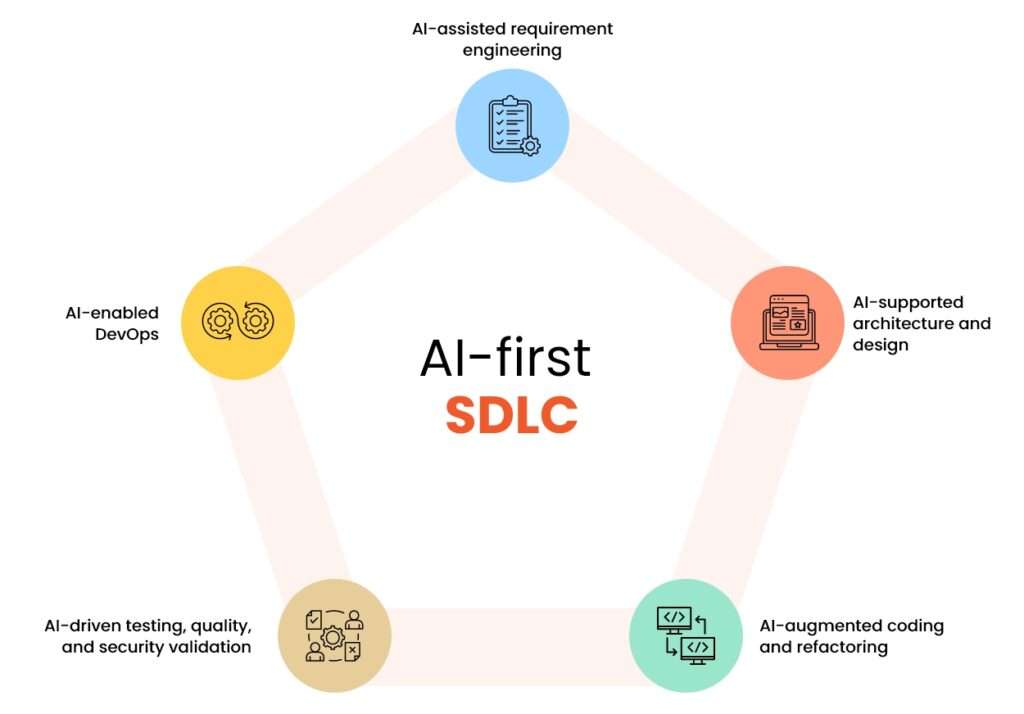
A mature AI-first SDLC combines five key elements:
The goal is not only speed. The goal is better flow, better traceability, better quality, and better business alignment.
Every successful software project starts with clarity. Unfortunately, requirement ambiguity is one of the biggest reasons for rework, delays, and delivery friction.
In an AI-first SDLC, AI can support requirement engineering by:
This helps product owners, business analysts, and delivery teams move faster from discussion to a structured backlog.
However, AI should not be treated as the final authority. Business stakeholders and analysts must validate intent, priority, edge cases, and domain-specific rules. AI can accelerate requirement documentation, but human review ensures correctness.
Also Read: Why Businesses Trust NextGenSoft for AI-First Digital Engineering in India?
Tools and Platforms NGS Uses in This Stage
At NextGenSoft, we use a combination of collaboration, project management, and AI-assisted documentation tools to convert business discussions into structured delivery inputs:
The objective is not to let AI write requirements independently. The objective is to reduce ambiguity, improve traceability, and help business and engineering teams move faster from conversation to actionable backlog.
At NextGenSoft, we see this as the first layer of AI-first delivery: converting raw business input into structured, traceable engineering work.
Architecture is where AI-first development must be handled carefully. AI can generate diagrams, compare architecture options, summarize trade-offs, and accelerate documentation. But architecture decisions require deep understanding of scalability, security, performance, cost, maintainability, and long-term product direction.
AI can help architects by:
In an AI-first SDLC, architecture is no longer a one-time document created at the beginning of a project. It becomes a living knowledge layer that evolves with code, infrastructure, security policies, and operational feedback.
NGS AI-First Architecture Workbench
At NextGenSoft, architecture design is supported by AI-assisted analysis, cloud-native design tools, and visual documentation platforms. Our focus is to make architecture more visual, traceable, and easier for business and engineering teams to understand.
This creates a more modern architecture practice: AI helps generate and refine the first draft, architects validate the design, and the final output becomes a living reference for development, QA, DevOps, and support teams.
For enterprise systems, this is extremely important. AI-generated code without architecture governance can create hidden technical debt. AI-first engineering must therefore combine acceleration with architecture discipline.
The most visible use of AI in SDLC is coding. Developers are already using AI assistants to generate functions, write boilerplate code, explain unfamiliar code, create documentation, refactor modules, and speed up repetitive tasks.
But mature AI-first development goes beyond code generation.
It uses AI to support the developer throughout the engineering workflow:
This changes the role of the developer. The developer is no longer only a code writer. The developer becomes a solution designer, reviewer, prompt engineer, quality controller, and business problem solver.
NGS AI-First Development Workbench
At NextGenSoft, AI-assisted development is used to improve developer productivity while keeping code quality under human engineering control. We treat AI as an engineering co-pilot, not an uncontrolled code generator.
The development workbench allows engineers to move from prompt to plan, from plan to implementation, and from implementation to review with better structure. This is important because enterprise software needs more than fast code, it needs maintainable, testable, secure, and production-ready code.
“The critical point is this: AI-generated code must still pass engineering review.”
Teams need coding standards, secure development guidelines, review checklists, test coverage expectations, and repository-level instructions. Without these guardrails, AI can increase code volume but reduce maintainability.
At NextGenSoft, our AI-first development approach focuses on using AI to improve engineering flow, not just to generate code faster.
Testing is one of the strongest areas for AI-first transformation.
Traditional QA often starts after development is complete. In an AI-first SDLC, testing begins much earlier and becomes continuous.
AI can help teams:
This helps teams move from reactive QA to predictive QA.
AI can also support better defect analysis. Instead of simply logging bugs, AI can summarize reproduction steps, compare recent code changes, identify likely root causes, and suggest possible fixes. This reduces the cycle time between defect discovery and resolution.
Tools and Platforms NGS Uses in This Stage
At NextGenSoft, we combine AI-assisted test design with automation and engineering review:
But again, AI should not become an uncontrolled testing authority. QA engineers must validate business-critical scenarios, data correctness, user experience, security expectations, and compliance requirements.
DevOps has already changed software delivery by introducing automation, CI/CD, infrastructure as code, and monitoring. AI-first DevOps takes this further.
AI can support DevOps teams by:
This is especially useful for cloud-native environments where applications depend on multiple services, pipelines, containers, databases, APIs, and monitoring tools.
NGS AI-First DevOps Workbench
At NextGenSoft, DevOps automation is strengthened with cloud-native tooling, infrastructure automation, and AI-assisted operational analysis. The objective is to make DevOps more proactive, repeatable, and intelligent.
This workbench helps the team move toward intelligent release engineering: pipelines become easier to create, failures become easier to diagnose, incidents become easier to summarize, and production learning flows back into development.
AI-first DevOps is not only about automation. It is about intelligent operations. The objective is to reduce manual effort, improve release confidence, and shorten the feedback loop between production and engineering.
For enterprise clients, this can translate into faster releases, fewer repeated incidents, better visibility, and stronger operational governance.
As AI becomes part of the SDLC, security becomes even more important.
AI tools can accidentally expose sensitive information, generate insecure code, suggest vulnerable dependencies, or follow malicious instructions hidden in prompts, files, or external content. Agentic AI introduces additional risks because agents may take actions across repositories, tools, APIs, or environments.
Therefore, AI-first SDLC must include DevSecOps guardrails from day one.
Important controls include:
Tools and Platforms NGS Uses in This Stage
At NextGenSoft, AI-first development is supported by security-first engineering practices and DevSecOps controls:
The principle is simple: AI can assist, but accountability stays with the engineering organization. For serious enterprise adoption, AI-first development must be secure by design, not experimental by habit.
The AI-first SDLC can be visualized as a continuous loop:
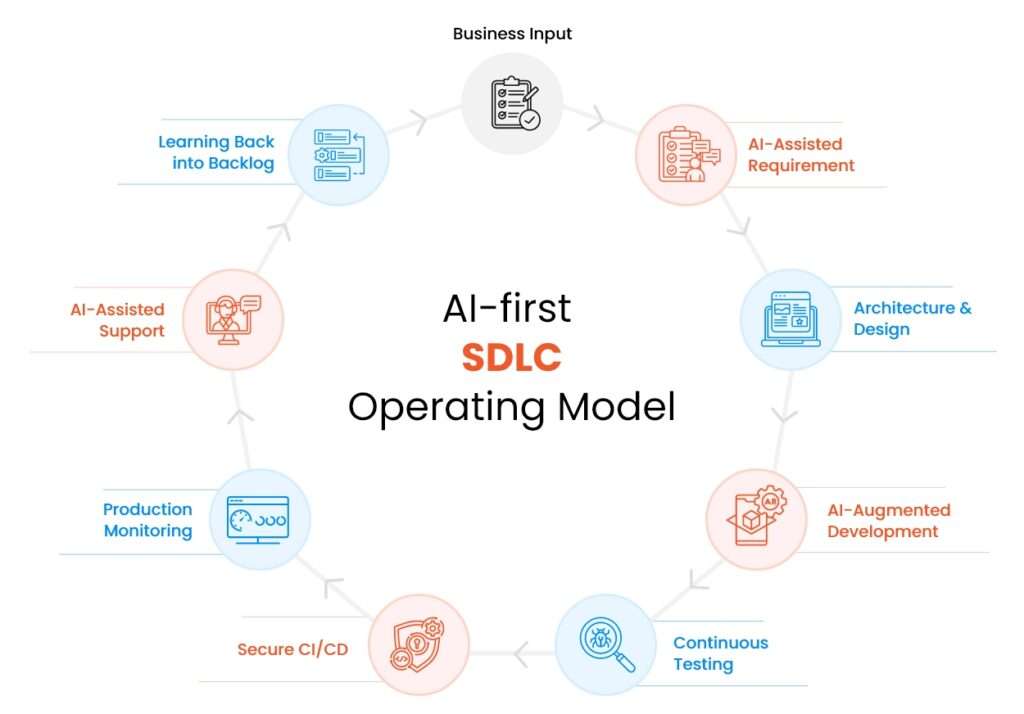
This model reduces handoff delays and improves traceability.
Instead of waiting for one phase to finish before another begins, teams can work more collaboratively:
At NextGenSoft, we are positioning AI-first engineering as a practical delivery model for enterprises, startups, and growing technology companies.
Our approach is not to simply add AI tools on top of the existing process. We focus on creating an integrated AI-first delivery ecosystem across:
We combine AI, cloud, DevOps, data engineering, and application modernization capabilities to help organizations move faster without losing control.
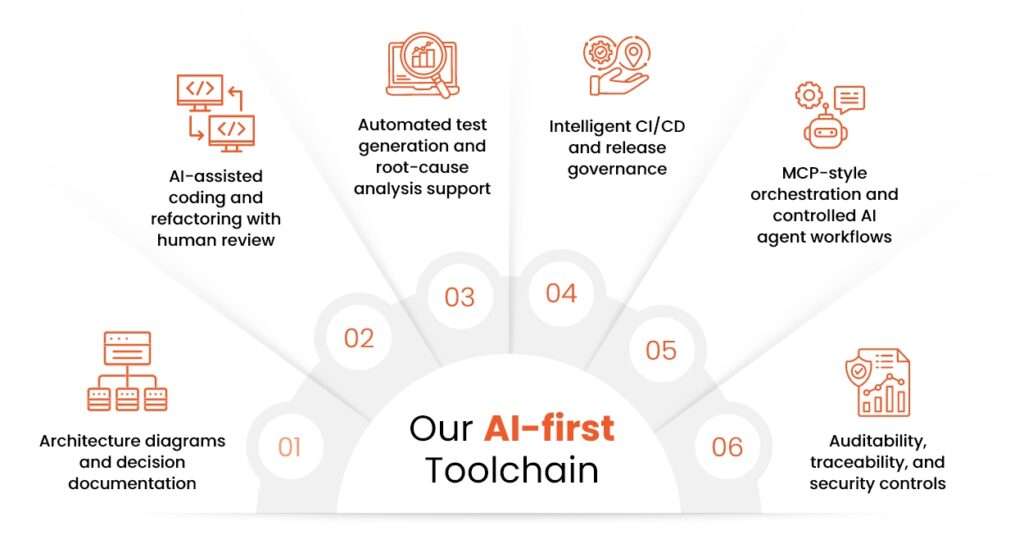
Our AI-first toolchain thinking includes:
NGS AI-First SDLC Toolchain Snapshot
While the exact toolset varies based on client environment and project needs, NGS commonly works with a layered AI-first engineering ecosystem:
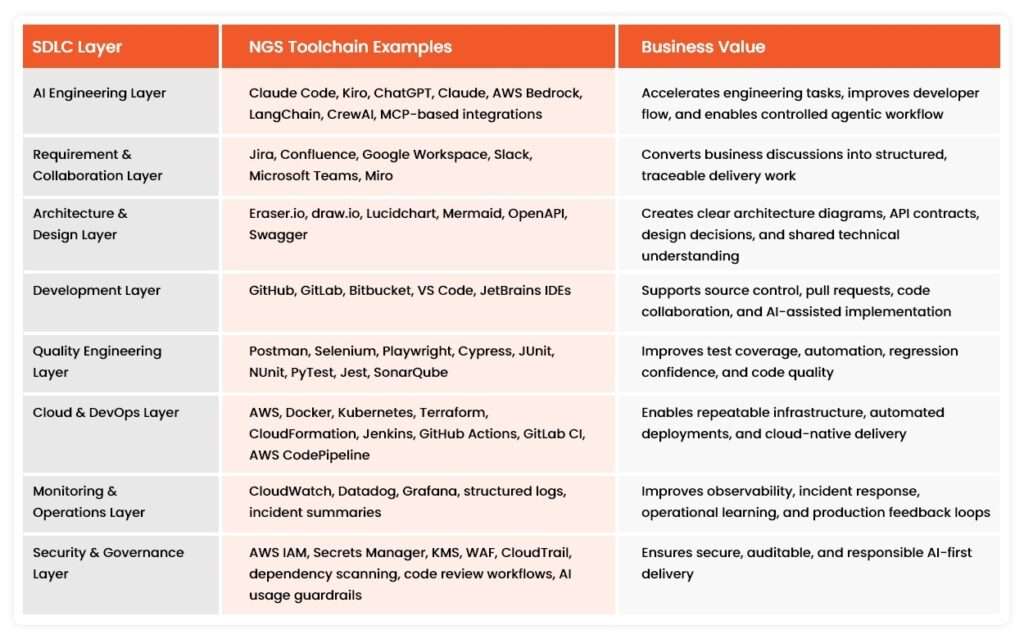
This is especially relevant for organizations that want to modernize legacy systems, improve engineering productivity, reduce delivery cycle time, and adopt AI responsibly.
The business value of AI-first SDLC should be measured in outcomes, not tool adoption.
Important KPIs include:
When implemented with the right governance, AI-first SDLC can help companies:
But the most important benefit is strategic: AI-first SDLC helps organizations convert software delivery from a cost center into an intelligence-driven capability.
Also Read: How to Find the Right AI-First Digital Engineering Company for Your Business?
Companies should not attempt to transform the entire SDLC overnight. A practical AI-first SDLC journey can begin with a focused pilot.
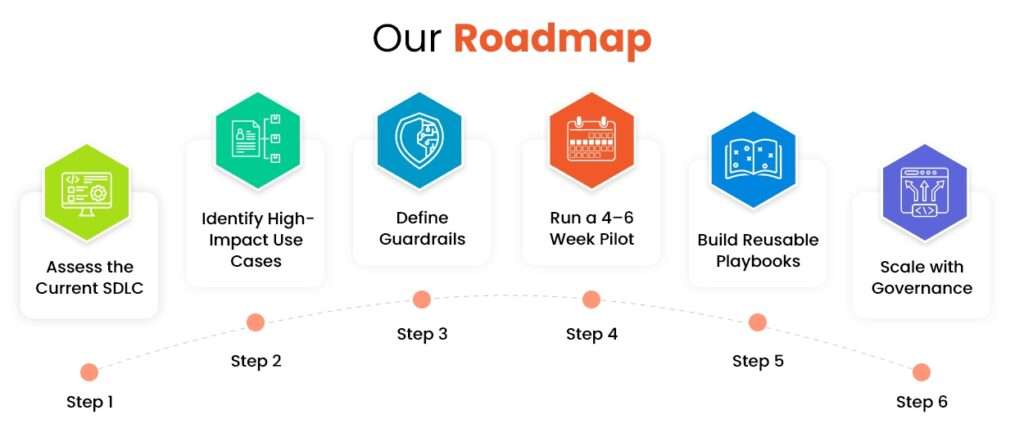
Step 1: Assess the Current SDLC
Review current bottlenecks in requirements, design, development, testing, DevOps, security, and support.
Step 2: Identify High-Impact Use Cases
Start with areas where AI can deliver quick value, such as requirement summarization, test generation, code review assistance, documentation, or release note automation.
Step 3: Define Guardrails
Create AI usage policies, data protection rules, review standards, and approval workflows.
Step 4: Run a 4–6 Week Pilot
Select one or two value streams and measure before-and-after metrics.
Step 5: Build Reusable Playbooks
Create prompt libraries, coding standards, architecture templates, test patterns, and delivery checklists.
Step 6: Scale with Governance
Expand AI-first practices across teams while continuously measuring quality, speed, security, and developer experience.
Engineering leaders must define how AI will be used, where it will be restricted, how quality will be validated, how teams will be trained, and how productivity will be measured.
Developers must learn how to work with AI responsibly. QA teams must shift from manual validation to intelligent quality engineering. DevOps teams must evolve toward autonomous and policy-driven operations. Architects must create stronger standards so that AI-assisted development remains scalable and maintainable.
This is why AI-first development is not just about tools. It is about operating model transformation.
AI-first development is becoming the new norm for modern software engineering. The organizations that succeed will not be the ones that simply buy the most AI tools. They will be the ones who redesign their SDLC with the right balance of speed, governance, quality, security, and human accountability.
AI can help teams write faster, test smarter, deploy more confidently, and support systems more intelligently. But strong engineering judgment, architecture thinking, domain understanding, and delivery discipline will remain essential.
At NextGenSoft, we believe the future of software delivery is AI-first, cloud-native, secure, measurable, and human-led. The next generation of AI software companies will not only build applications. They will build intelligent engineering systems. That is the real promise of AI-first SDLC.
1. What exactly is AI-First Development or AI-First SDLC?
Answer: AI-First Development is a contemporary method of creating software using a Software Development Life Cycle (SDLC) where Artificial Intelligence is utilized at each point in the SDLC to help shape and develop the final product. An AI-First SDLC uses AI as more than just a tool to assist with code development. It uses AI as a strategic partner throughout the process while allowing humans to maintain control over logical decisions such as business rules, how the application is physically developed and eventually how the application is tested and released into production.
2. Will AI replace software developers and engineers in the future?
Answer: No. Artificial intelligence is not expected to take away the jobs of software developers. However, it is anticipated to enhance the work of those on the software development team by removing repetitive and time-consuming administrative tasks from their workload. It allows them to concentrate their attention on higher value-added activities like innovation, solution designs, complex problem resolution, and aligning with the company’s business objectives. At NextGenSoft, we see artificial intelligence as an excellent assistant to all employees, increasing their productivity, but still needing the use of good judgment and strategic thinking to produce quality software, safe, secure, and successful provision of services to our customers and end-users.
3. How can businesses start adopting AI-First Development practices?
Answer: The best way for any company that wants to use AI in software development and delivery is to have a practical, low-risk approach. Companies should first identify any bottlenecks in their current software development life cycle (SDLC) where AI can help improve efficiency. Then, companies could conduct a 4–6 week pilot program on one specific area of their company (e.g., AI-assisted requirement writing, automated test case generation, or intelligent code review). Prior to using AI, companies should define AI usage policies and safeguards. NextGenSoft enables companies to follow a structured implementation plan for AI that meets their current maturity level. In addition, NextGenSoft has a methodology that allows for smooth transitions to AI without disrupting current projects in the company.
4. What are the real business benefits of switching to AI-First SDLC?
Answer: Organizations that are adopting AI-First Development are seeing benefits such as faster development and delivery cycles, less manual work to create software applications, and higher quality of code produced by the organization. In fact, they also witness fewer defects after production, enhanced developer experiences, improved clarity of business requirements, faster time to modernize legacy systems, lower operational costs, and a more thorough traceability from requirement to production. AI changes the view of software development from being a cost centre to an organization’s strategic capability that will drive transformational results.
5. How is NextGenSoft different in implementing AI-First Digital Engineering?
Answer: NextGenSoft does not stop at providing access to the tools associated with developing and delivering software. We have built out a complete integrated Engineering ecosystem for companies that believe in developing AI-driven Solutions. Our Ecosystem includes Intelligent Automation, Strong Architecture Disciplines, DevSecOps Governance, and Cloud-Native Practices. In addition, we focus on the responsible use of AI to ensure that all solutions meet proper human oversight, security controls, and measurable outcomes. Because of this, organizations trust us to enable them to achieve real speed and quality gains.
 Brijesh Shah
Brijesh is an IIM Ahmedabad alumnus with 22+ years of experience in software development and management. As the visionary leader of NextGenSoft, he drives the company toward becoming a global leader in software services and digital transformation. He also serves as Vice President of the PMI Gujarat Chapter.
We’re ISO/IEC 27001:2022 certified, ensuring your projects are executed with globally recognized security standards.

INDIA
 sales@nextgensoft.io
 +91 81284 66678
 Brijesh Shah
CEO, NextGenSoft
Brijesh Shah
CEO, NextGenSoft


