DevOps Maturity Assessment Service
We don’t just identify gaps through our DevOps Maturity Assessment Services; we convert them to clear, practical next steps.
 Get in Touch!
Understanding DevOps Maturity with NextGenSoft
Most DevOps issues don’t come from missing tools; they come from unclear maturity. You may have CI/CD, automation, and cloud in place, but releases still feel slow, risky, or inconsistent. This is exactly where DevOps Maturity Assessment Services help, by clearly showing how mature your DevOps really is and where it’s breaking down.
We review workflows, team handoffs, automation depth, release practices, and operational readiness, not assumptions. Unlike surface-level audits, our approach aligns closely with DevOps gap analysis services. By the end, you get clarity, not theory. We identify gaps in your DevOps, risk, and inefficiency, then we’ll provide you with the prioritized view.

DevOps Maturity Stages: From Manual to Scalable
1. Initial / Ad-hoc
At this stage, Most work is still manual. Releases depend on specific people, and things often break when someone is unavailable. Environments behave differently, so teams spend more time fixing issues than delivering features.
2. Defined but Inconsistent
Some automation exists, usually CI pipelines or basic deployment scripts. The problem is consistency; each team does things its own way, which leads to uneven release quality and avoidable delays.
3. Automated and Repeatable
Deployments are repeatable and less stressful. Pipelines are defined, environments are predictable, and teams can release without major surprises. However, monitoring, rollback, and incident response may still feel reactive.
4. Measured and Optimized
These metrics, like lead time, deployment frequency, and failure rates, are used to measure delivery performance. So, decisions and improvements are based on real data, and it’s continuous rather than reactive.
5. Scalable and Resilient
DevOps is no longer a separate effort; it’s built into how the platform is designed and operated. Teams can handle growth, traffic spikes, and failures without slowing down or putting releases at risk.
How to Assess Your DevOps Maturity ?
Trace a Production Release End-to-End
Pick a recent feature or bug fix and track its progression from commit to release. Every wait, manual step, approval, or workaround you notice is a direct indicator of maturity gaps.
Identify Recurring Release Failures
Teams know where things usually go wrong, failed deployments, last-minute config fixes, and rollbacks under pressure. These repeat failures tell you more about DevOps maturity than dashboards ever will.
Assess Release Dependency on Individuals
If releasing depends on specific people being available, maturity is low. Strong DevOps setups don’t rely on heroes of tribal knowledge to ship safely.
Validate Test-to-Production Consistency
Look at how close your test environments are to production. The more differences you find, the more risk you’re carrying into every release.
Evaluate Incident Detection and Visibility
Ask how issues are usually discovered. If customers report them first, your feedback loops are weak, and maturity hasn’t caught up with delivery speed.
Measure Recovery and Rollback Speed
Failures are normal. What matters is how quickly you can roll back or fix them without panic. Long recovery times point to shallow DevOps foundations.
DevOps Maturity Gaps We See in Real Projects
Assuming tools equal maturity
We often see teams add CI/CD tools and call it DevOps. The problem shows up later, unclear ownership, broken handoffs, and pipelines no one fully trusts.
Chasing speed before stability
Teams push for faster releases, while deployments and rollbacks remain fragile. This turns every release into a risk instead of a routine.
Not knowing where they actually stand
Many teams start “improving DevOps” without a clear baseline. Without knowing the current maturity level, efforts stay scattered and hard to measure.
Hidden gaps between teams
Dev, QA, and Ops may look aligned, but small gaps or if they work in silos, DevOps breaks down. Approval, manual steps, and unclear responsibilities quietly slow the delivery process and increase the failure rate.
Pipelines that work only in ideal cases
On paper, CI/CD looks fine. In real production scenarios, environment differences, edge cases, failures, it starts to break.
Monitoring was added too late
Monitoring and alerting are often afterthoughts. When something fails, teams scramble instead of responding with confidence.
Trying to fix everything at once
We’ve seen teams attempt big DevOps overhauls and stall halfway. Real maturity comes from fixing the right things first, not all things together.
Why NextGenSoft?
End-to-End Expertise
Partner with NextGenSoft, a global digital transformation company, and leverage our multi-cloud engineers’ abilities. As a trusted IT solutions provider, we build up secure inter-cloud networks, map native cloud services, and make vendor-agnostic methodologies to maximize esteem and minimize dangers.
Delivery Excellence
We rethink conveyance fabulousness with optimized program lifecycles. From advancement to arrangement, our digital transformation services and solutions focus on dependable, high-quality discharges that enhance client satisfaction.
Flexible Hiring Model
NextGenSoft’s adaptable contracting models give access to talented IT service providers custom-fitted to your needs. Scale easily with agile assets for DevOps, guaranteeing consistent collaboration and venture victory.
Transparent Actions
Our commitment to straightforwardness builds belief and cultivates cooperation. As a leading digital transformation company in India, we guarantee adjusted objectives, open communication, and compelling collaboration for shared success.
Our Method for Measuring Real DevOps Maturity

Understand Real Workflows
We first spend time understanding how your DevOps works today. How code moves to production, how often releases happen, and where teams usually struggle. This gives us a real baseline, not assumptions.
Assess Beyond Tools
Through DevOps maturity assessment services, we check how your DevOps works every day, where manual steps creep in, and how much effort it takes to ship and support a release. This helps us separate tool usage from actual maturity.
Identify Delivery Bottlenecks
Next, we focus on what causes delays or failures. This could be manual deployments, unstable releases, unclear ownership, or slow recovery when something breaks. These issues directly affect delivery confidence.
Define Maturity Level
Based on what we see, we place your setup at a clear maturity stage. Our DevOps maturity assessment services help you understand where you stand today and what capabilities are missing to move forward.
Prioritize Improvements
We don’t suggest fixing everything at once. We highlight the changes that will reduce risk and improve delivery the fastest, based on your product and team size.
Create an Actionable Plan
You get a simple, practical direction for improving DevOps maturity. No heavy reports, just clear next steps your teams can realistically work on.
Blogs
Browse through the technical knowledge about latest trends and technologies our experienced team would like to share with you.
View all articles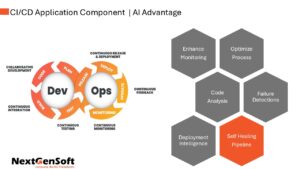
AI and ML in CI/CD: The Rise of Intelligent Pipelines
Let's dive into how AI and machine learning are changing the game for CI/CD. It's not just about automation anymore; we're talking about intelligent automation that's making software development faster, smoother, and more reliable.
 Pranav Lakhani
Architecting for Success: Essential System Design Principles for Developers
In the IT industry, it is a common yet critical mistake to dive straight into coding when starting a new project. However, this approach can lead to inefficiencies, technical debt, and costly rework down the line.
 Niraj Salot
Mastering Power BI Embedding: A Comprehensive Guide for Developers
In today's data-driven world, the ability to visualize data effectively is more critical than ever. Power BI, a powerful business analytics tool from Microsoft, allows users to create interactive and insightful reports and dashboards.
 Kushal Baldev
 Enhance Assessment with Our DevOps Expertise

CI/CD Services
Automate software delivery with streamlined CI/CD pipelines, enabling faster releases, improved quality, and reduced manual effort.

Cloud DevOps Services
With DevOps, you can implement automation into deployments and infrastructure optimization, as well as, ensuring a high level of availability with AWS, Azure, and GCP.

Containerization Services
Effortlessly deploy, managed, and scale your microservices with Kubernetes, Docker, and container orchestration.

DevSecOps Services
Automatically manage compliance with CI/CD pipelines, vulnerability management, and mitigate threats to ensure security is built in.
Frequently Asked Questions
-
What does a DevOps maturity assessment actually evaluate?
It evaluates how well your delivery, automation, collaboration, and governance really work today, not what’s documented. We look at CI/CD, cloud usage, security integration, and team workflows to expose real bottlenecks. You get a factual maturity baseline, not assumptions. -
Is DevOps maturity assessment suitable for small teams?
Yes, small teams benefit the most because issues surface early. We identify lightweight process fixes and automation gaps that prevent future scaling pain. You don’t need enterprise complexity to gain value. -
Do we need existing DevOps tools beforehand?
No. We assess both tool-driven and manual workflows. If tools exist, we check whether they’re used correctly; if not, we define what you actually need. This avoids overengineering and wasted licenses. -
Will this assessment disrupt ongoing development work?
Not at all. We work alongside your teams through interviews, data analysis, and pipeline reviews without blocking delivery. The goal is insight, not interruption. -
How is this assessment different from traditional audits?
Audits check compliance; DevOps gap analysis services check real performance and delivery health. We focus on flow efficiency, failure recovery, and deployment confidence. It's built for engineering leaders, not just compliance reports. -
How does NextGenSoft help us improve maturity levels?
We don’t stop at findings; we guide execution. From CI/CD optimization to DevSecOps adoption and cloud cost control, we help implement each recommendation. The goal is measurable improvement, not just a report.
Get in Touch!
Submit Your Inquiry
We’re ISO/IEC 27001:2022 certified, ensuring your projects are executed with globally recognized security standards.
-

INDIA
-
301/304/305 Addor Aspire-II, Nr. Jahanvee Restaurant, University to Panjarapole Road, Ahmedabad, Gujarat 380015, India
-
INQUIRE US!
 sales@nextgensoft.io
 +91 81284 66678

 sales@nextgensoft.io
 +91 81284 66678