The Hidden Reason: Why Your AI Gets Answers Wrong
Brijesh ShahSeptember 3, 2026
Share this article


Let AI highlight what matters.
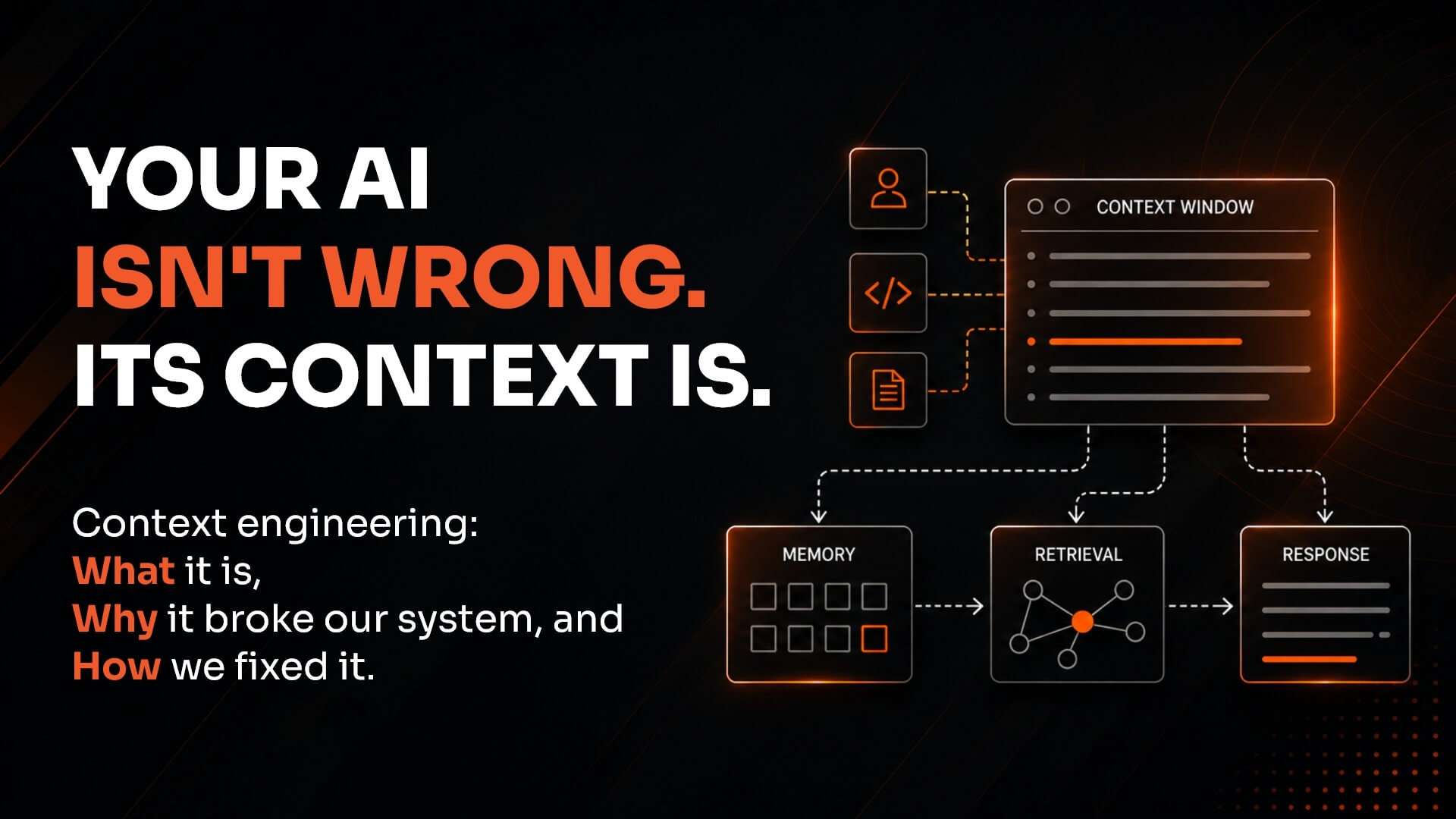
“Context engineering: what it actually is, why it broke our system, and how we fixed it.”
We built an AI-driven observability and error-resolution system for a production platform.
The idea was clean. Capture every log. When an exception occurs, an AI layer reads it and takes action. If it recognises the problem, it pulls a resolution from a knowledge base. If it cannot solve it, it raises a properly formed support ticket. Deployment, pipeline, or security issues route to DevSecOps. Core faults route to engineering.
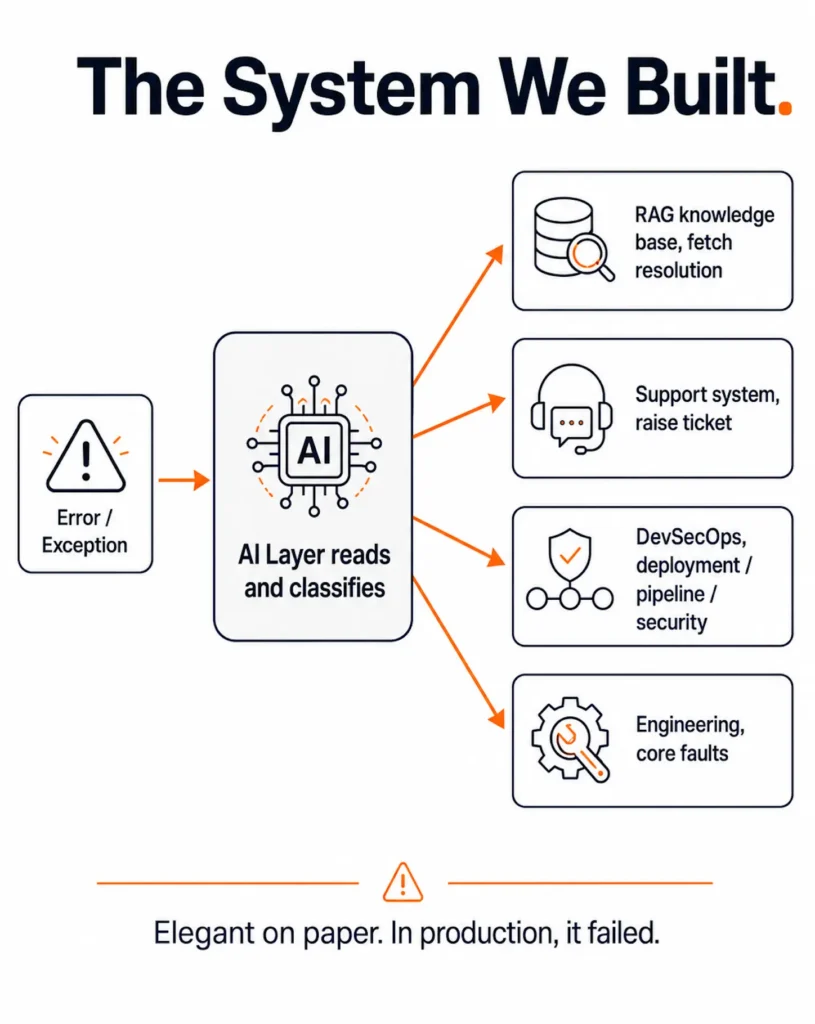
“On paper, elegant. In production, it failed. Repeatedly.”
It routed errors to the wrong teams. Security issues went to engineering. Pipeline failures went to support. And when it did find a resolution, the resolution often did not work.
We spent weeks assuming the model was not good enough. We were wrong. The model was fine. What we fed it and what it retrieved was broken. That distinction is the whole of context engineering.
Here is the most common misunderstanding. Most people think context engineering means writing a better system prompt. Others think it means adding RAG. Both are pieces of it. Neither is the whole.
Prompt engineering is about instructing the model, crafting the wording of the request. Context engineering is about equipping the model, designing the system that assembles the right information, at the right time, in the right form, so the model can get the answer right in the first place.
The difference matters. A perfect prompt handed to a model with no context still fails. A modest prompt handed to a model with excellent context often succeeds. The leverage moved from the instruction to the information around it.
The industry felt this shift as soon as people moved from single questions to real agents, systems that use tools, remember conversations, pull in documents, and make decisions across many steps. At that point, clever wording stopped being the bottleneck. What the model could see became everything.
The trade-off: context engineering costs far more design effort than writing a prompt, in exchange for a system that is reliable rather than occasionally lucky.
At any given moment, a model only knows what is inside its context window. That one snapshot is everything it has to work with. So context engineering is, concretely, the discipline of deciding what goes into that window, and what stays out.
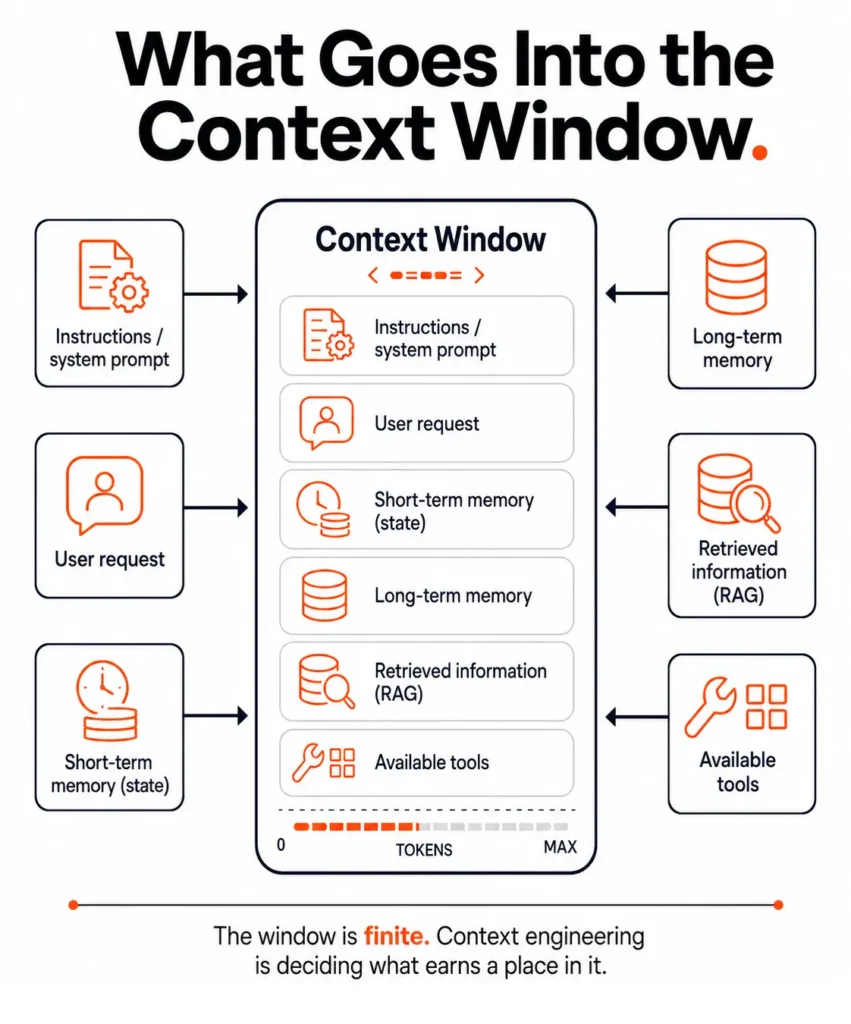
The window is assembled from a handful of distinct ingredients:
Here is the part most people miss. The window is finite. You cannot pour everything in. So context engineering is really an allocation problem: with limited space, what earns a place in the window for this specific task, and what does not? Too little and the model guesses. Too much and it drowns in noise and loses the thread. The skill is assembling exactly what the task needs, and nothing more.
In our system, the two failures mapped straight onto this. The misrouting was thin instructions and a missing signal on the input side. The failed solutions were poor retrieved information on the knowledge side. Same window. Wrong ingredients.
The trade-off: assembling the window per task is more engineering than dumping everything in, in exchange for a model that sees the signal instead of the noise.
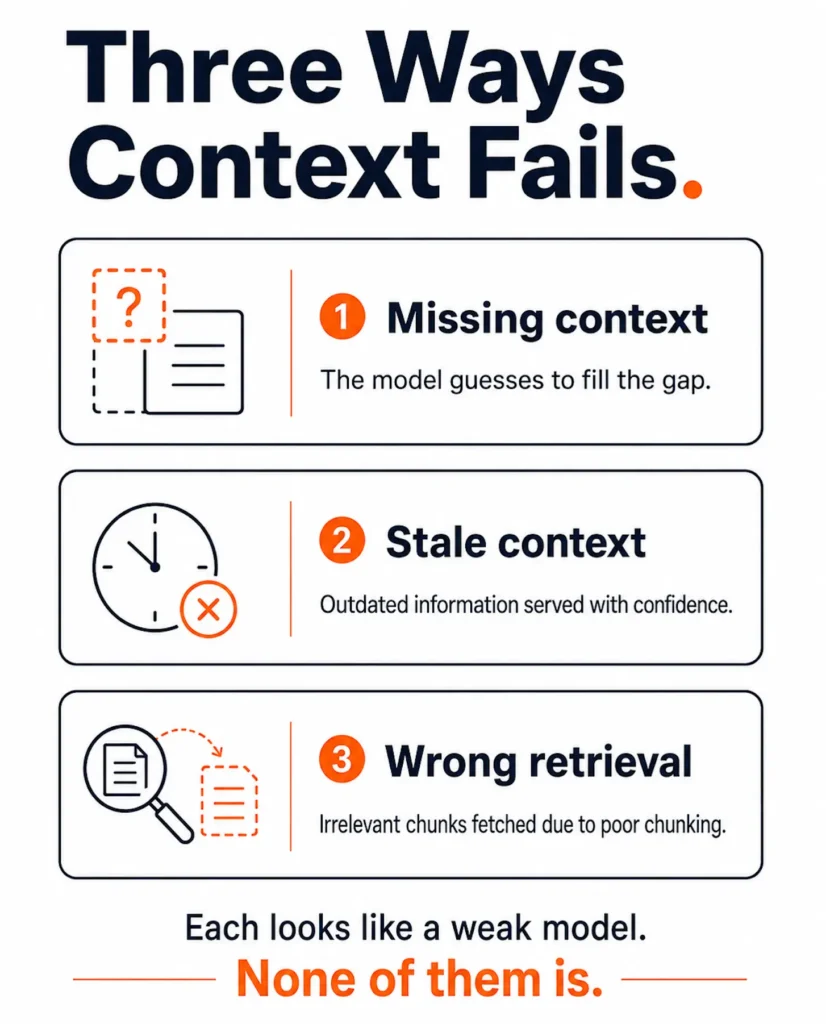
We hit three failure modes. Naming them is half the battle, because each one looks like a model problem and is not.
The model does not have what it needs, so it fills the gap with a confident guess. This was our wrong-routing problem. We handed the model a bare error message, and it classified from a fragment, sending security issues to engineering. The information it needed existed. We just were not giving it to the model.
Information that was accurate once quietly goes out of date while still sounding authoritative. This sat underneath our retrieval problem. Knowledge changes, and a retrieval system that is not refreshed keeps serving yesterday’s answer with today’s confidence. Stale context does not throw an error. It just gets slowly, quietly wrong.
The system fetches something that looks relevant but is not, because of how the knowledge was split and matched. This was our chunking problem. The retrieval looked successful, the resolution looked plausible, and it did not work because the chunks pulled were the wrong ones.
Every one of these looks like the AI is not good enough. Every one of them is a context failure.
Read Also: Five Moves Every CTO Should Make Before 2027
Here is the uncomfortable truth for anyone still chasing the next model release.
The frontier models available today are extraordinary. [VERIFY AND INSERT: Claude’s latest, alongside models like MODEL, MODEL, and MODEL] can write production-grade code, reason across complex problems, and handle genuinely hard tasks. The raw capability sitting inside these models is almost certainly far beyond what most applications are actually using.
So when an AI product underperforms, the instinct is to reach for a newer, bigger model. It rarely helps. Because the limit was never the model. It was the context around it.
This is exactly what we saw in our own system. The model classifying our errors and proposing resolutions was highly capable. It was not failing because it lacked intelligence. It was failing because we handed it a bare error message with no surrounding signal, and it retrieved resolutions from a knowledge base that was poorly chunked and going stale. Same model throughout. We changed what it could see, and routing accuracy went from 70 percent to 90 percent.
Fix the context, and the same model that was producing mediocre output starts producing reliable output. Not because the model changed. Because what you fed it changed.
That is the line that separates teams shipping AI products that work in production from teams endlessly upgrading models and hoping.
The trade-off: getting the context right is slow, unglamorous engineering, in exchange for finally using the model capability you are already paying for.
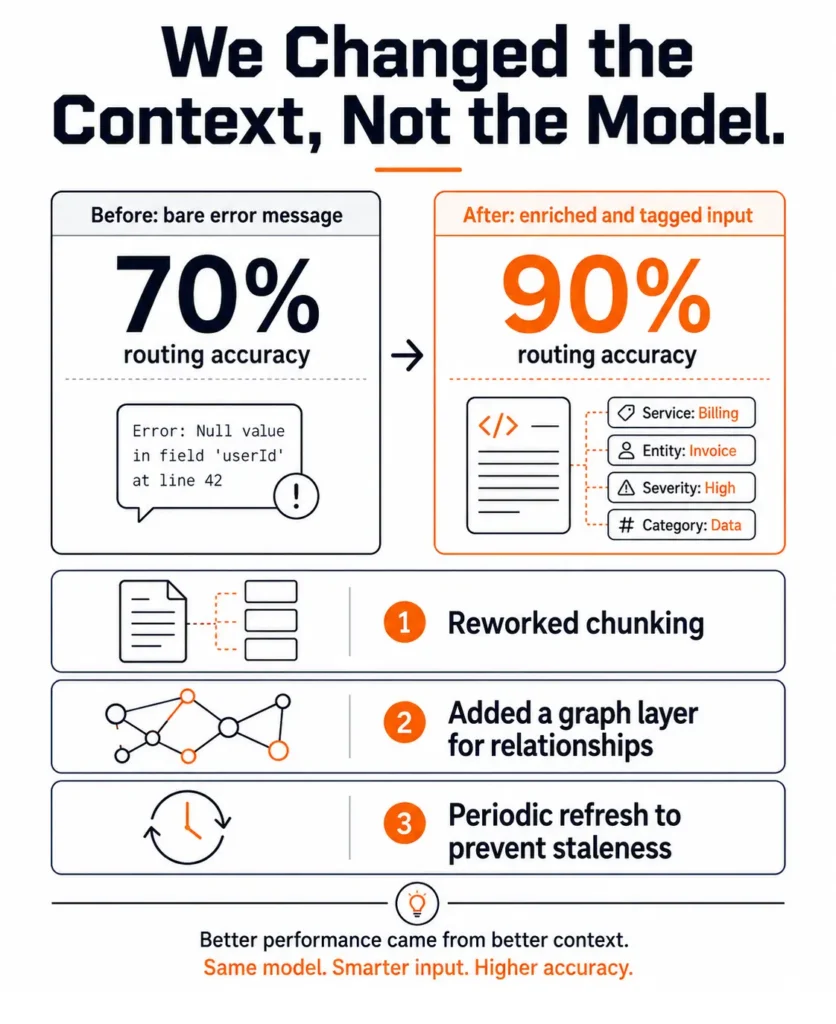
We stopped handing the model a bare error message. We improved log capture so it saw the fuller picture, and we tagged logs to map each one to its right context. Routing accuracy went from 70 percent to 90 percent. Same model. Better input context.
Chunking was the core problem, so we reworked it. We added a graph layer so the system understood the relationships between pieces of knowledge, not just surface similarity. And we set a periodic refresh so the knowledge stayed current instead of rotting.
This is the deepest lesson, and it shows up in two habits worth adopting. First, treat your system prompt as code: versioned, tested, and reviewed, not a text file someone wrote once that everyone is now afraid to touch. Second, build the ability to measure context quality before you start tuning it, because context engineering done by gut feel is how you ship regressions that nobody notices until production does.
The trade-off: all of this is ongoing engineering effort, in exchange for an AI system you can actually trust in production.
 Brijesh Shah
Brijesh is an IIM Ahmedabad alumnus with 22+ years of experience in software development and management. As the visionary leader of NextGenSoft, he drives the company toward becoming a global leader in software services and digital transformation. He also serves as Vice President of the PMI Gujarat Chapter.
We’re ISO/IEC 27001:2022 certified, ensuring your projects are executed with globally recognized security standards.

INDIA
 sales@nextgensoft.io
 +91 81284 66678


