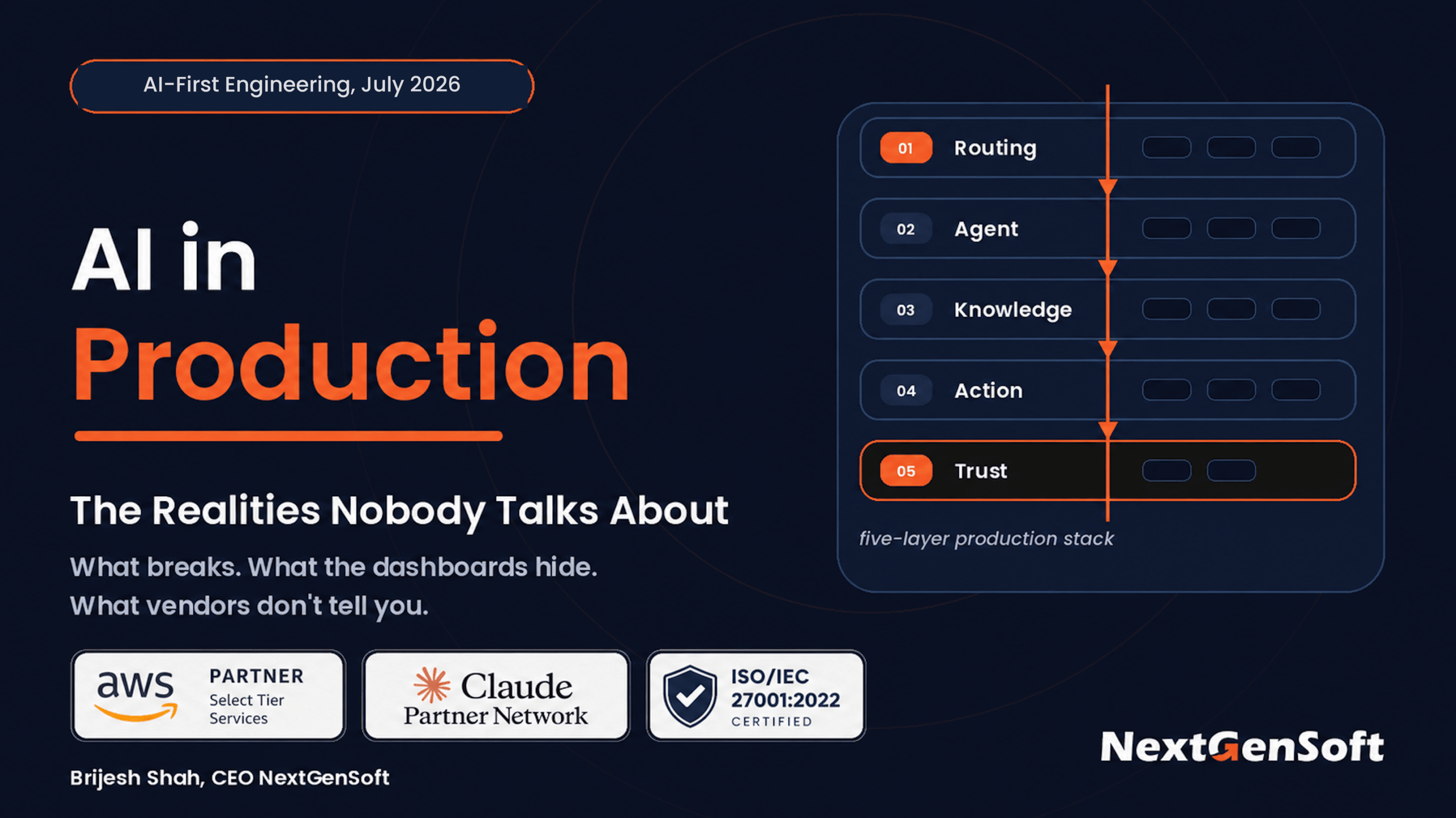
AI in Production: The Realities Nobody Talks About
Brijesh ShahJuly 24, 2026
Share this article


Let AI highlight what matters.
One data point frames the whole discussion. Across the teams we track, AI-native engineering teams modify only about 5% of AI-generated code before merge. In a large enterprise application team, that figure is 20%. Four times higher. The model is the same. The API is the same. The tools are identical.
The gap is entirely human. It is the difference between a team that understands what an AI system is doing and a team that is hoping it is doing the right thing. This guide is about that gap: what creates it, what sustains it, and what it costs in production when nobody is measuring it.
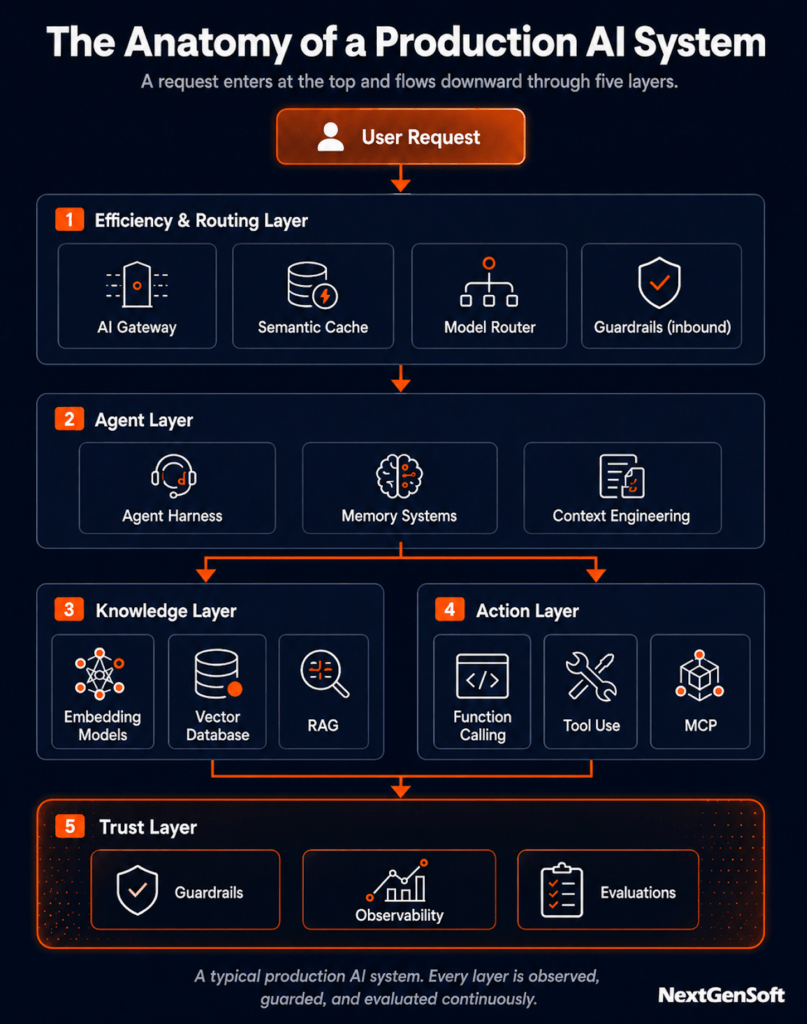
A chatbot in a demo needs a model and an API key. A production AI system model needs far more. It needs to know things it was never trained on. It needs to stay fast and affordable at scale. It needs to take real actions in real systems. It needs to reason across steps and remember. And it needs to stay safe, visible, and correct while doing all of it.
Those five needs map to five layers. Follow them in the order a real request travels: it enters through the routing layer at the front door, is coordinated by the agent layer, draws on the knowledge layer and acts through the action layer, and is watched over at every step by the trust layer.
Layer 1: Efficiency and Routing
In a demo, cost and latency do not matter. In production, they decide whether a feature ships or gets killed by the finance team. This layer sits at the front door. The gateway is your single controlled entry point. The router sends simple work to cheap, fast models and saves the expensive models for when they are genuinely needed. The cache recognizes when a new request means the same as an old one and answers without calling the model at all. The single fastest way to cut an enterprise AI bill is not a cheaper model. It is a router and a cache in front of the models you already use.
Layer 2: Agent
Single-shot AI answers one question and forgets everything. Real work is a sequence: understand the goal, gather context, take a step, check the result, take the next. The agent layer turns a model into something that can carry out a multi-step task with continuity, through a harness that manages the loop and a memory system that persists what matters. Agents fail silently. A step produces a plausible but wrong result, the next step accepts it, and the error compounds down the chain. If you cannot watch each step in real time, you do not have a production agent. You have a production experiment that has not failed loudly yet.
Layer 3: Knowledge
A base model does not know your contracts, your codebase, or your customer history. The knowledge layer closes that gap without retraining. Embedding models turn your content into searchable meaning, the vector database retrieves the closest matches in milliseconds, and retrieval-augmented generation grounds the answer in your data rather than the model’s training. It fails quietly and confidently, the worst combination in production. Teams that treat retrieval quality as a one-time setup are the ones surprised six months later when answer quality has silently degraded and no code changed.
Layer 4: Action
A model that only produces text is a very expensive autocomplete. The moment it can query a database, call an API, or update a record, it becomes a system that does work. Function calling gives structured, reliable calls. Tool use lets the model choose the right capability. MCP, the Model Context Protocol, is the standard way to connect AI to tools and data so integrations are reusable across models. This is where AI mistakes become real-world consequences. A hallucinated argument does not just produce a wrong sentence; it updates the wrong record. NextGenSoft is among the first fifty organizations globally running MCP servers in production.
Layer 5: Trust
This is the layer teams build last and need first. It does not sit at one point in the flow; it wraps every other layer. Guardrails control what goes in and out. Observability gives real-time visibility into what the AI is doing. Evaluations test output quality over time. Most teams ship the first four layers and bolt on the fifth after an incident. By then, the AI has been making unobserved decisions in production for months. You cannot retrofit trust. You can only rebuild on it. This is precisely the gap CloudByte PMS was built to close.
Read Also: Agentic AI Systems: Types, Architecture & Enterprise Use Cases
The five layers are the building blocks. Patterns are how you assemble them. Most teams choose a pattern by accident, usually the first that worked in a demo, and that decision follows them for years.
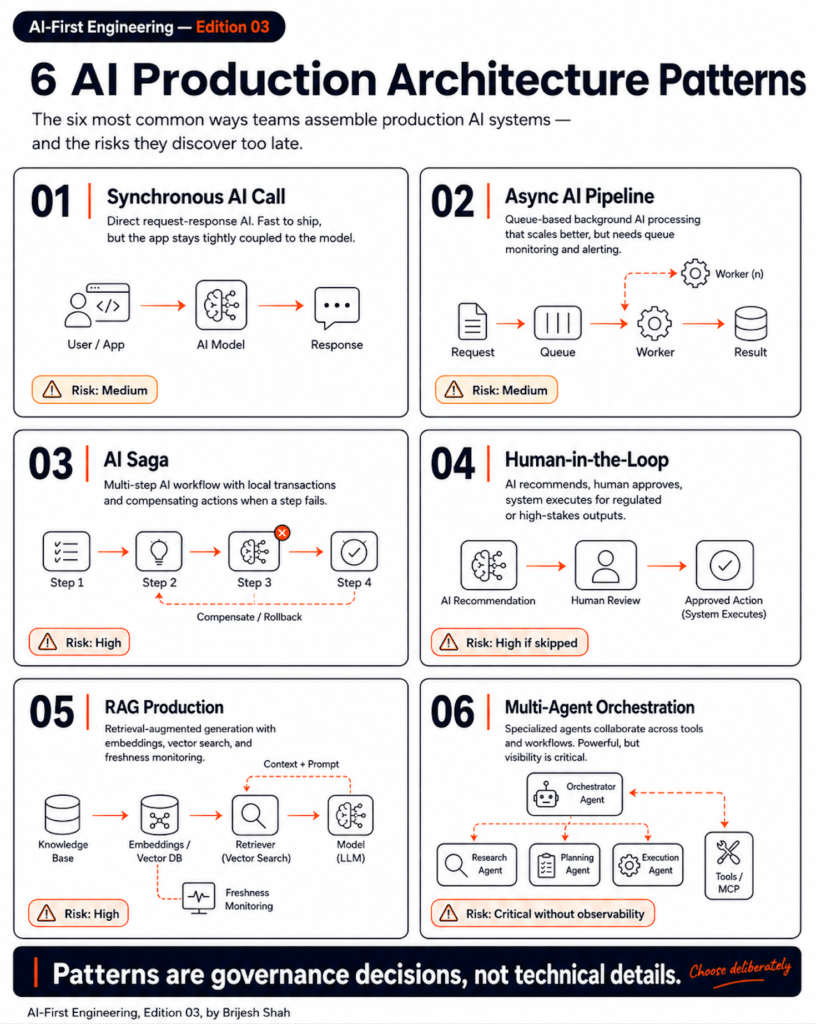
Pattern 1: Synchronous AI Call (Medium risk)
Your application calls the model directly and waits. Fine for low volume and single-turn queries. As volume grows it couples you tightly to the model, and every outage or latency spike becomes user-facing. Build timeout and fallback logic on day one, not after your first 3 AM alert.
Pattern 2: Async AI Pipeline (Medium risk)
Processing moves offline, results arrive when ready. Scale it with competing consumers, more workers on the same queue, rather than re-architecting. The most common failure is not the AI layer, it is unmonitored queue depth. Build alerting on the queue before you build the feature.
Pattern 3: AI Saga (High risk)
Multi-step workflows across services, each step a local transaction with compensating rollback if a later step fails. Coordinate through choreography or orchestration, and choose deliberately. Sagas fail at the compensation step, not the happy path, because teams test the workflow forward and never test the rollback.
Pattern 4: Human-in-the-Loop (High risk if skipped)
AI generates, a human approves, the system executes. Non-negotiable in regulated industries. The teams that skip it for speed are the ones dealing with a hallucination that reached a customer or a regulator. Our data shows teams with explicit review gates have the lowest error rates. The 20-minute review saves the 20-hour incident.
Pattern 5: RAG Production (High risk)
RAG Development in production is not RAG in a demo. Embeddings go stale, retrieval quality degrades, and the model answers confidently from outdated context. It needs a dedicated observability layer or it fails silently. Build retrieval quality monitoring before the feature, not after.
Pattern 6: Multi-Agent Orchestration (Critical without observability)
Specialized AI agents collaborating via MCP. The most powerful pattern and the most complex failure surface. Agents produce plausible but incorrect handoffs that the next agent accepts. If you cannot see what each agent is doing in real time, you have a production experiment, not a production system.
The full 16-point checklist we use before go-live and at month three and six.
Delivered as a PDF.
Everything here is drawn from real engineering teams in production, tracked through CloudByte PMS, and anonymized. AI-native teams modify 5% of AI code before merge; an enterprise application team, 20%. AI-native teams run 22 prompts per engineer per day, roughly one every 22 minutes; the enterprise team, 18. The 4x modification gap is not model quality. Both use the same models. It is prompt literacy, review discipline, and engineering culture.
Two production environments tell opposite stories. The enterprise team codes fast and ships slow: coding 3 hours, review 45 minutes, deploy 10 minutes, promotion 15 minutes. The AI-native team codes slower and ships almost instantly: coding 3.1 days, review 2 minutes, deploy 2 minutes, promotion 2 minutes. The lesson: AI acceleration at the coding layer means nothing if your review, deploy, and release pipeline is not equally optimized. You cannot AI your way out of a slow deployment process.
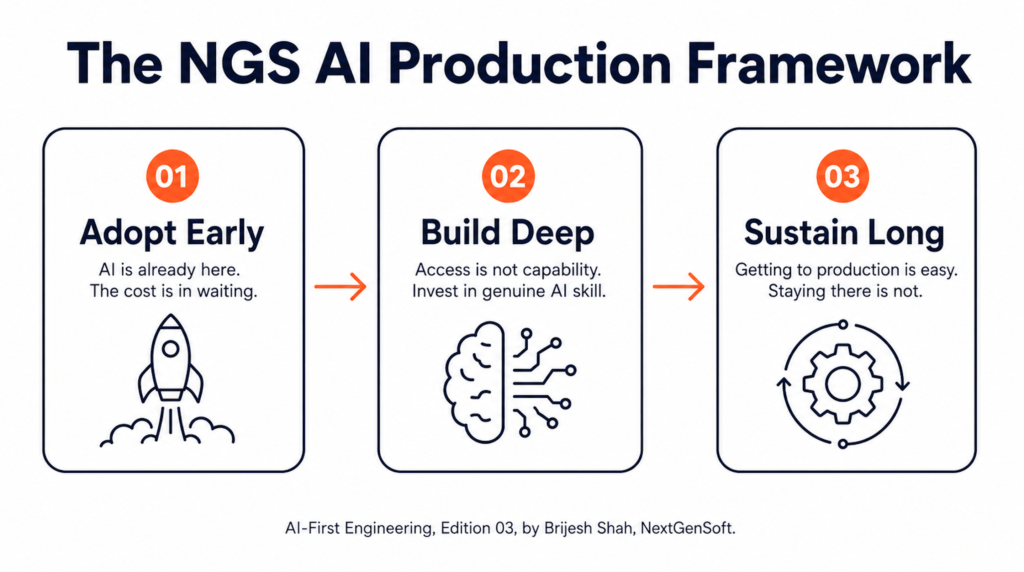
For CXOs: Ask your engineering leader one question. Can you show me how AI is actually being used inside our team right now? If they cannot answer in five minutes, you do not have an AI strategy. You have an AI hope.
For engineering leaders: The next time your team accepts AI-generated code, ask whether anyone can explain every line to a colleague who was not in the room. If not, the team is outsourcing its thinking.
For delivery leaders: Add one five-minute agenda item to sprint planning. AI governance review. What did AI generate? Is it documented, is it traceable, does the team understand it? If this is not happening, it becomes a production crisis in six months.
 Brijesh Shah
Brijesh is an IIM Ahmedabad alumnus with 22+ years of experience in software development and management. As the visionary leader of NextGenSoft, he drives the company toward becoming a global leader in software services and digital transformation. He also serves as Vice President of the PMI Gujarat Chapter.
We’re ISO/IEC 27001:2022 certified, ensuring your projects are executed with globally recognized security standards.

INDIA
 sales@nextgensoft.io
 +91 81284 66678


