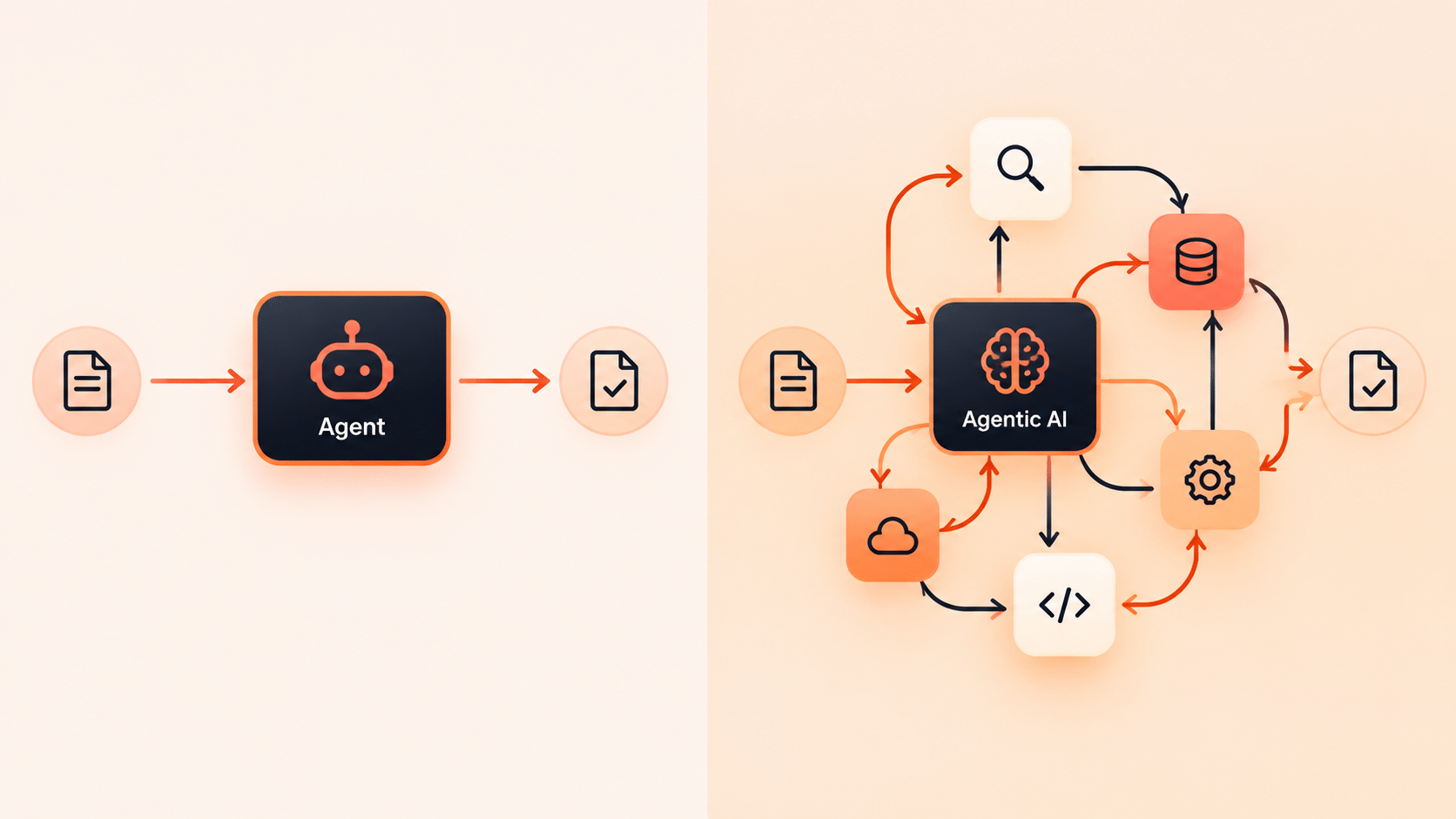
Agentic AI vs AI Agents: The Architecture Difference Enterprises Keep Getting Wrong
Yash BaravaliyaSeptember 22, 2026
Share this article


Let AI highlight what matters.
Search “agentic AI” right now, and you’ll find dozens of 2026 prediction posts, vendor decks, and LinkedIn hot takes, most of them using “AI agent” and “agentic AI” as if they’re interchangeable. They aren’t. And for an enterprise deciding what to actually build, conflating the two isn’t a semantic nitpick—it’s the difference between shipping a support chatbot in six weeks and greenlighting a nine-month autonomous-systems project you didn’t need.
The confusion isn’t really about definitions. It’s about architecture. An AI agent and an agentic AI system are built differently, reason differently, and fail differently. Get the architecture wrong, and you either overbuild a simple problem into a fragile mess or underbuild a complex one into something that breaks the moment a real-world edge case shows up.
This post lays out the actual architectural difference with a comparison table, a diagram, real enterprise examples, and a decision framework you can use before your next AI project kickoff.
An AI agent is a system that uses a large language model to perceive an input, decide on an action, and execute it, usually by calling one tool or a small, fixed set of tools in a single pass or a short, predictable loop. Think of it as an LLM with a job description and a toolbox. It reacts to what it’s given.
Agentic AI describes a system where multiple AI agents (or a single agent operating across an extended, multi-step process) plan, sequence, and adapt their own actions toward a goal, with limited or no human input at each step. It doesn’t just execute a task; it decomposes a goal into sub-tasks, decides what to do next based on the outcome of the last step, and can revise its own plan when conditions change.
The distinction enterprises keep missing: “agentic” describes a degree of autonomy and orchestration, not a type of model. A single well-built agent with a retry loop is not agentic AI. A single agent that plans multi-step work, calls other agents, checks its own outputs, and adjusts course without a human in the loop- that’s agentic.
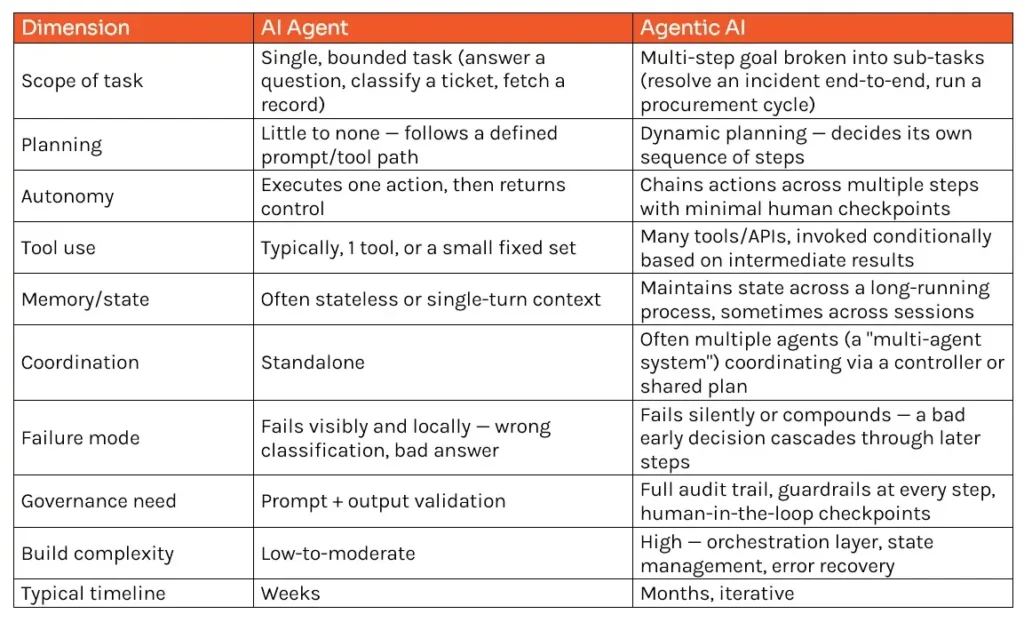
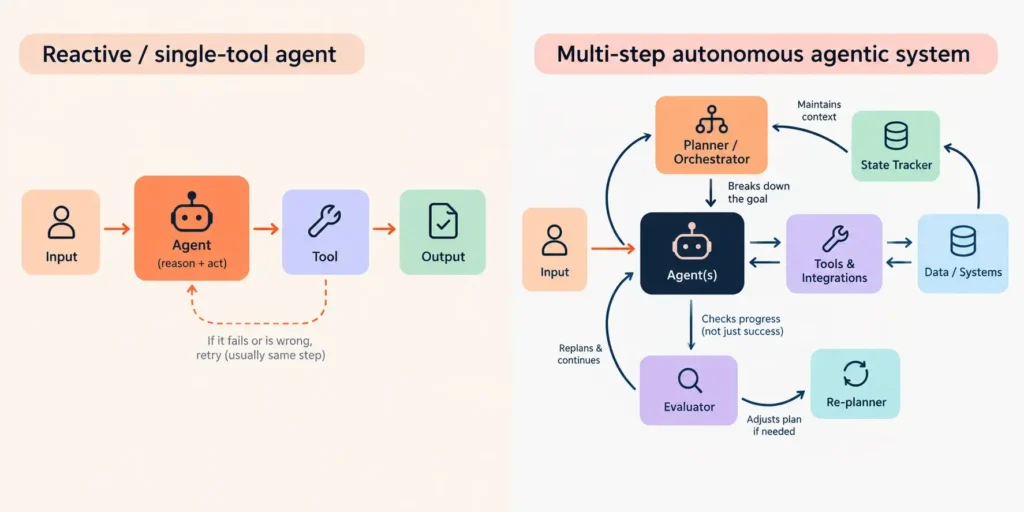
The table above describes behavior. The diagram below shows why the behavior differs—it’s a structural difference in how the system is wired.
One input, one reasoning pass, one action, done. If the tool call fails or the answer is wrong, the loop typically ends or retries the same step, there’s no broader plan being revised.
The key structural additions in agentic AI: a planner/orchestrator that decomposes the goal, a state tracker that persists context across steps, an evaluator that checks whether progress was actually made (not just whether a tool call succeeded), and a re-planning loop that lets the system change course. None of that exists in a reactive single-tool agent — and building it in is precisely what adds months to a timeline.
A support chatbot that reads an incoming ticket, classifies intent, and either answers from a knowledge base or routes to a human is a textbook AI agent. It’s one reasoning pass, one or two tool calls (search KB, create ticket), and a clear success condition. Wrapping this in a full agentic orchestration layer would add cost and failure surface with no corresponding benefit.
An autonomous supply-chain agent that monitors inventory signals, forecasts demand shifts, checks supplier lead times, evaluates multiple reorder scenarios, negotiates within pre-set parameters, and only escalates exceptions to a human- that’s agentic AI. It’s coordinating multiple data sources and sub-decisions toward a goal (avoid stockouts and overstock) that can’t be resolved in a single pass, and it has to revise its plan as new data (a delayed shipment, a demand spike) comes in.
An invoice-processing agent that extracts data, matches it to a purchase order, and flags mismatches is a single-tool agent. But an accounts-payable system that extracts, matches, resolves discrepancies against three internal systems, decides whether to auto-approve or route for review based on a risk model, and updates its own confidence thresholds over time- that’s crossing into agentic territory. This example matters because it shows the boundary is often a design choice, not a hard technical line: you can build the same business function either way, and the right answer depends on volume, risk tolerance, and how much variance the task actually has.
Read Also: Agentic AI Frameworks Compared: LangGraph vs CrewAI vs AutoGen
Ask these questions before scoping the build:
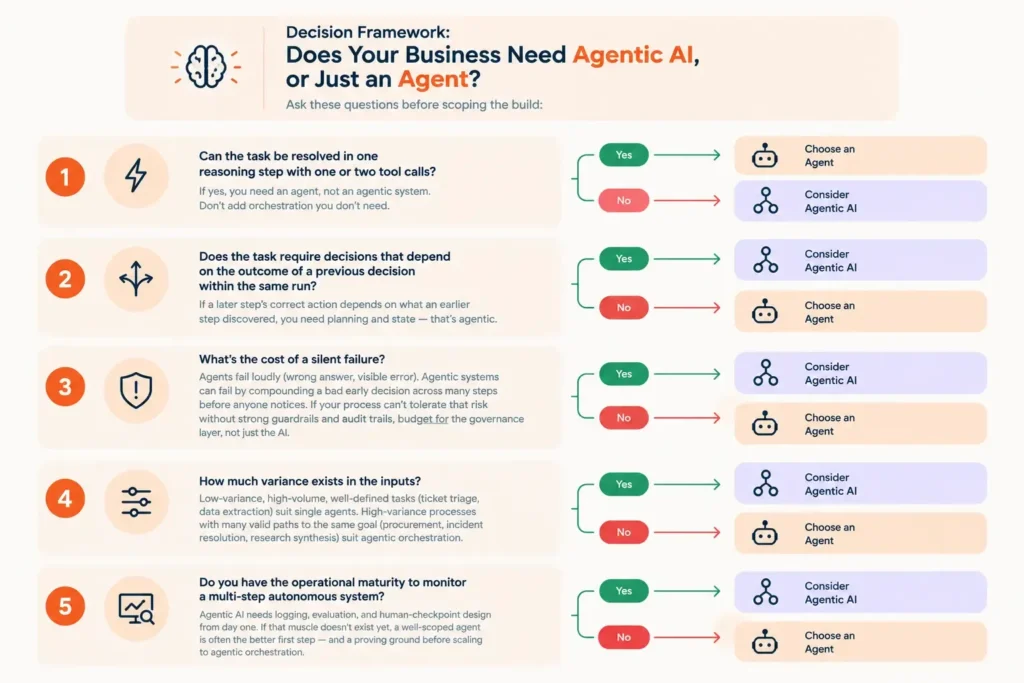
If most answers point to “single step, low variance, tolerable failure mode”, build an agent. If they point to “multi-step, high variance, compounding risk”, you’re in agentic AI territory, and the project should be scoped, staffed, and timelined accordingly.
The cost of getting this wrong runs in both directions. Enterprises that treat every use case as “agentic” end up over-engineering simple workflows, burning budget on orchestration layers, state management, and evaluation infrastructure that a single well-built agent didn’t need. Enterprises that treat every use case as “just an agent” end up bolting autonomy onto a system that was never designed for multi-step planning and watch it fail in ways that are hard to trace back to a root cause.
The right starting point is almost always to map the actual task against the questions above before choosing a framework or writing a line of orchestration code.
Need help scoping which architecture fits your use case? NextGenSoft’s AI agent development team works through this exact framework with enterprise teams assessing task complexity, failure tolerance, and operational maturity before recommending an agent or a full agentic build.
1. Is agentic AI just a marketing term for AI agents?
Answer: No. “Agentic AI” describes systems with multi-step planning, state persistence, and autonomous replanning across a process- a structural and behavioral difference from a single-tool AI agent, not a rebrand of the same thing.
2. Can one AI agent be “agentic”?
Answer: Yes, if it plans its own multi-step sequence, maintains state across those steps, and adapts course based on intermediate results, a single agent can exhibit agentic behavior. Agentic AI more commonly involves multiple coordinating agents, but the defining trait is autonomous multi-step planning, not agent count.
3. What’s the biggest risk of agentic AI systems specifically?
Answer: Compounding, silent failure. Because agentic systems chain decisions across steps, an error early in the process can propagate and shape every downstream decision before a human notices—which is why evaluation and human-checkpoint design matter more here than in single-agent systems.
4. Do agentic AI systems always use multiple agents?
Answer: Not necessarily. Many production agentic AI systems use a multi-agent architecture (a planner plus specialized sub-agents), but the term refers to the degree of autonomous, multi-step orchestration—a single agent with a planning/re-planning loop also qualifies.
5. How long does it typically take to build an agentic AI system vs. a single agent?
Answer: A well-scoped single-tool agent can often ship in weeks. Agentic systems—with orchestration, state management, evaluation, and guardrails- typically take months and are usually built iteratively, starting narrow and expanding scope as reliability is proven.
 Yash Baravaliya
Yash Baravaliya specializes in exploring and building intelligent AI-driven systems, focusing on practical innovation and modern framework development. With a strong drive for experimentation and problem-solving, he turns complex AI concepts into clear, usable solutions.
We’re ISO/IEC 27001:2022 certified, ensuring your projects are executed with globally recognized security standards.

INDIA
 sales@nextgensoft.io
 +91 81284 66678

 Brijesh Shah
CEO, NextGenSoft
Brijesh Shah
CEO, NextGenSoft


