Agentic AI Frameworks Compared: LangGraph vs CrewAI vs AutoGen (2026)
Niraj SalotSeptember 17, 2026
Share this article


Let AI highlight what matters.
If you’ve spent any time in LangChain or scrolling dev. to lately, you’ve seen the same debate resurface every few weeks: which agentic AI framework should you actually build on? LangGraph, CrewAI, and AutoGen all promise to help you orchestrate multiple LLM-powered agents, but they solve that problem in genuinely different ways, and picking the wrong one for your use case usually shows up six weeks into a project, not on day one.
This comparison breaks down how each framework handles orchestration and state, where each one wins in practice, and how a real enterprise deployment might map to each. The goal isn’t to crown a winner; it’s to help you match the framework to the shape of your problem.
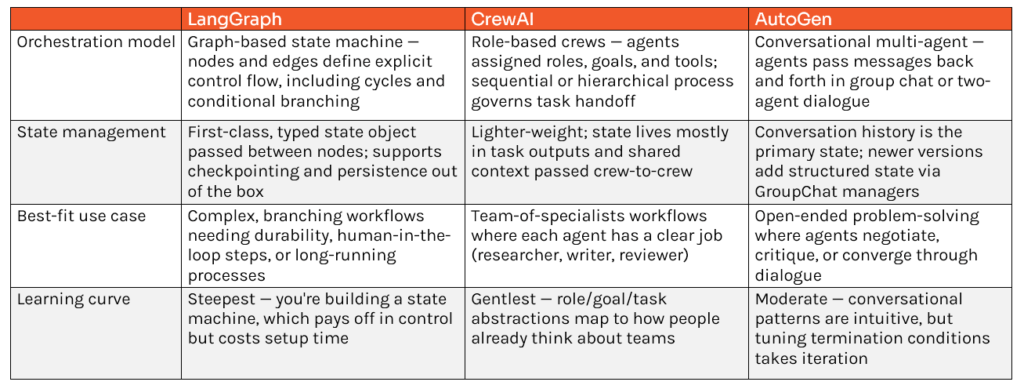
The comparison table tells you what each framework is; here’s when that matters.
LangGraph is built for workflows where you can’t afford to lose track of state- think multi-step approval chains, agents that pause for human review, or processes that might run for hours and need to resume cleanly after a failure. Because it models everything as a graph, you can draw an explicit map of every possible path an agent’s reasoning can take, including loops back to earlier steps. That’s overkill for a simple task, but it’s exactly what you want when the workflow has real branching logic, and the cost of an agent going off the rails is high.
CrewAI’s whole design philosophy is borrowed from how human teams work: assign a role, give it a goal, hand it some tools, and let it collaborate with teammates who have different roles. If your use case genuinely breaks down into specialist functions—a researcher agent that gathers information, a writer agent that drafts, an editor agent that reviews—CrewAI gets you there with the least scaffolding. The tradeoff is that once your workflow needs conditional branching or persistent state across long-running processes, you’ll feel the abstraction start to strain.
AutoGen shines when the task benefits from agents debating, critiquing, or iterating on each other’s output through natural conversation—code generation with a built-in reviewer agent, or a planner agent that checks its own plan against a critic agent before executing. The conversational pattern is flexible and easy to reason about early on, but that same flexibility means you’ll spend real engineering time on termination conditions and guardrails so conversations don’t spiral or loop indefinitely.
Read Also: AWS MCP Server: Complete Guide for Building AI Agents on AWS
The orchestration model is the headline difference, but three other factors tend to decide real-world adoption once teams get past the prototype stage.
LangGraph’s explicit graph structure makes it easier to visualize exactly where a workflow is at any point in time, which matters enormously when something goes wrong in production at 2 a.m. CrewAI’s task-based logs are readable but less structured, so you’re often piecing together what happened from sequential outputs rather than inspecting a live state object. AutoGen’s conversation logs are the most human-readable of the three, but that readability doesn’t always translate into fast root-cause analysis when a multi-agent conversation loops or diverges unexpectedly.
LangGraph inherits LangChain’s large surface area of pre-built integrations, vector stores, retrievers, and tool wrappers, which shortens the path to connecting agents to existing enterprise systems. CrewAI has a smaller but growing tool ecosystem and leans on simplicity over breadth. AutoGen’s ecosystem is strongest around code-execution and developer-tooling use cases, reflecting its origins as a research project focused on agent conversation patterns.
Conversational frameworks like AutoGen can rack up token costs quickly if termination conditions aren’t tuned carefully, since agents can go back and forth more times than a graph-based flow ever would. LangGraph’s explicit control flow tends to be more token-predictable because you’re defining exactly how many times a step can execute. CrewAI sits in between, and cost depends heavily on how many agents are in a crew and whether the process type is sequential or hierarchical, since hierarchical processes introduce a manager agent that adds its own token overhead.
None of these factors override the core orchestration-model decision, but they’re worth budgeting for before you commit engineering time to a framework, especially at production scale where token costs and on-call debugging time compound quickly.
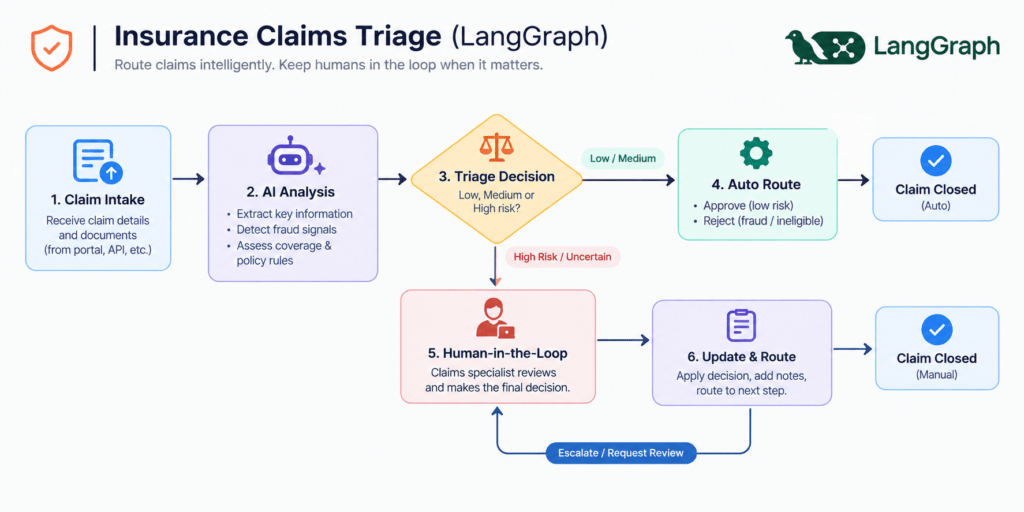
LangGraph, Insurance claims triage. A claims-processing pipeline where an agent extracts claim details, checks them against policy rules, routes ambiguous cases to a human adjuster, and resumes automated processing once that human approves or rejects. The explicit state graph and checkpointing make it straightforward to pause for that human-in-the-loop step and resume exactly where the process left off, days later if needed.
CrewAI — Marketing content production. A content pipeline where a research agent pulls competitive and keyword data, a writer agent drafts the piece, an SEO-review agent checks it against on-page best practices, and an editor agent finalizes tone and structure. Each agent has a clean, single-responsibility role, and the sequential handoff between them mirrors an actual content team’s workflow.
AutoGen — Software code review and remediation. A coding assistant setup where one agent proposes a code change, a second agent acts as a critical reviewer flagging security or performance issues, and the two go back and forth until the reviewer approves. The conversational back-and-forth is a natural fit for the kind of iterative critique a human code review actually looks like.
There isn’t a universally “best” framework here, and the honest answer depends more on your workflow’s shape than on any one framework’s raw capability:
It’s also worth noting that these frameworks aren’t always mutually exclusive; some teams use CrewAI-style role decomposition inside a LangGraph node or use AutoGen’s conversational pattern for a single sub-task within a larger graph-based pipeline. Framework choice is a means to an end, not a philosophy to commit to permanently.
Given how quickly this space moves, all three frameworks ship frequent updates, and community sentiment on things like debugging tooling and production-readiness shifts often—it’s worth validating your own benchmarks against your actual workload rather than relying solely on any single comparison, including this one.
We don’t start agentic AI development by picking a framework; we start by mapping the workflow. Whether that mapping points to LangGraph’s durability, CrewAI’s role-based simplicity, or AutoGen’s conversational flexibility (or a hybrid of more than one), our job is to build the right architecture for your specific process rather than force-fit your problem into whichever framework happens to be trending. If you’re evaluating agentic AI frameworks for a real production use case, our agent architecture design process walks through exactly how we make that call, including the tradeoffs most comparisons like this one skip.
“The best agentic AI architecture isn’t the one with the most stars on GitHub — it’s the one that matches how your workflow actually needs to branch, hand off, or negotiate.”
— NextGenSoft Engineering Team
Choosing an agentic AI framework is ultimately less about following the latest trend and more about understanding what your workflow actually requires. LangGraph, CrewAI, and AutoGen each take a different approach to agent orchestration, from structured state and durable workflows to role-based collaboration and conversational problem-solving. The right choice depends on factors such as workflow complexity, state management, human involvement, debugging needs, and scalability.
For enterprise teams, the decision should start with the business process, technical requirements, and production expectations, not the framework itself. In some cases, a hybrid architecture may even make more sense than relying on a single framework. As agentic AI continues to evolve, testing frameworks against real workloads and measurable requirements will remain essential. The goal isn’t to choose the most popular framework; it’s to build an agent architecture that is reliable, maintainable, and aligned with the problem you’re solving.
1. Is LangGraph harder to learn than CrewAI?
Answer: Generally yes. LangGraph asks you to think in terms of nodes, edges, and state transitions, which takes longer to get comfortable with than CrewAI’s role-based abstractions. The payoff is finer-grained control over complex, branching workflows.
2. Can I use CrewAI and LangGraph together?
Answer: Yes, it’s a common pattern to use CrewAI-style role decomposition for a subtask and wrap the overall process in a LangGraph state machine for durability and control, especially when parts of the workflow need human-in-the-loop checkpoints and other parts don’t.
3. Which framework is best for a small team just getting started?
Answer: CrewAI tends to have the shortest path from idea to working prototype for teams new to agentic AI, since its role/goal/task model maps closely to concepts people already understand.
4. Does AutoGen require more prompt engineering than the others?
Answer: Often, yes. Tuning conversation flow, termination conditions, and agent turn-taking in AutoGen typically takes more iteration than defining a role in CrewAI or a node in LangGraph, since the conversational structure is inherently less constrained.
5. Are these frameworks production-ready, or are they still mostly for prototyping?
Answer: All three have moved well beyond pure prototyping and are used in production systems, but maturity varies by feature—checkpointing and persistence in LangGraph, for instance, tend to be more battle-tested for long-running production workflows than some of the more experimental multi-agent conversation patterns in AutoGen. Test against your own reliability requirements rather than assuming production-readiness applies uniformly across every feature of a given framework.
 Niraj Salot
Niraj Salot, with 20+ years of expertise in software architecture, specializes in delivering robust enterprise applications. His cloud optimization skills help clients cut costs while maximizing performance. As a key leader at NextGenSoft, he drives scalable, efficient, and high-performing solutions.
We’re ISO/IEC 27001:2022 certified, ensuring your projects are executed with globally recognized security standards.

INDIA
 sales@nextgensoft.io
 +91 81284 66678

 Brijesh Shah
CEO, NextGenSoft
Brijesh Shah
CEO, NextGenSoft


