Enterprises Run 12 AI Agents on Average, But Half Work Alone: Fixing Agent Orchestration
Niraj SalotSeptember 21, 2026
Share this article


Let AI highlight what matters.
Most enterprises did not plan to end up with a dozen AI agents. It happened one team, one use case, and one pilot at a time. A support team stood up an agent to triage tickets. Sales added one to qualify leads. Engineering built an internal agent to summarize incident logs. Each one works. None of them talk to each other.
According to a 2026 report from Belitsoft, the average enterprise now runs 12 AI agents, and roughly half of them operate without any coordination with the others. That statistic has been circulating widely on LinkedIn this month, usually alongside a warning that fragmented agents create more operational risk than they remove.
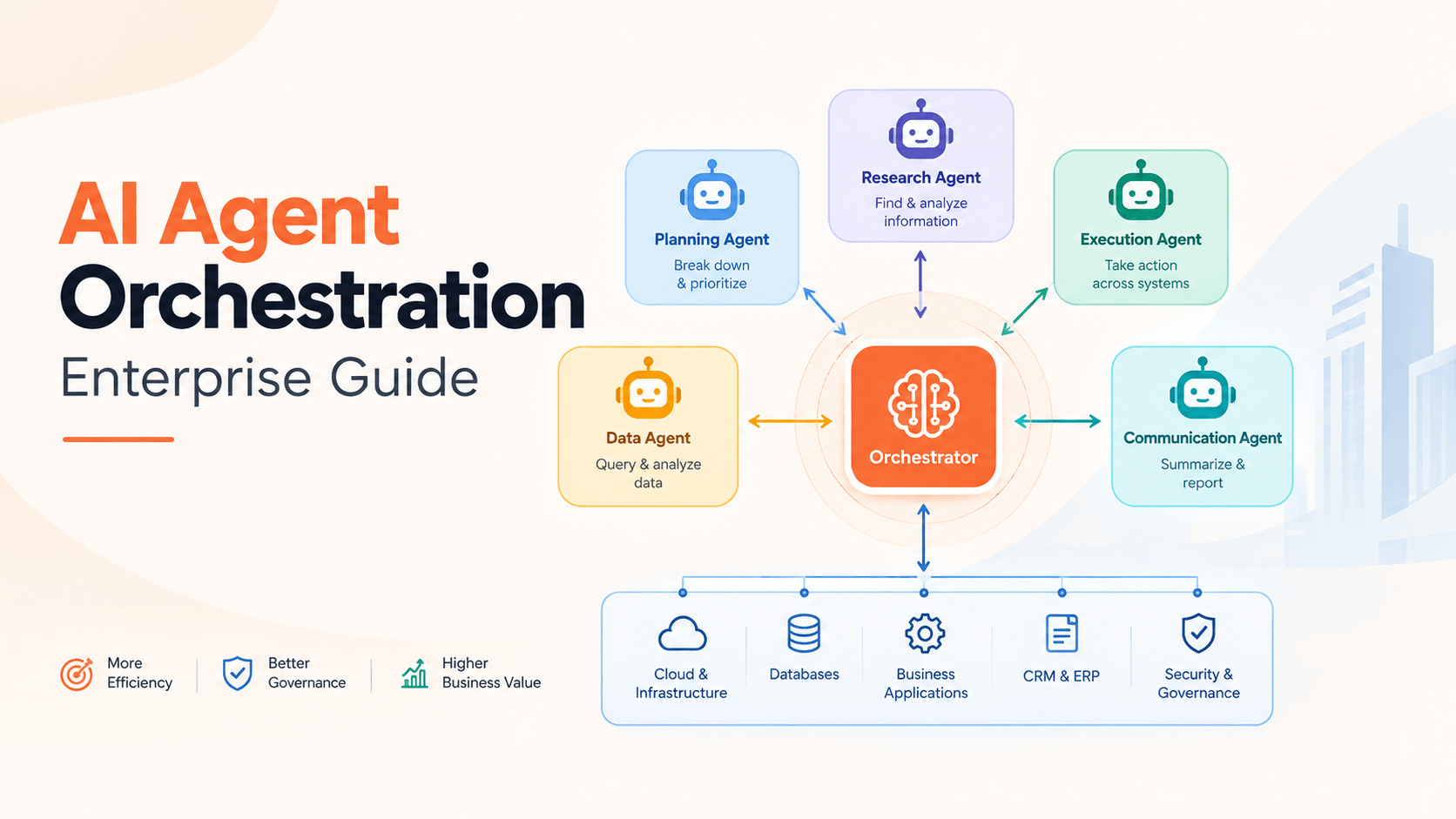
The number itself is not the story. The story is what “working alone” actually costs and what it takes to fix it. This is where AI agent orchestration comes in: the discipline of coordinating multiple AI agents so they share context, hand off work, and operate as a system instead of a pile of disconnected scripts.
An agent working alone is not necessarily broken. It is isolated. It has its own memory (or none), its own tools, and no visibility into what other agents in the organization already know or have already done. In practice, that looks like:
None of these are failures of the individual agents. They are failures of the system around them. AI agent orchestration is what turns 12 independent agents into one coordinated workforce, with a defined division of labor, shared context, and a way to trace decisions end to end.
Read Also: Agentic AI Frameworks Compared: LangGraph vs CrewAI vs AutoGen (2026)
There is no single “correct” way to orchestrate agents. The right pattern depends on how predictable the workflow is and how much autonomy each agent needs. Three patterns cover most real-world deployments.
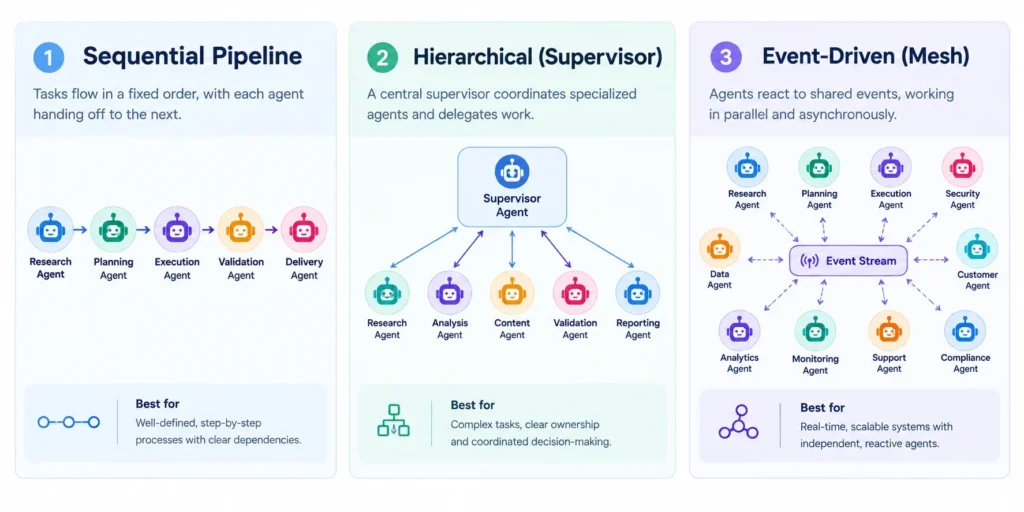
Agents run in a fixed pipeline, each one passing its output to the next. Agent A extracts data, Agent B validates it, Agent C acts on it. This is the simplest pattern to build, test, and debug, because the flow of control is linear and predictable.
Sequential orchestration fits well-defined, repeatable processes: document processing pipelines, structured data enrichment, multi-step approval workflows. Its limitation is rigidity. If step two needs to loop back to step one, or if the process branches based on intermediate results, a strict sequence starts to strain.
A supervisor agent breaks a task into subtasks and delegates each one to a specialized worker agent, then assembles the results. The supervisor does not do the work itself; it plans, routes, and checks output quality before returning a final answer.
This pattern scales better than sequential pipelines for open-ended tasks, because the supervisor can decide, at runtime, which specialist agents are actually needed. A supervisor agent handling a customer inquiry might route pricing questions to one agent, technical questions to another, and escalate anything ambiguous to a human, all within a single interaction. The trade-off is added complexity in the supervisor’s planning logic and the need for careful guardrails, since a poor routing decision compounds downstream.
Agents subscribe to and emit events rather than calling each other directly. When something happens—a new ticket, a completed transaction, an inventory threshold- any agent listening for that event can react. There is no central controller dictating the sequence.
Event-driven orchestration fits high-volume, asynchronous environments where multiple agents need to respond to the same signals independently: fraud monitoring, real-time inventory management, or IT operations where several systems need to react to an alert simultaneously. It offers the most flexibility and resilience, but it is also the hardest pattern to reason about and debug, since there is no single execution trace to follow from start to finish.
Once a pattern is chosen, most teams reach for a framework rather than building coordination logic from scratch. Two conceptual approaches dominate current enterprise implementations.
(The category LangGraph represents) model the workflow as an explicit graph of nodes and edges, where each node is an agent or a tool call and edges define allowed transitions, including loops and conditionals. This gives developers fine-grained control over state and makes hierarchical and sequential patterns easy to express and audit. The trade-off is that the graph has to be designed upfront, which suits well-understood workflows better than highly emergent ones.
(The category CrewAI represents) organizes agents around defined roles and responsibilities, closer to how a human team is structured, with agents collaborating toward a shared goal rather than following a predefined graph. This tends to be faster to prototype for hierarchical, supervisor-style workflows, because you describe what each agent is responsible for rather than every possible transition between them. The trade-off is less deterministic control over exact execution order, which matters more in regulated or high-stakes workflows.
Neither approach is universally better. Graph-based frameworks tend to win where auditability and precise control matter most; role-based frameworks tend to win where speed of iteration and natural task delegation matter more than exact reproducibility. Many enterprise AI agent orchestration platforms now support both models, letting teams pick the right one per use case rather than standardizing on a single paradigm across the organization.
Read Also: How to Choose the Right AI Agent Development Company (2026 Buyer’s Checklist)
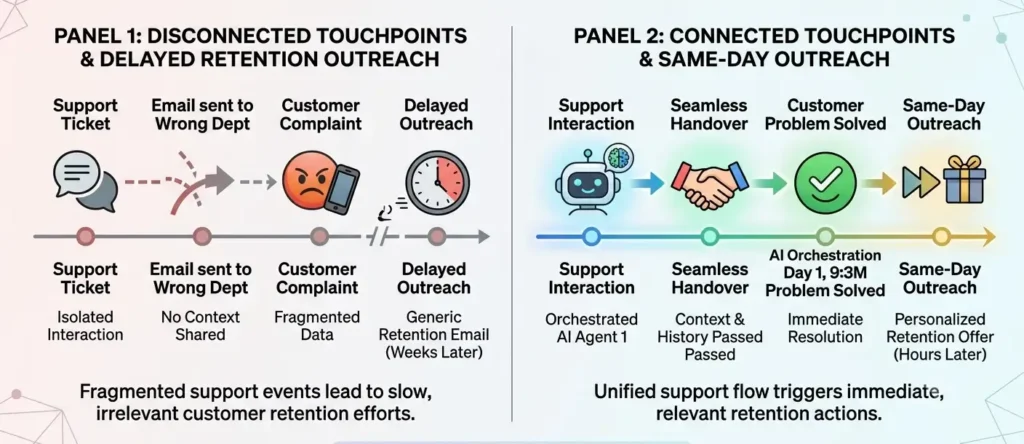
Before orchestration: A customer submits a support ticket about a billing discrepancy. A support agent resolves the immediate issue but has no visibility into the customer’s account history. Separately, a churn-prediction agent flags the same customer as high-risk two days later, based on data that was already available at the time of the support ticket. A retention specialist reaches out a week after the original complaint, by which point the customer has already downgraded their plan. Three agents touched this customer. None of them coordinated.
After orchestration: The support agent resolves the billing issue and, through an event-driven trigger, emits a “billing dispute resolved” event. A supervisor agent picks it up, checks the customer’s risk profile using the churn-prediction agent’s existing output, and, because the combination of a billing dispute and an elevated risk score crosses a defined threshold, immediately routes a retention offer to the account team the same day, with full context attached. No agent had to be rebuilt. What changed was the coordination layer between agents that already existed.
That is the practical difference orchestration makes: not smarter agents, but agents that stop working in isolation.
Fixing agent orchestration does not require replacing the 12 agents already in production. It requires an AI agent orchestration architecture that sits above them: shared context, defined handoff points, and a pattern (sequential, hierarchical, or event-driven) matched to how the underlying work actually flows. For most enterprises, that starts with mapping which of the existing agents overlap, where handoffs currently break down, and which orchestration pattern fits the highest-value workflow first, rather than orchestrating everything at once. See how NextGenSoft designs AI agent architecture for enterprises.
If your organization is somewhere in the middle of this curve, with several working agents and no coordination layer between them, that is the most common starting point we see. NextGenSoft’s AI Agent Architecture practice works with enterprise teams to assess existing agents, choose the right orchestration pattern, and build the coordination layer without a rebuild from scratch. Talk to our team about AI agent orchestration architecture.
1. What is AI agent orchestration?
Answer: AI agent orchestration is the practice of coordinating multiple AI agents so they share context, hand off tasks, and operate as a connected system rather than as isolated, single-purpose tools.
2. What is the difference between an AI agentic workflow and AI agent orchestration?
Answer: An agentic workflow describes the steps a single agent takes to complete a task autonomously. Orchestration describes how multiple agents, each potentially running their own workflow, coordinate with each other. Orchestration is the layer above individual agentic workflows.
3. Which orchestration pattern should we start with?
Answer: Start with the pattern that matches your workflow’s predictability. Well-defined, repeatable processes fit sequential orchestration. Open-ended tasks that need routing to specialists fit hierarchical orchestration. High-volume, asynchronous processes fit event-driven orchestration. Most enterprises end up using more than one pattern across different workflows.
4. Do we need a new platform to orchestrate agents we already built?
Answer: Not necessarily. Orchestration is a coordination layer, not a replacement for existing agents. Many enterprises add a supervisor agent or an event bus on top of agents already in production rather than rebuilding them inside a new framework.
5. Is agent orchestration a security risk?
Answer: Coordinating agents introduces new considerations around access control and data sharing between agents, since orchestration expands what each agent can see and trigger. This is a distinct topic from orchestration itself and is worth evaluating separately as part of a broader agent identity and access strategy.
 Niraj Salot
Niraj Salot, with 20+ years of expertise in software architecture, specializes in delivering robust enterprise applications. His cloud optimization skills help clients cut costs while maximizing performance. As a key leader at NextGenSoft, he drives scalable, efficient, and high-performing solutions.
We’re ISO/IEC 27001:2022 certified, ensuring your projects are executed with globally recognized security standards.

INDIA
 sales@nextgensoft.io
 +91 81284 66678

 Brijesh Shah
CEO, NextGenSoft
Brijesh Shah
CEO, NextGenSoft


