Securing AI Agent Identity: The New Enterprise Attack Surface in 2026
Yash BaravaliyaSeptember 18, 2026
Share this article


Let AI highlight what matters.
AI agents are no longer confined to chat windows. They read email, query databases, trigger deployments, and call other agents on your behalf—often with standing credentials that never expire and permissions no one has fully audited. That shift is why AI agent security has become one of the fastest-moving conversations in enterprise IT this year, echoed recently in a widely shared LinkedIn post from identity security vendor Britive on securing AI agent identity heading into 2026.
The core problem is simple to state and hard to fix: most organizations are securing AI agents the same way they secure human employees, and agents don’t behave like humans. They act at machine speed, they chain tasks together across systems, and a single compromised agent can touch far more than any one person ever could in the same window of time. Treating agent access as an extension of human single sign-on (SSO) is quietly becoming one of the largest unaddressed risks in enterprise software.
This article breaks down why agents need their own identity model, the specific risks that show up when they don’t have one, and a practical checklist your team can act on this quarter—tied to the DevSecOps practices most engineering organizations already have in place.
Human identity and access management (IAM) was built around a set of assumptions that simply don’t hold for AI agents:
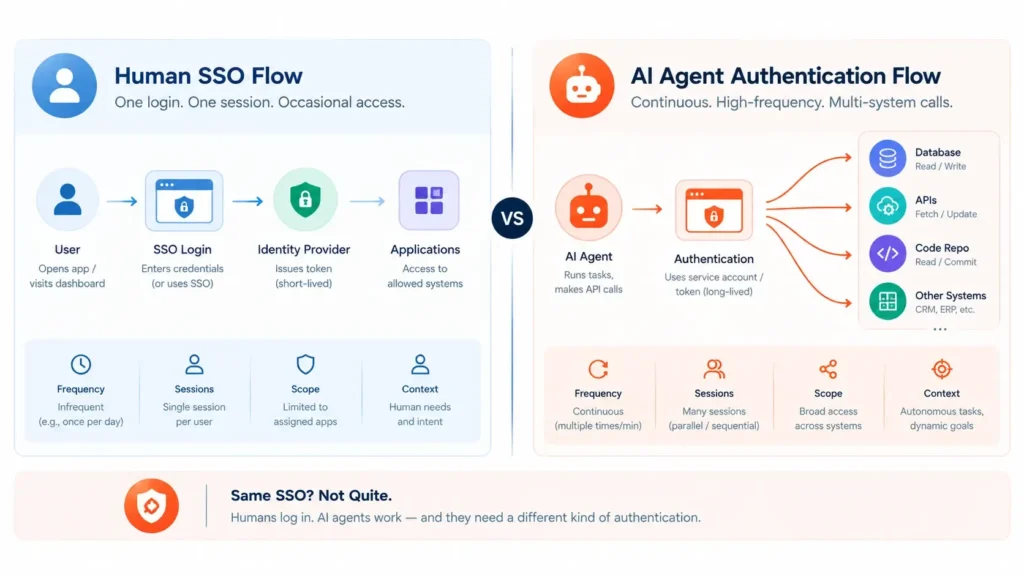
When agents are issued human-style credentials like a shared service account, a long-lived API key tied to someone’s SSO session, or worse, a developer’s personal token, every one of these mismatches becomes an open door. The fix isn’t a stronger password policy. It’s a separate identity and access model built for non-human, high-frequency, task-scoped actors—with its own lifecycle, its own audit trail, and its own revocation path that doesn’t depend on a human’s account status.
Most agents are provisioned the way most cloud roles are provisioned: broadly, “to make sure nothing breaks.” An agent built to summarize support tickets often ends up with read/write access to the entire ticketing system, the customer database it’s connected to, and sometimes the email account used to send replies. If that agent is compromised or manipulated, the blast radius is the sum of everything it was ever given—not just what it was built to do.
Prompt injection is the agent-era equivalent of SQL injection: hostile instructions hidden inside content the agent processes—a webpage, a PDF, an email, or a support ticket—that hijack the agent’s next action. The danger isn’t the injected text itself; it’s what the agent is authorized to do once it follows those instructions. An agent with access to a payments API, a code repository, or an internal wiki can be talked into exfiltrating data, granting access, or making changes using credentials that were legitimately issued—just used illegitimately.
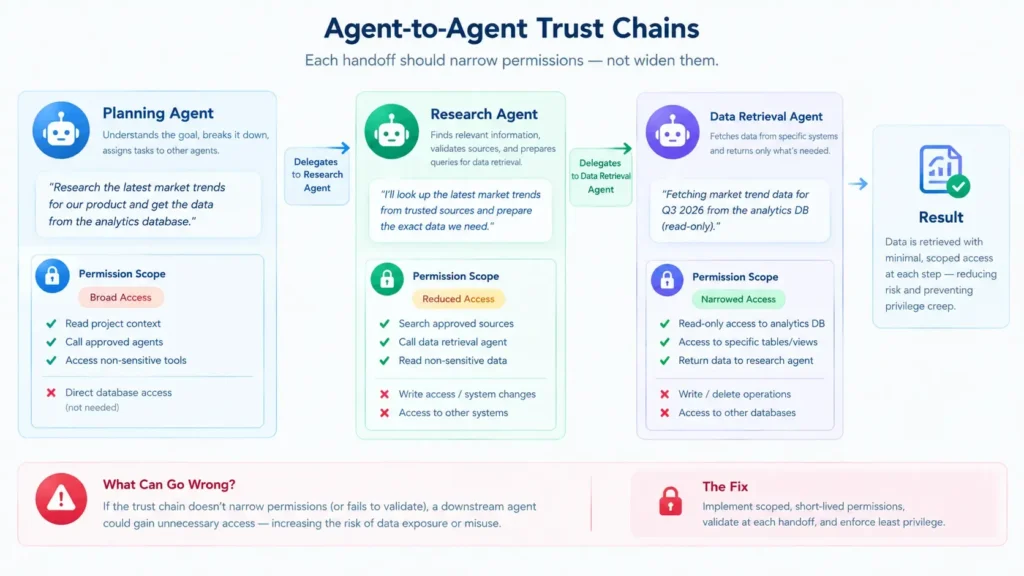
As agent architectures mature, agents increasingly call other agents—a planning agent delegates to a research agent, which delegates to a data-retrieval agent, and so on. Each hop typically inherits the permissions of the one before it, with no re-authentication or re-scoping in between. This creates a trust chain where the weakest agent in the chain effectively sets the ceiling for what the entire chain can do, and a single injected or misconfigured link can propagate access failures several steps removed from where anyone would think to look for them.
“The mistake we see most often isn’t a missing firewall rule—it’s an agent that was never asked to justify the access it was given. If you can’t explain why an agent needs permission, that permission is the vulnerability.”
— NextGenSoft DevSecOps Team
None of this requires reinventing your security program from scratch. It requires extending the identity discipline you already apply to services and infrastructure to a new class of actor. Start here:
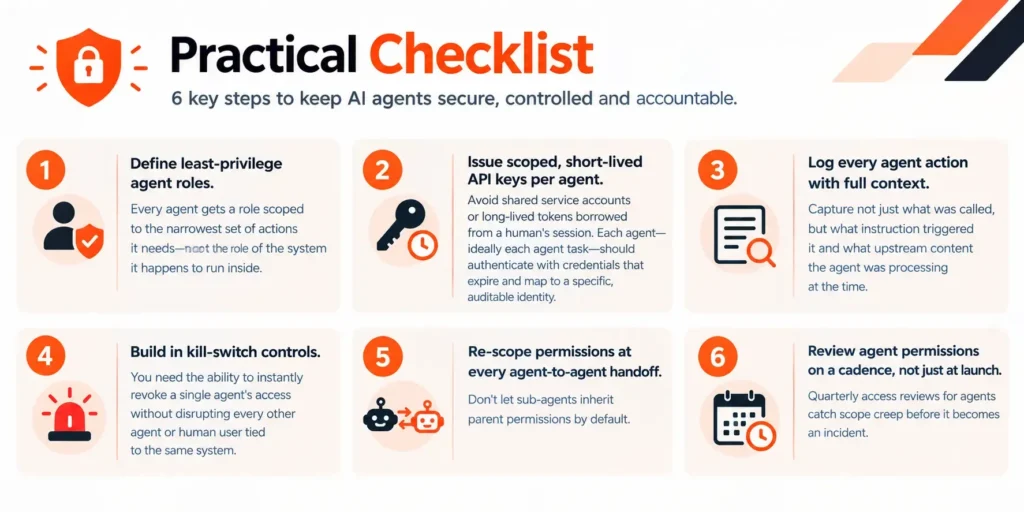
None of the above sits outside your existing DevSecOps practice—it extends it. Secrets management, least-privilege IAM, CI/CD pipeline hardening, and centralized audit logging are already core to a mature DevSecOps program; agent identity is simply the newest category of actor that needs to be brought inside that perimeter rather than treated as a special case living outside it.
At NextGenSoft, this is the lens we apply when we help engineering teams build and secure AI-driven systems: agent access controls, credential scoping, and audit logging get designed in from architecture review onward, not retrofitted after an agent is already in production with standing access it was never meant to keep. As agentic AI moves from pilot projects into systems that touch real customer data and real infrastructure, that “secure from the start” posture is the difference between an agent rollout and an incident report.
If your team is deploying—or planning to deploy—AI agents with access to production systems, a DevSecOps review focused specifically on agent identity is worth doing now, before scope creep makes it harder to untangle. Talk to NextGenSoft about a DevSecOps review for your AI agents.
1. Why can’t AI agents just use the same SSO as employees?
Answer: Human SSO assumes occasional logins, human judgment before acting, and slowly changing roles. AI agents authenticate constantly, act on instructions without pausing to question them, and often need different scopes from one task to the next—mismatches that turn shared human credentials into an oversized attack surface.
2. What is prompt injection, and why does it matter for agent security?
Answer: Prompt injection is when hidden or malicious instructions embedded in content an agent processes—a document, email, or webpage—hijack the agent’s next action. It matters because the damage is bounded not by the injected text itself, but by whatever access the agent was already authorized to use.
3. What’s the single highest-priority fix for agent security?
Answer: Least-privilege, per-agent scoped credentials with short lifespans. Most of the other risks—overprivileged agents, unchecked agent-to-agent trust chains, and hard-to-trace incidents—trace back to agents holding more access for longer than their actual task requires.
4. Do kill-switch controls slow down agent operations?
Answer: They shouldn’t, if designed correctly. A well-scoped kill switch revokes a single agent instance’s credentials without touching other agents or human sessions on the same system—the goal is isolation, not a blunt system-wide shutdown.
5. How does agent identity security relate to existing DevSecOps practices?
Answer: It’s an extension, not a separate discipline. Secrets management, least-privilege access, pipeline hardening, and audit logging already exist in mature DevSecOps programs—agent identity work applies those same principles to a new, faster-moving class of actor.
 Yash Baravaliya
Yash Baravaliya specializes in exploring and building intelligent AI-driven systems, focusing on practical innovation and modern framework development. With a strong drive for experimentation and problem-solving, he turns complex AI concepts into clear, usable solutions.
We’re ISO/IEC 27001:2022 certified, ensuring your projects are executed with globally recognized security standards.

INDIA
 sales@nextgensoft.io
 +91 81284 66678

 Brijesh Shah
CEO, NextGenSoft
Brijesh Shah
CEO, NextGenSoft


