MVP Development Services: Process, Timeline and Key Cost Drivers
Priya GoyalOctober 13, 2026
Share this article


Let AI highlight what matters.
Define clear project goals, user needs, and MVP scope before development.
Ensure the engagement covers discovery, design, development, testing, deployment, and launch measurement.
Focus on essential features and postpone non-critical functionality.
Plan realistic timelines, with 8–12 weeks possible for simpler MVPs when dependencies are managed.
Avoid budget overruns by controlling scope changes, checking integrations, and preparing data early.
Clarify development costs, third-party expenses, security requirements, and post-launch support.
For AI MVPs, evaluate output quality, data permissions, reliability, and ongoing operating costs.
Track activation, task completion, repeat usage, commercial intent, and reliability after launch.
Your product concept might be understood but often does not clarify the way to realize it.
One development company may include both discovery and launch stages, while another claims to execute only coding, both mentioning that they will provide a minimum viable product, and not mentioning what you would actually find out from your customers once they start using it.
MVP development service should cover product scope, design, engineering, testing, deployment, and measurement of launch. The purpose is to provide a usable product to test a defined hypothesis for a business without investing the full budget.
For founders and CTOs, the decision should be made on three issues: what will be provided, what can delay the process, and what will provide proof of the next investment.
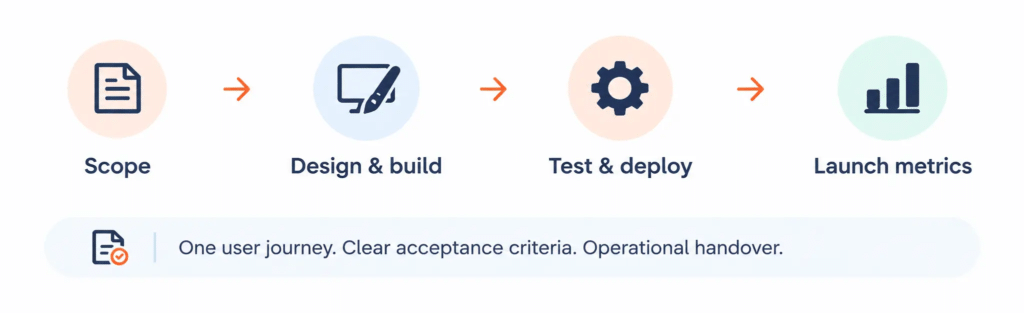
MVP engagement should have a clear outcome, defined outcomes, and responsibilities that are made clear for everyone. A separate feature list is not enough information.
In the discovery phase, the team ought to determine who the user is, what problems they face, and what is the simplest way to solve them.
For instance, one could develop a booking application to help consultants carry out their appointment scheduling automatically instead of manually. This specification is more precise than saying one needs to build a service company platform.
Expected outcomes for this stage of the project include:
The team should also state the possible scenarios that could lead to the unprofitability of the plan, such as the lack of API capabilities, lack of access to data, or that a permission must be reviewed by a specialist.
This connects with the customer learning principles explored in From Lean Thinking to Lasting Impact.
The product should allow for full accomplishment of the task at hand.
Here’s what the product may entail: user experience, front-end programming, back-end programming, user data verification process, data management, and integration of the application with business systems.
The MVP in booking must properly deal with the case of an unavailable time slot. The payment-enabled MVP must show what happens in the event of a failed payment.
Minimum level of service requires effective performance of the product.
Implementation must include production settings, monitoring system, rollback option, and administration accounts.
Transition must provide:
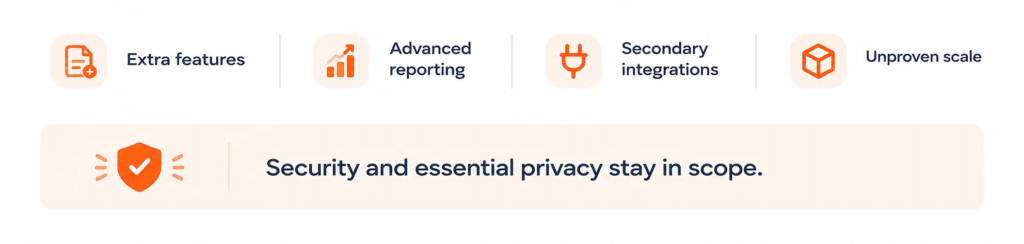
A focused MVP usually defers additional customer segments, advanced reporting, extensive customisation, and secondary workflows.
Examples include:
Nevertheless, privacy, access restrictions, and security cannot just be postponed without consideration. The requirements depend on the data and the users concerned.
Make sure to have clarifications written by your provider. It is more practical to specify something as “not included” in the documentation at the pre-development stage rather than at the testing stage.
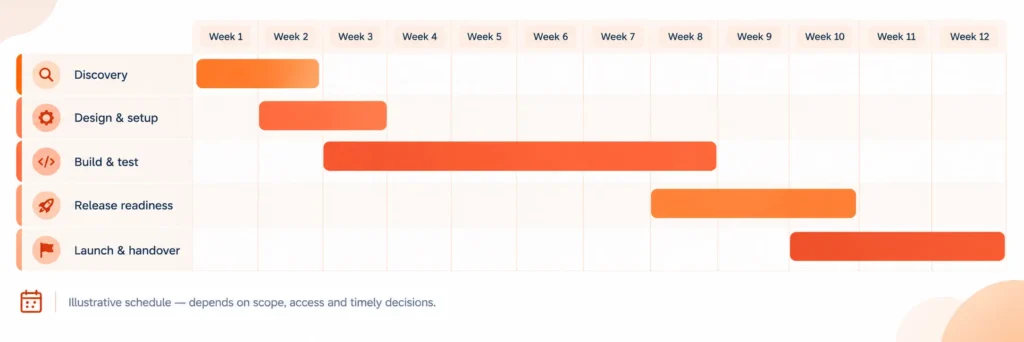
Phases are simultaneous. Testing takes place during development, while integration testing should be completed before any dependent feature is built.
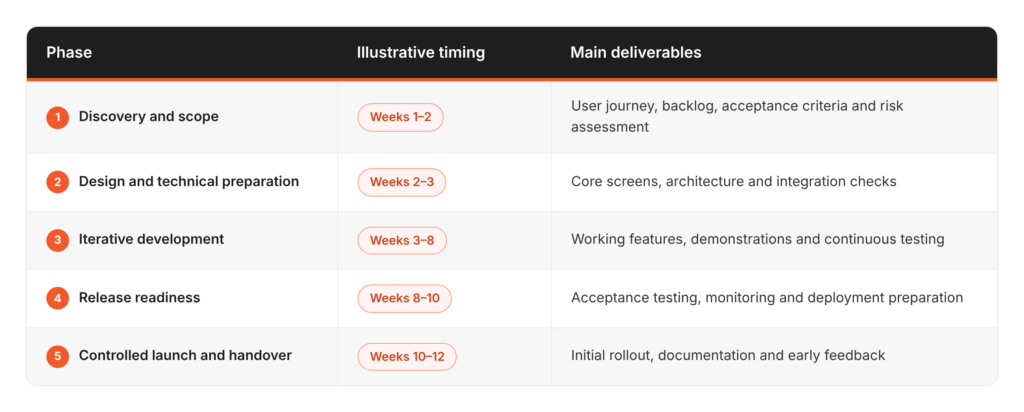
Weekly demos should show actual performance against acceptance criteria. They help uncover the misunderstandings before they are spread all over the product.
A planned launch can be incorporated into a project, but proving retention or demand may require a longer timeframe.
MVP budgets are expanded when uncertainties turn into reworks. These five problems should be tackled before a signing.
“One more feature” can require new screens, permissions, database changes, and testing.
Adding team accounts to a single-user product, for example, introduces invitations, roles, and potentially separate billing rules.
Budget control: Require each addition to replace existing scope, move to a later release or receive an approved budget adjustment.
A documented API does not guarantee an easy integration. Missing test environments, approval delays, rate limits, and inconsistent records can all increase effort.
Budget control: Check critical integrations during discovery. Confirm credentials, sample data, limitations, and failure-handling requirements before estimating dependent work.
Imported spreadsheets may contain duplicate customers, missing fields, or inconsistent formats. AI products can face additional problems with outdated documents and unclear permissions.
Budget control: Review representative data early and assign responsibility for cleaning, migration, and access approval.
A request for audit logs, stronger account isolation, or recovery procedures can affect architecture across the product.
Budget control: Define essential security, performance, and operational requirements during scoping. Match them to the actual launch audience and risk.
Conflicting stakeholder feedback can undo completed work. Delayed approvals also leave developers blocked or working from assumptions.
Budget control: Appoint one product owner, agree on review deadlines, and record decisions. Feedback should relate to the agreed user journey and acceptance criteria.
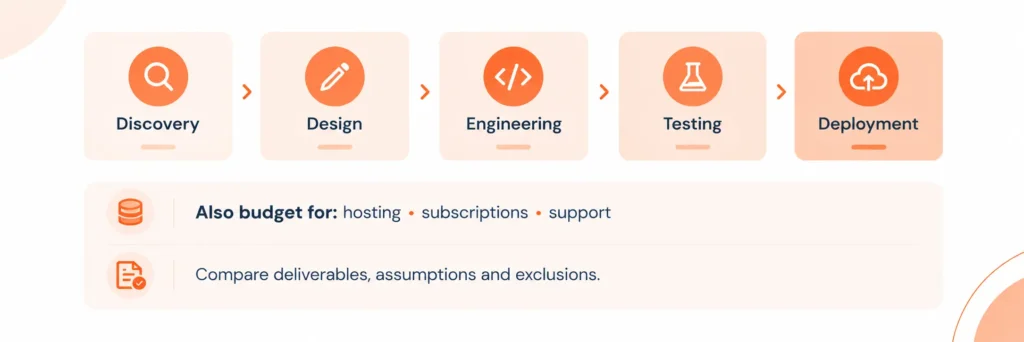
A credible estimate connects cost to scope, effort, and uncertainty.
It should separate:
For MVP development services for startups, this clarity helps protect the budget needed after launch, when customer feedback starts shaping the next release.
AI introduces uncertainty around output quality and ongoing operating costs. A working demonstration does not establish that the product is dependable.
Confirm that the required information is available, usable, and permitted for the intended purpose.
If an assistant retrieves internal documents, it must respect the user’s access rights. Relevant information should not become accessible simply because an AI interface can retrieve it.
Decide what will be deemed acceptable before the rollout.
When putting together an evaluation set, make sure it contains representative tasks, complex data inputs, and scenarios when the model must decline to answer or ask for review. The NIST Generative AI Profile warns about confabulation, or confidently produced inaccurate content, which businesses must tackle.
In the case of a document assistant, useful metrics include factual accuracy, supporting source availability, response time, and user correction rate.
Models are only part of the operational cost. Retrieval, storage, repeat requests, monitoring, and human checks make other contributions.
Track cost per completed task, alongside quality and latency.
The use of artificial intelligence for coding does not necessarily guarantee shorter time to market. For assistant-based products, review AI Copilot Development: Build vs Buy for Enterprise Teams before committing to custom development.
Choose metrics that show whether users receive the intended value:
An appropriate MVP Development company is one that provides scope, dependencies, expenditures, and launch proofs before the actual development begins. Proper engagement ensures that we have a targeted product and adequate operational visibility for making further decisions.
Partner with a trusted software product development company like NextGenSoft to evaluate your initial release and refine your product strategy.
1. What do MVP development services include?
Answer: The phases typically consist of discovery, scoping, design, development, as well as testing and measurement of launch. So check if the proposal contains any accountability, documentation, and charges for third-party providers of services, as well as support services after the launch of the product.
2. Can an MVP be delivered in 8–12 weeks?
Answer: If you would like to create a simple product and have all dependencies and decisions made on time, it is feasible. However, long integration periods, government regulations, or the need for a considerable amount of data preparation may prolong the project.
3. What determines the cost of MVP development?
Answer: Among the key aspects that shape the overall cost of a project are the difficulty of the workflow, different integrations that might take place, getting data ready, quality criteria, and changes to the scope, etc.
4. Does AI MVP development always cost more?
Answer: Not at all. It highly depends on the project’s needs and requirements. The existing algorithms may help save some money on development, but additional costs could arise because of the need to prepare data, obtain permission, evaluate the work done, and use the algorithm again.
5. What happens after the MVP launches?
Answer: Study the user behavior and experience, as well as the overall cost of running the application. Use these outcomes to decide on further developments concerning your product idea and the actual scope of work to be performed and further arranged.
 Priya Goyal
Priya Goyal, a detail-oriented DevOps Engineer with 2+ years of experience, specializes in building scalable, automated, and reliable infrastructure. Proficient in AWS, Azure, Kubernetes, CI/CD, and IaC, with expertise in GitLab CI, Terraform, Prometheus, and Grafana. Passionate about enhancing performance, security, and automation to streamline software delivery.
We’re ISO/IEC 27001:2022 certified, ensuring your projects are executed with globally recognized security standards.

INDIA
 sales@nextgensoft.io
 +91 81284 66678


