Microservices vs Serverless: How To Choose the Right Architecture
Kushal BaldevOctober 8, 2026
Share this article


Let AI highlight what matters.
As an application expands, two challenges seem to arise simultaneously. Developers find it difficult to implement the changes without impacting various functionalities, while the business spends additional time looking after the infrastructure requirements.
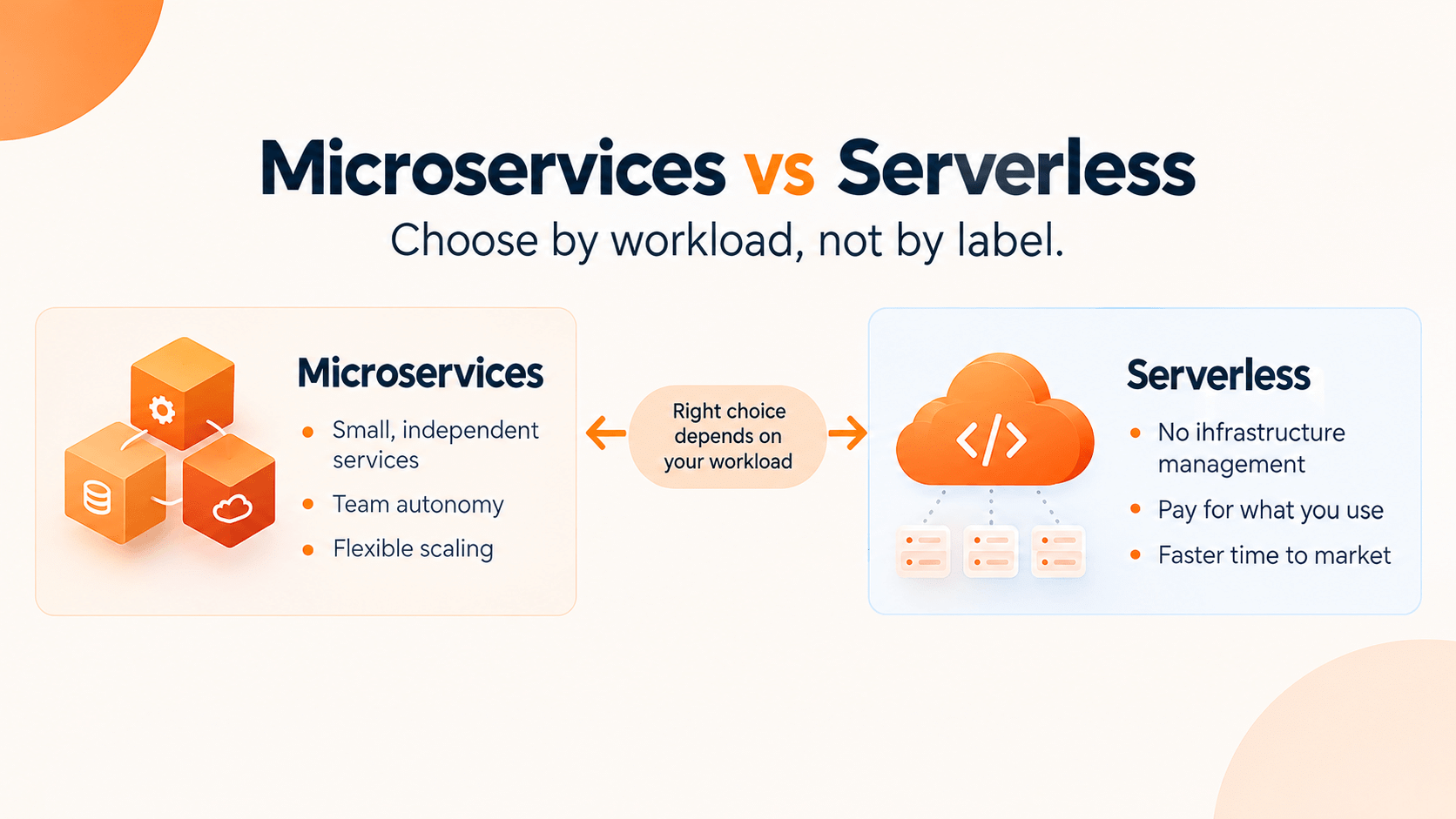
The microservices vs serverless comparison provides valuable insight in this domain. As stated earlier, these two approaches are focused on two different issues: the microservices approach shows how to break an application into independent services, while serverless describes how much work with the infrastructure the cloud provider takes on.
It is possible to use both approaches either separately or together. The final choice depends on the flow of traffic, the skills of the team, the length of the particular tasks, and the response requirements.
Before making a decision, it is important to distinguish between two questions that must be answered: how to deploy our application and how to operate it.
Picture an online shop that is responsible for product searching, payments, stock keeping, and delivery alerts. All these activities form a single business. However, each of them has its own duty to perform.
Microservices architecture ensures that all the duties are allocated to different independent services. Developers are allowed to update the product catalog without making any changes to the payment service, provided that the interfaces remain compatible. The approach is defined by Microsoft as use of small services focusing on different business capabilities. microsoft.com
The services can be deployed on virtual machines, containers or cloud services. Their environment of execution is a separate choice.
Read Also: Why Software Architecture Diagrams Fail and How to Fix Them
It is an approach that makes use of managed cloud services, which means developers do not need to provision and take care of the servers that run the application. Servers are still doing the work, but they have been managed by the cloud provider.
For anyone asking “what is serverless computing,” the practical answer is that it lets teams execute application code while delegating much of the infrastructure work to a provider. Some typical cases where this method is used are executing APIs, performing scheduled tasks, and triggering applications through the occurrence of events.
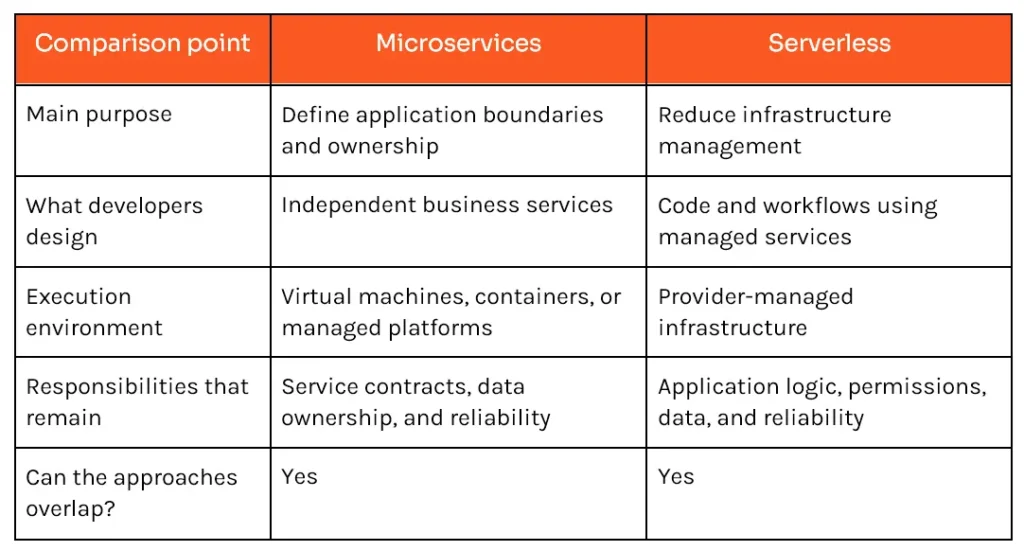
This differentiation is critical to understanding the differences between microservices and serverless architecture. Breaking down an application into smaller components will not necessarily lessen the requirement for infrastructure maintenance. Similarly, using managed infrastructure will not ensure the design of well-functioning services.
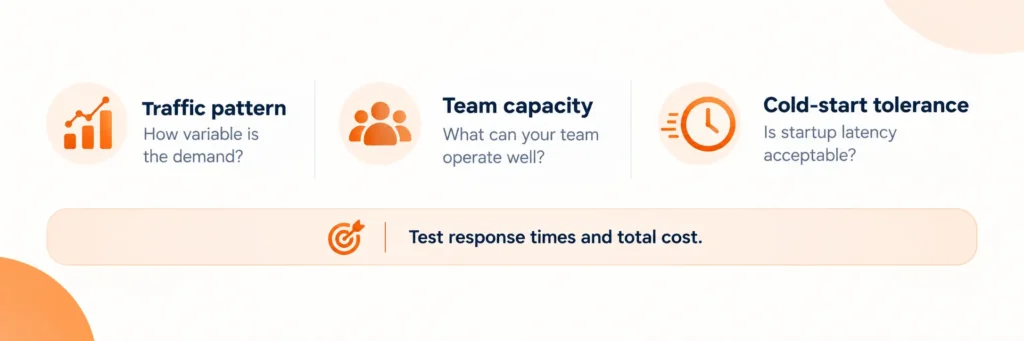
Begin with three practical questions: how does the demand fluctuate, who will run the application, and how much startup delay are users ready to experience?
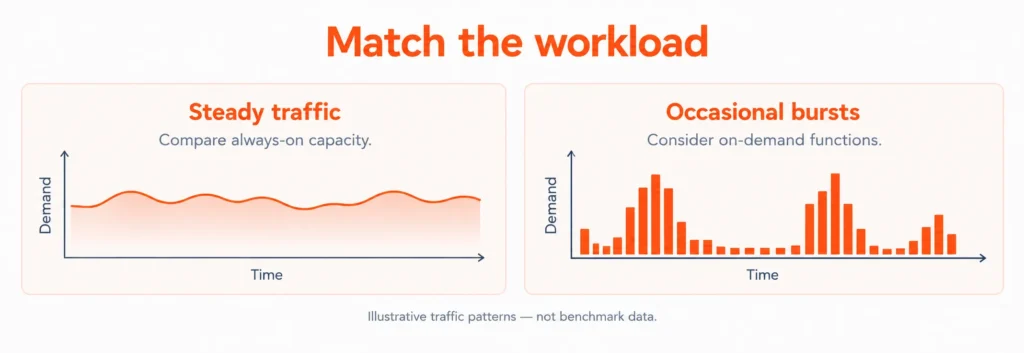
Short jobs with long periods of inactivity are perfect for on-demand services. For example, processing of uploaded images or responding to the occasional payment notification.
Continuous loads require a different analysis of costs. If the service is running non-stop during the day, it is necessary to check the costs of the function execution against the costs of deploying the appropriate container.
Neither method guarantees decreased costs. The result will depend on resource consumption, execution time, and services connected.
Auto-scaling has its limitations as well. Even though there may be plenty of computing resources available, the database or the API may be slowing down.
AWS has provided a useful formula for planning:
Concurrency = requests per second × average execution time in seconds.
For example, 100 requests per second with an average duration of 0.5 seconds require approximately 50 concurrent executions. This estimates average capacity requirements; sudden bursts still need separate testing. docs.aws.amazon.com
The importance of team size cannot be refuted. Nevertheless, the number of developers needed for a particular project may be different in different situations.
While a small team may benefit from using managed infrastructure since it will require fewer people to manage the environments used during execution, a simple application, which is broken down into many services, will involve substantial work. The given system will feature several components, each one of which needs to undergo particular deployment processes, undergo appropriate tracking, have the necessary permissions, and have clear ownership.
Independent services may be crucial when different teams deal with distinct elements of the business process. For instance, if a billing department is separated from inventory management, the two services should operate separately.
When deciding on whether to introduce a new service, the following questions need to be answered:
In a situation where results are ambiguous, having more options might cause delays.
A cold start occurs when an execution environment must initialise before processing a request. This can add latency to on-demand functions.
A background image-processing task may tolerate that delay. A checkout request may have a much tighter response budget.
AWS offers provisioned concurrency, which prepares execution environments in advance to reduce cold-start latency. It carries additional charges, so include it in performance testing and cost estimates.
Measure the 95th percentile response time, meaning the time within which 95% of requests finish. A satisfactory average can hide delays that affect a smaller group of customers.
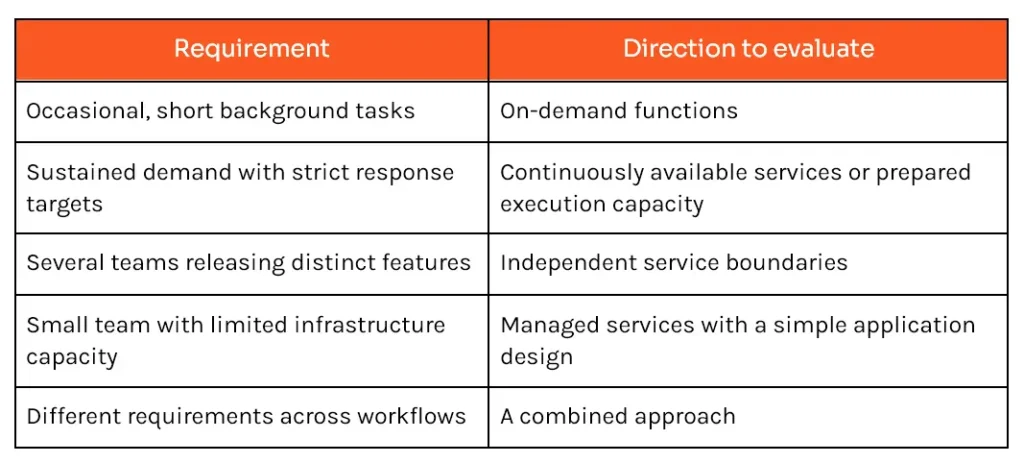
A useful microservices vs serverless comparison includes more than the compute bill. Consider engineering time, database usage, monitoring, networking, and incident handling.
For function-based execution, memory allocation and duration matter alongside request count.
AWS Lambda’s published free tier includes 1 million requests and 400,000 GB-seconds of compute per month. This does not make an entire application free. Connected services and usage beyond the allowance can generate additional charges. aws.amazon.com
Consider this simplified calculation:
The calculation shows why request volume alone cannot predict costs.
Execution limits also influence suitability. A standard AWS Lambda function has a maximum configured timeout of 900 seconds, or 15 minutes. A job requiring 40 uninterrupted minutes needs another execution option or a workflow divided into suitable steps. This limit applies to Lambda functions, rather than every managed compute product. docs.aws.amazon.com
A serverless computing architecture should therefore account for task duration, retry behaviour, external dependencies, and platform quotas before implementation.
Read Also: AI-First Development- The New Operating Model for Modern Software Engineering
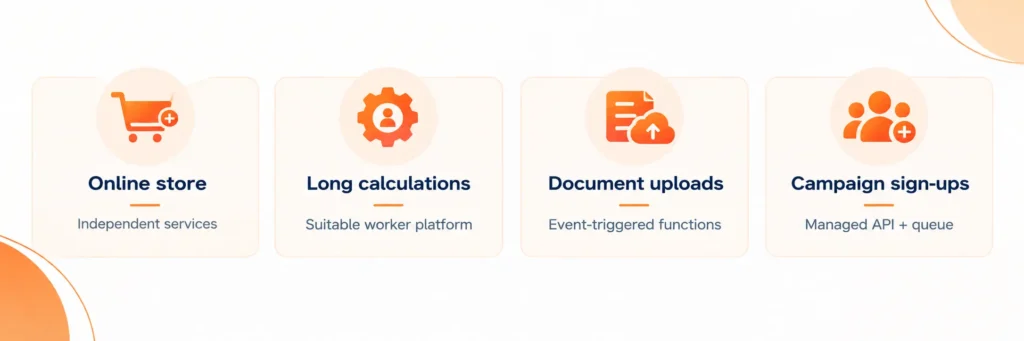
The following examples illustrate architecture choices. They are hypothetical scenarios, rather than NextGenSoft client results.
1. An Established Online Store with Separate Product Teams
An online retailer has separate teams for catalogue, checkout, and fulfilment. Orders arrive throughout the day, and checkout has strict response targets.
Suitable direction: Independent business services, with continuously available capacity for critical request paths.
Each team can release changes within its area. Checkout capacity can be planned and tested separately from catalogue browsing.
However, service separation alone does not prevent outages from spreading. The design still needs timeouts, controlled retries, and appropriate fallback behaviour.
2. A Subscription Platform with Long-Running Calculations
A subscription platform includes billing, account management, and a calculation engine. Some calculations take 40 minutes to complete.
Suitable direction: Independent services where business ownership justifies them, with containers or another suitable worker platform for long calculations.
The calculation engine can scale independently without forcing billing to use the same resources. Its execution environment must support the required job duration.
This is a reminder that a workload’s actual behaviour matters more than an architecture label.
3. A Document Portal with Occasional Uploads
A small company receives documents irregularly. Each upload triggers validation and thumbnail generation lasting a few seconds.
Suitable direction: Storage events connected to on-demand functions.
Processing runs when a file arrives, reducing the need to maintain idle workers. A modest startup delay may be acceptable because users do not require every processing step to finish immediately.
The team must still handle failed files and duplicate events.
4. A Registration Tool with Campaign-Driven Traffic
A marketing team collects registrations mainly during launches. Activity remains low between campaigns.
Suitable direction: A managed API, functions, a database, and a queue for confirmation messages.
This fits short requests and uneven demand. Queueing email work allows the registration response to finish without waiting for the email provider.
Before launch, test peak traffic and check whether the database and messaging provider can handle the expected volume.
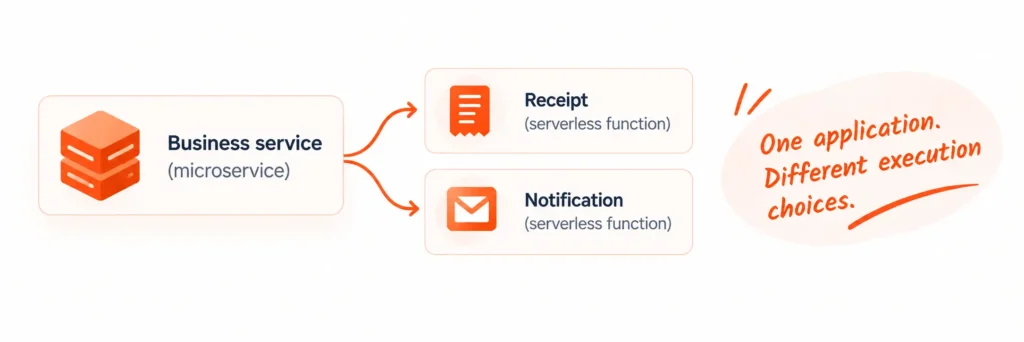
The microservices vs serverless decision does not require one approach for the entire application. Business boundaries and infrastructure choices can be evaluated separately.
Google Cloud’s managed compute offering explicitly includes containerised services and event-driven functions. This demonstrates how both execution models can support the same application. cloud.google.com
For an online store, the order service might run continuously. Once an order is confirmed, it publishes an event. Functions then generate a receipt, send a notification, and update analytics.
These functions support defined workflows. Each function does not need to become a separately owned business service.
To keep the combined design reliable:
The aim is to match each workload to an appropriate execution environment while keeping the application understandable.
Choose service boundaries around business responsibilities. Then select execution environments based on traffic, task duration, response requirements, and team capacity.
Start with one representative workflow. Test normal demand, sudden bursts, and dependency failures. Compare operating costs alongside performance before expanding the design.
NextGenSoft’s Microservices & Serverless Architecture Services cover business-driven service boundaries, practical workload selection, observability, and incremental modernisation. Discuss your application’s requirements to identify which services need continuous capacity and which tasks suit managed, on-demand execution.
1. Does Every Function Count as a Microservice?
Answer: Not really. A function performs a task while a microservice performs a business function. There may be several functions supporting one service.
2. Do You Need Kubernetes to Run Microservices?
Answer: No. These independent microservices can operate on both virtual machines and container platforms without using Kubernetes through your team.
3. How Do Serverless Functions Store Customer Data?
Answer: Your functions will use storage services that allow persistent data storage. Importantly, customer data should not rely on the constant availability of an execution platform.
4. Who Is Responsible for Application Security?
Answer: You are responsible for the code in your application, permissions, and ensuring data security. It depends on the type of service you use.
5. Should You Rebuild the Entire Application at Once?
Answer: The incremental approach works better. You simply start with one key workflow, see how it behaves, and use this to guide your future actions.
 Kushal Baldev
Kushal Baldev is currently serving as a Technical Lead at NextGenSoft, bringing over 8.5 years of experience in software development and technology leadership. With a strong background in designing scalable systems and leading high-performing teams, Kushal has played a pivotal role in delivering innovative solutions across various domains.At NextGenSoft, he leads cross-functional teams, mentors junior developers, and collaborates with stakeholders to drive digital transformation initiatives. His dedication to continuous learning and staying updated with emerging trends has made him a valuable asset in the tech community.
We’re ISO/IEC 27001:2022 certified, ensuring your projects are executed with globally recognized security standards.

INDIA
 sales@nextgensoft.io
 +91 81284 66678


