Digital Transformation Consulting Firms: How to Evaluate ROI in 2026
Brijesh ShahSeptember 2, 2026
Share this article


Let AI highlight what matters.
Digital transformation has advanced beyond just replacing legacy systems and transferring applications to the cloud. By 2026, organizations will be investing in various technologies, including artificial intelligence, robotics, cloud platforms, data analytics, application modernization, and intelligent processes to enhance their operations.
However, the investment in new technology does not guarantee the creation of business value.
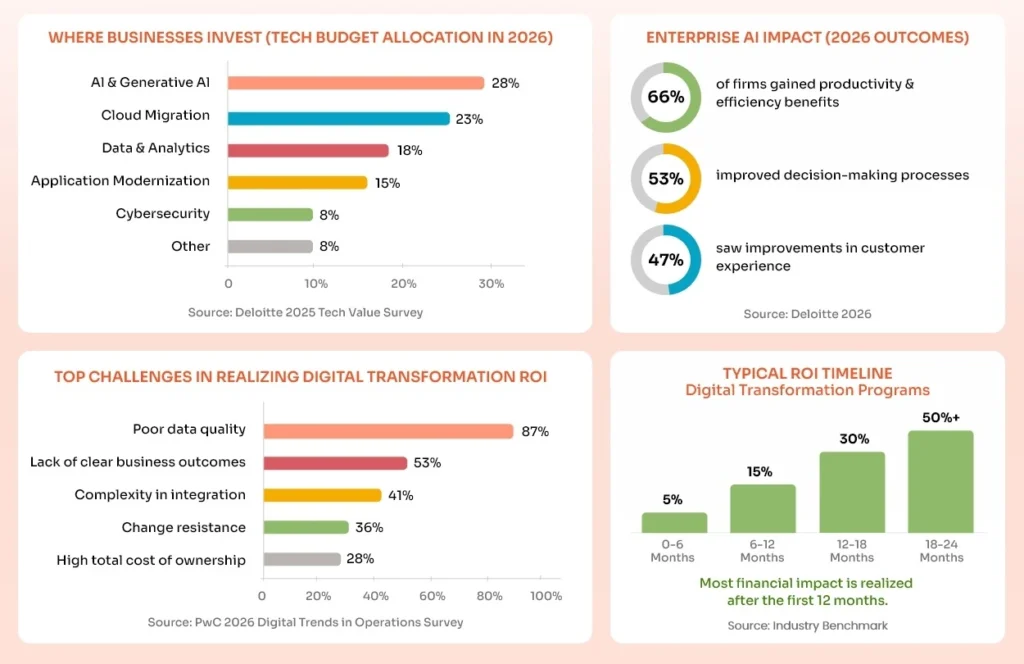
According to the 2026 Digital Trends in Operations Survey conducted by PwC, 89 percent of operations executives reported that their technology investments did not yield the anticipated results.
Furthermore, 87 percent of respondents stated that poor quality data had hindered their efforts to realize value from the digital transformation process.
According to BCG research, approximately 70 percent of the transformations fail.
This makes the following question very important: How can companies determine whether a consulting firm will help them achieve measurable ROI?
Digital transformation ROI measures the business value created by a transformation initiative compared with the total amount invested in it.
The basic calculation is straightforward:

For example, suppose an enterprise spends $600,000 on cloud modernization, workflow automation, system integration, and employee training.
Over two years, the transformation produces $900,000 in measurable savings and additional revenue.
The calculation would be:

However, this calculation only works when the business tracks the right costs and benefits.
A good digital transformation consultant should therefore help establish the measurement model before implementation begins.
Modern transformation programs often involve several technologies at the same time.
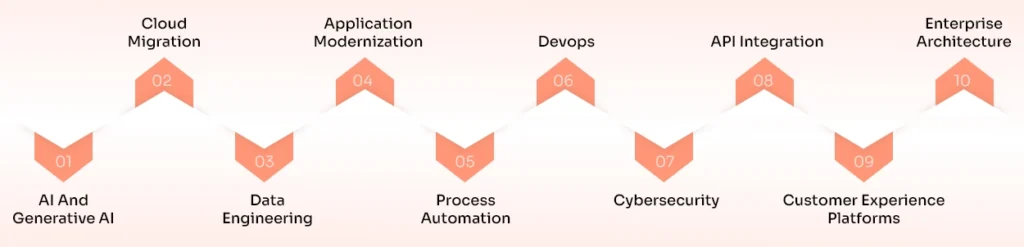
An enterprise digital transformation may include:
Each investment may create value differently.
Cloud modernization could reduce infrastructure costs. Automation could reduce processing time. AI may increase employee productivity. Better customer platforms may improve retention.
The challenge is connecting each improvement to financial value.
This issue becomes even more important as AI takes a larger share of technology budgets. According to Deloitte’s 2025 Tech Value Survey, 74% of companies surveyed reported investing in AI and generative AI over the past 12 months. Respondents also saw the share of their budget allocated for digital initiatives rising from 7.5% in 2024 to 13.7% in 2025.
As a result, businesses are spending more, while company boards and CFOs are asking tougher questions about ROI.
Here are seven areas businesses should examine.
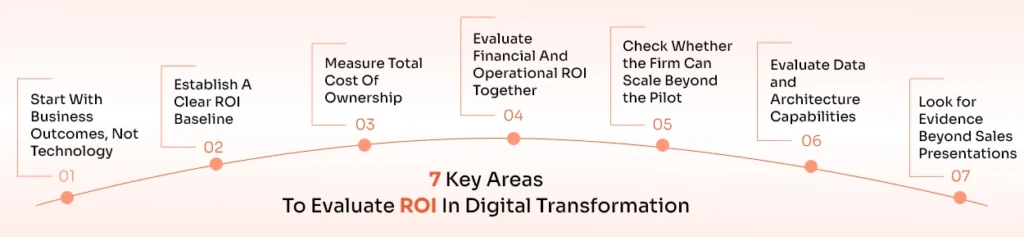
Be careful when a consulting company starts a conversation by recommending technologies before understanding the business problem.
Good digital transformation consulting begins with questions such as:
Technology should come after the business problem is clear.
For example, “implement generative AI” is not a measurable business objective.
A stronger goal would be: Reduce average customer support resolution time from 12 minutes to 7 minutes within nine months.
Now the business has a baseline, target, timeline, and measurable outcome.
You cannot prove improvement if you do not know where you started.
Before implementing digital transformation services, measure the current performance of the processes being changed.
The baseline might include:
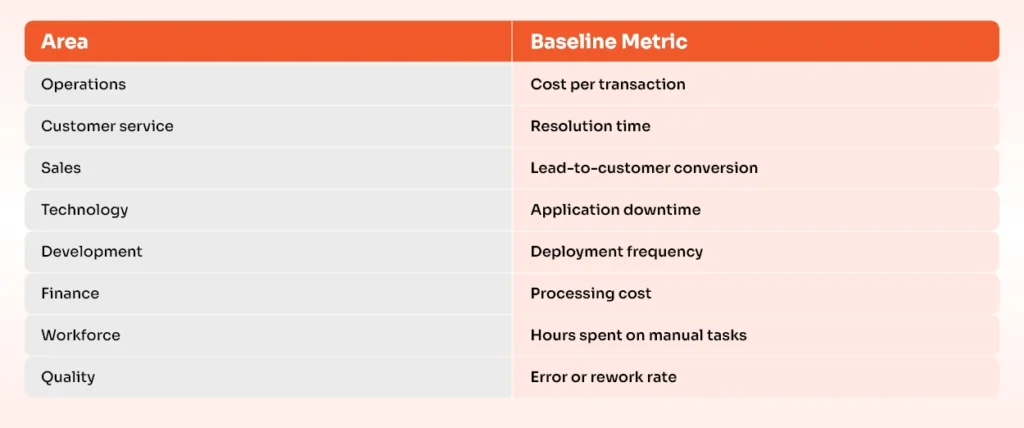
The consulting partner should document these numbers before implementation starts.
Without a baseline, teams often celebrate improvements without being able to prove what actually changed.
One of the biggest ROI mistakes is counting only development costs.
The true investment may also include:
As a simple example, a $300,000 modernization may need around $150,000 for migration, integration, training, and support. If these costs are not included in the budget of the project, the ROI indicators would seem very attractive rather than demonstrating an actual situation.
The best digital transformation consulting firms should provide visibility into total cost of ownership, not simply project cost.
Revenue and cost savings matter, but they should not be the only measurements.
Deloitte found that AI First companies using a broader measurement approach were more likely to associate digital transformation with higher enterprise value. Its research notes that businesses often rely heavily on productivity when measuring digital value, even though transformation affects many other parts of the organization.
A practical ROI scorecard can include five areas.
Financial Metrics
Track:
Operational Metrics
Measure:
Customer Metrics
Review:
Technology Metrics
Monitor:
Workforce Metrics
Measure:
This gives leadership a clearer view of whether transformation is producing real business improvement.
Running a successful pilot is very different from transforming an enterprise.
BCG research has shown that many companies struggle to move digital solutions beyond pilots and isolated departments.
When reviewing digital transformation consulting firms, ask: What happens after the proof of concept succeeds?
A reliable digital transformation strategy should cover:
This becomes especially important with AI. Deloitte’s 2026 report showed that 66% of firms have gained productivity and efficiency benefits from enterprise AI, while 53% improved their decision-making processes.
The lesson is simple. Technology may show early operational value before its full financial impact appears.
Your ROI model should account for both.
AI cannot repair weak data foundations on its own.
PwC found that only 51% of surveyed companies establish a clean, structured data foundation before scaling digital initiatives.
This is why the consulting firm’s capabilities in data engineering and enterprise architecture matter.
Ask potential partners:
A transformation may look successful during the first six months but become expensive later if the underlying architecture cannot scale.
Certifications alone do not guarantee ROI, but they can help validate whether a firm has established technical and security practices.
Look for evidence such as:
The firm should also be able to explain what happened after implementation.
Instead of asking only, “What technology did you build?” ask: What business metric improved because of it? That question quickly separates technology delivery from business transformation.
Read Also: Top 10 Leading AI Companies Shaping the Future in 2026
Businesses can use the following model when comparing providers.
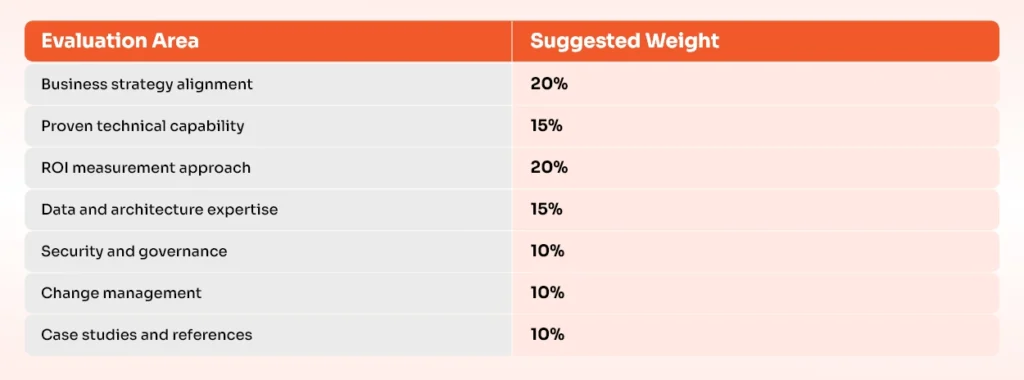
Choosing a vendor for a project solely based on the lowest price offered may be a mistake in terms of getting the largest ROI. The best service provider is often the one who is not just able to provide a service but also explains how exactly this service affects operating costs, revenue, risks, etc.
Watch carefully if a potential partner:
These problems often appear small during planning but become expensive during implementation.
At NextGenSoft, digital transformation is approached through a combination of enterprise architecture, AI, cloud, DevOps, data science, and application development.
The enterprise is recognized as an AWS Select Tier Services Partner, part of the Claude Network Partner, and has obtained the ISO/IEC 27001:2022 certification. Furthermore, NextGenSoft has 9+ accredited AWS specialists and over 15 certifications in technology and AI fields, including but not limited to cloud architectures, DevOps, security, etc.
NextGenSoft’s current company profile also reports:
Read Also: AI-First Development: The New Operating Model for Modern Software Engineering
So, finding the right technology partner in 2026 is not simply about knowing who can assist in the process of building an AI application, migrating workloads to AWS, or modernizing legacy software.
The bigger question has to be: Can the partner show how that technology will create measurable business value?
Strong digital transformation consulting firms establish baselines before implementation, connect technology decisions with business KPIs, calculate total cost of ownership, and measure results long after deployment.
That is also how organizations should think about digital transformation ROI.
Start with the business outcome. Define the numbers. Build the right architecture. Measure continuously. Then scale what works. Reach out to us and get a complete consultation that can work best for you.
1. What is digital transformation ROI?
Answer: Digital transformation ROI is the process by which the monetary and business impact of the digital transformation efforts is assessed and compared to the overall cost of the transformation.
2. How should companies choose a digital transformation consulting firm?
Answer: Search for consulting firms that possess knowledge in business strategy, enterprise architecture, cloud, data and security, AI, and creating change management activities and have the ability to establish measurable indicators for the evaluation of ROI.
3. How long does digital transformation take to show ROI?
Answer: The time needed to see results varies based on the project. For instance, some efforts such as automating processes may lead to ROI in a few months, while other activities such as application updating, transitioning to cloud software, etc. may require more time. Because of this, organizations should discuss the timeline before starting the project.
4. What are the most important digital transformation ROI metrics?
Answer: Among the most crucial indicators are revenue increase, operating expenses, costs for one transaction, cycle time, automation level, customer satisfaction ratio, employee efficiency, software availability, implementation speed, cloud cost, and error reduction.
5. What should a digital transformation strategy include?
Answer: It is crucial for a solid plan to lay out the business strategy, standard metrics, tech architecture, data needs, safety aspects, priority of execution, change management technique, KPI of activity, expense, and timeline, as well as the approach for calculating ROI.
6. Why is ROI important when evaluating digital transformation services?
Answer: ROI significantly aids business leaders in assessing whether tech investments yield solid benefits. It additionally enables companies to pinpoint effective projects, abandon inefficacious ones, enhance budgeting, and make smart decisions about their future transformation expenditures.
 Brijesh Shah
Brijesh is an IIM Ahmedabad alumnus with 22+ years of experience in software development and management. As the visionary leader of NextGenSoft, he drives the company toward becoming a global leader in software services and digital transformation. He also serves as Vice President of the PMI Gujarat Chapter.
We’re ISO/IEC 27001:2022 certified, ensuring your projects are executed with globally recognized security standards.

INDIA
 sales@nextgensoft.io
 +91 81284 66678


