Platform Engineering vs DevOps: Why the Debate Won’t Die Down?
Aman MishraSeptember 14, 2026
Share this article


Let AI highlight what matters.
Type “platform engineering vs DevOps” into any dev forum right now and you’ll find a fight. Half the thread says platform engineering is just DevOps with a new job title. The other half says DevOps promised self-service infrastructure a decade ago and never delivered it, and platform engineering is the correction.
Both sides have a point. That’s what makes this worth untangling properly instead of picking a side.
These three terms get used almost interchangeably in job postings, which is part of the confusion. Here’s the practical distinction.
DevOps is a philosophy, not a team. It asks developers and operations to share responsibility for the full software lifecycle: build, test, deploy, run. In practice, this often meant every product team owned its own CI/CD pipelines, Terraform modules, and on-call rotations. That works well in a 15-person startup. It gets expensive fast at 150 or 1,500 engineers, because everyone is solving the same infrastructure problems in slightly different, undocumented ways.
Site Reliability Engineering (SRE), Google’s contribution to this lineage, applies software engineering discipline to operations, error budgets, SLOs, and blameless postmortems. SRE is fundamentally about reliability as a measurable, engineered property, usually for a specific set of production services.
Platform Engineering takes a different angle: it treats internal infrastructure as a product, built by a dedicated team, for an internal customer, your own developers. Instead of every team reinventing deployment pipelines, secrets management, and environment provisioning, a platform team builds a self-service layer that other engineers use without needing to become infrastructure experts.
Read Also: Building a DevSecOps Maturity Framework: A High-Level Playbook for Enterprises
The short version:
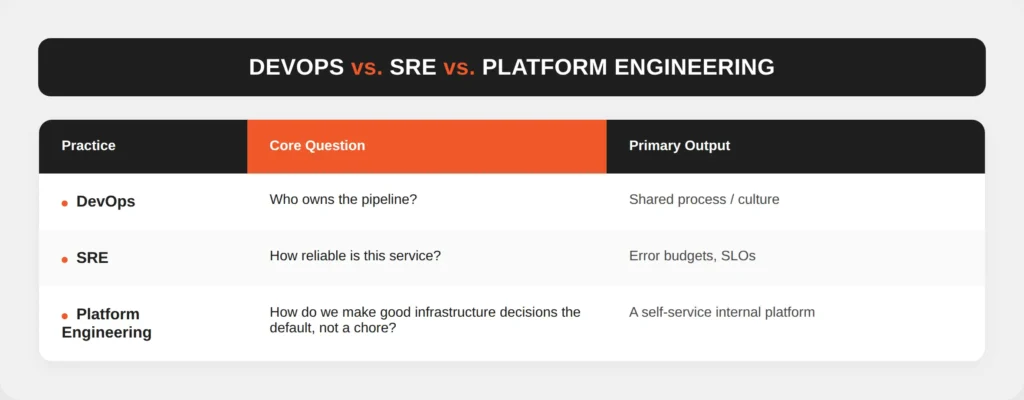
Platform engineering doesn’t replace DevOps principles; it operationalizes them at scale. Think of it as the productized layer that makes DevOps practices usable without every team needing deep infrastructure expertise.
The stat driving a lot of the current conversation comes from Gartner, which has projected that by 2026, 80% of large software engineering organizations will have established platform engineering teams as internal providers of reusable services, components, and tools for application delivery.
A few things worth being precise about before you use this number anywhere public-facing:
That caveat aside, the direction of the trend lines up with what’s visible elsewhere: heavy platform engineering programming at recent Google Cloud and IEEE-affiliated webinars, a steady rise in “Platform Engineer” as a distinct job title on LinkedIn and job boards, and the emergence of CNCF’s Platform Engineering Maturity Model as organizations look for a shared vocabulary. The debate on Medium and dev.to isn’t just noise; it’s a sign that the terminology is still settling even as the practice matures.
Read Also: Release Engineering Security Best Practices
“Internal Developer Platform” gets thrown around loosely, so it’s worth being concrete about what a functioning one contains.
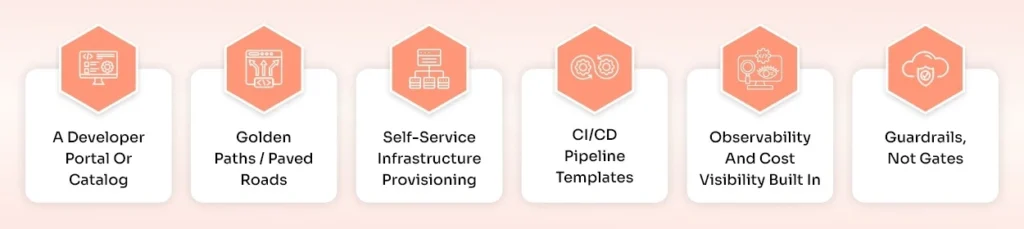
An IDP is not a single tool you buy. It’s a layer, usually built on top of Kubernetes, cloud provider APIs, and existing CI/CD, that gives developers a self-service interface to the infrastructure decisions a platform team has already made well. The components typically include:
The test of a good IDP isn’t how much technology it contains — it’s whether a developer can go from “I need a new service” to a running, monitored, compliant deployment without opening a ticket to another team.
Platform engineering solves a real problem for the right org, and creates unnecessary overhead for the wrong one. Before committing budget and headcount to a platform team, it’s worth being honest about where you stand.
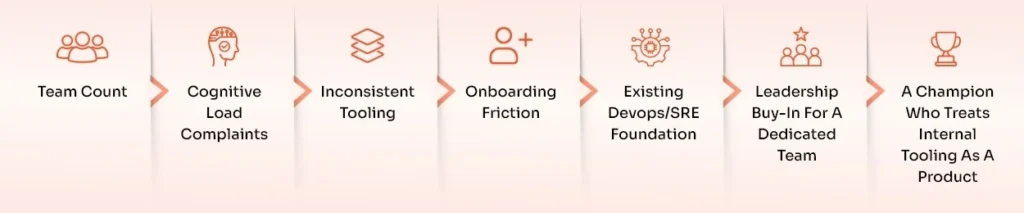
Readiness checklist:
If you’re checking most of these boxes, a platform team is likely to pay for itself in reduced onboarding time and fewer duplicated infrastructure efforts. If you’re checking two or three, the more practical next step is usually strengthening your existing DevOps practices first, standardizing CI/CD, tightening infrastructure-as-code, and improving observability, before adding a new team on top.

For most organizations, the honest starting point isn’t “build a platform team tomorrow.” It’s an audit: where is infrastructure work actually duplicated across teams, where is onboarding slowest, and what would a single golden path save in engineering hours per quarter.
That audit, and the DevOps foundation it typically surfaces gaps in, is exactly where a structured DevOps services engagement earns its keep before you invest in a full platform engineering build-out.
1. Is platform engineering just DevOps with a new name?
Answer: No. DevOps is a shared-responsibility philosophy for the software lifecycle; platform engineering is a specific organizational response — a dedicated team building self-service internal infrastructure as a product. Many platform engineering teams implement DevOps principles at scale, rather than replacing them.
2. Do we need an SRE team and a platform engineering team?
Answer: Not necessarily as two separate teams, especially at smaller scale. Some orgs fold SRE practices (SLOs, error budgets) into the platform team’s remit; others keep them distinct because SRE focuses on specific production services while platform engineering focuses on the infrastructure layer itself.
3. What’s the smallest org size where platform engineering makes sense?
Answer: There’s no fixed number, but the pattern usually shows up once you have several product teams (often 5+) independently solving the same infrastructure problems. Below that, strengthening core DevOps practices is usually the higher-leverage move.
4. What tools are commonly used to build an IDP?
Answer: Backstage (developer portal/catalog) is the most common open-source starting point, often paired with Kubernetes, Terraform, or Crossplane for provisioning, and CI/CD tooling like GitHub Actions, GitLab CI, or Argo CD. The specific stack matters less than whether it’s wired into consistent golden paths.
5. Should we buy an IDP platform or build one?
Answer: Depends on team size, existing tooling investment, and how differentiated your infrastructure needs are. Vendor platforms (e.g., managed Backstage offerings, Humanitec, Port) reduce build time; a custom-built IDP gives more control but requires sustained platform team investment. A short internal audit — the kind covered in a DevOps services assessment — usually clarifies which path fits.
 Aman Mishra
Aman Mishra, a DevOps Engineer with over 8+ years of experience, specializes in AWS, Azure, Kubernetes, CI/CD pipelines, and more. Passionate about learning new technologies, he continuously explore cloud innovations and automation to drive efficiency and scalability.
We’re ISO/IEC 27001:2022 certified, ensuring your projects are executed with globally recognized security standards.

INDIA
 sales@nextgensoft.io
 +91 81284 66678


