Okta vs Auth0: Which Enterprise SSO Platform Fits Your Stack?
Priyanshu JethanandaniSeptember 30, 2026
Share this article


Let AI highlight what matters.
Choose Okta Workforce Identity when you need to manage employee access across business applications. Choose Auth0 when your developers need to build login into a customer-facing product. If your business has both needs, the platforms can work together.
That distinction matters as application estates grow. Okta’s Businesses at Work 2025 report found that its customer organizations used an average of 101 applications. The figure comes from Okta’s customer dataset, rather than every business worldwide, but it explains why access management deserves attention before another application goes live.
The Okta vs Auth0 decision starts with who is signing in, which systems they need, and who will maintain the integration. Here is how to make that choice without confusing employee SSO with customer authentication.
Okta is an identity and access management platform. Its Workforce Identity offering helps employees and contractors access assigned applications through one managed identity. IT teams use it to apply login policies and coordinate account access as people join, move roles, or leave.
Auth0 is a developer-focused customer identity platform. It supplies authentication services for web apps, mobile apps, and APIs. A software team can add hosted login, connect an enterprise customer’s identity provider, and customize parts of the authentication flow.
Okta completed its acquisition of Auth0 in May 2021. They share ownership, but their configurations and commercial offerings are not interchangeable. Okta also sells a separate Customer Identity product. This article primarily compares Okta Workforce Identity with Auth0, the common shortlist behind this search.
Use this Auth0 vs Okta comparison to identify the operational fit first. Feature availability depends on the selected plan, add-ons, and contract; a product capability does not mean every subscription includes it.
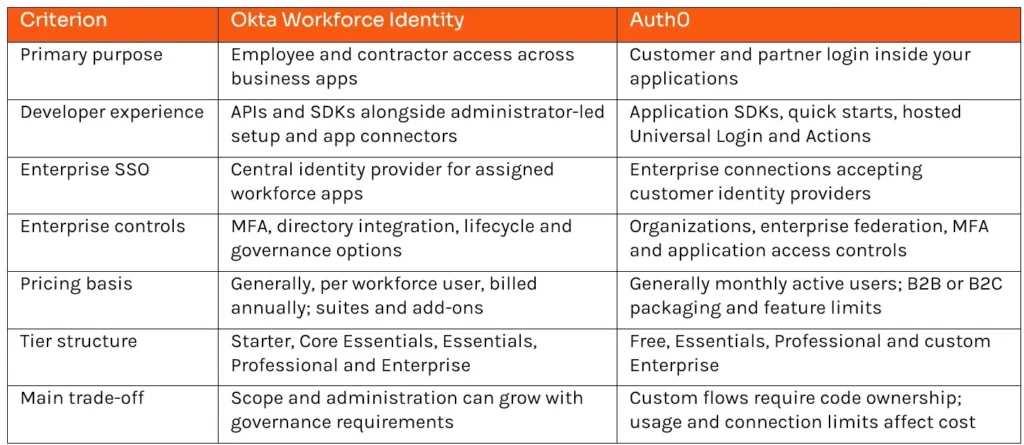
Sources: Okta plans and pricing, Auth0 plans and pricing, Auth0 Actions and Organizations documentation. No current price figures are assumed here.
Auth0 Actions let developers run custom logic at supported points in an authentication flow. That flexibility helps when login must connect to business rules, but someone must test and maintain the code when requirements change.
Okta advertises more than 8,000 pre-built integrations. This can reduce configuration work across a large application estate. Still, verify each connector’s capabilities: SSO support alone does not establish whether automated provisioning or logout is supported.
For an Okta vs Auth0 budget review, count employees separately from customers who actively sign in. A company with a small workforce can still operate a product with substantial customer traffic.
Ask vendors to price expected growth, enterprise connections, support, environments, and any required security add-ons. For Auth0, check B2B entitlements rather than assuming the B2C plan covers enterprise SSO. Include implementation and maintenance effort in the comparison.
Headcount is a useful clue, but identity ownership matters more. The following scenarios are decision examples, not vendor eligibility rules.
Auth0 is often the more practical starting point when developers own customer signup and login. A small team can use managed authentication while focusing on product functionality. It still needs someone responsible for token validation, tenant boundaries, and access rules.
Okta deserves closer consideration when IT needs consistent access policies across HR, finance, collaboration, and engineering tools. Even a small business can need this structure if contractors change frequently or access removal is difficult to track.
For an Auth0 vs Okta for enterprise evaluation, identify whether you are solving workforce governance, customer federation, or both. An enterprise may use Okta internally while its product uses Auth0 to accept customer logins from Okta or Microsoft Entra ID.
Before committing, test a realistic journey: a new user joins, receives the correct permissions, changes roles, and loses access when removed. Include audit evidence and support procedures. Successful login proves only part of the design.
Read Also: OIDC vs SAML: Which SSO Protocol Should You Choose?
Switching identity platforms affects application trust, user records, and recovery procedures. First establish whether migration is necessary. Adding federation between systems may meet the requirement without relocating every account.
Record applications, user identifiers, organizations, roles, MFA methods, enterprise connections, and custom login logic. Distinguish locally stored users from users authenticated by an external identity provider.
Auth0 documents bulk and automatic user migration. Its password hash and MFA export process involves a support request. Do not assume an ordinary profile export includes credentials or that the destination supports every exported format. Confirm compatibility before promising users a migration without resets.
Review issuer URLs, client IDs, redirect addresses, signing keys, and token audiences. Map old user identifiers to new records so account history remains attached to the right person. Rework provider-specific Actions, policies, and claims rather than expecting them to transfer automatically.
A staged rollout should cover:
Existing sessions and refresh tokens need explicit handling. Track login failures and support requests during cutover, and retire the previous configuration only after critical journeys work.
Start with the agent’s role. An agent embedded in a customer application needs permission to perform specific actions for a user. An internal agent estate also needs ownership, governance, and a way to revoke access.
Auth0’s Token Vault manages third-party OAuth tokens for delegated API access. Okta for AI Agents focuses on managing and governing agent identities. These are different requirements; confirm current availability and entitlements for your deployment.
SSO alone does not authorize an agent to read every file or execute every transaction. Define narrow permissions, record actions, and require human approval for sensitive operations. A background service acting independently also needs a workload identity design rather than a borrowed employee session.
The best Okta vs Auth0 choice follows your access model. Favor workforce administration for employee applications and developer-focused customer identity for product login. Where both are needed, plan how the systems will connect before buying overlapping capabilities.
Need help evaluating the integration? Explore NextGenSoft’s Software Integration Services and discuss your applications, identity providers, and migration requirements with the team.
1. Is Auth0 the same as Okta
Answer: No. Okta owns Auth0, but they remain distinct platforms. Identify the exact Okta offering before comparing features, contracts, or migration work.
2. Can Auth0 accept logins from an Okta customer?
Answer: Yes. Auth0 can federate with enterprise identity providers through supported connections. Confirm the protocol, customer configuration, and plan entitlement before implementation.
3. Which platform is cheaper?
Answer: There is no universal cheaper choice between Okta vs. Auth0. Workforce licensing and customer activity measure different populations. Compare quotes for the same required capabilities and growth assumptions.
4. Does enterprise SSO automatically create and remove accounts?
Answer: No. SSO authenticates users; provisioning manages accounts. SCIM can support account creation and removal where both systems and the selected plans support the required integration.
5. Can I switch without asking users to reset passwords?
Answer: Sometimes. The answer depends on credential export, supported hash formats, and whether users authenticate externally. Test a representative sample before committing to a reset-free migration.
6. How should I compare Auth0 vs Okta pricing, features, pros and cons?
Answer: Separate requirements into workforce access, customer login, and agent permissions. Then compare plan coverage, usage limits, and maintenance responsibilities. A pilot will reveal more than a feature checklist alone.
 Priyanshu Jethanandani
 is a Software Engineer at NextGenSoft, specializing in designing and developing scalable, high-performance software solutions. He is passionate about modern application development, cloud technologies, and AI-driven innovation, with a focus on building reliable and efficient digital products that solve real-world business challenges.
We’re ISO/IEC 27001:2022 certified, ensuring your projects are executed with globally recognized security standards.

INDIA
 sales@nextgensoft.io
 +91 81284 66678


