How to Choose a Custom Software Development Company (2026 Buyer’s Checklist)
Prince PatelOctober 12, 2026
Share this article


Let AI highlight what matters.
Evaluate Expertise: Check industry experience, technical skills, and relevant project case studies.
Review Engineering Practices: Assess code quality, automated testing, CI/CD, and documentation.
Prioritize Security and IP Ownership: Ensure strong security practices and clear source code ownership.
Check Communication and Team Stability: Look for transparent reporting, experienced developers, and consistent project management.
Verify Track Record: Review client references, past projects, and post-launch support services.
Compare Engagement Models: Choose between fixed scope, dedicated teams, and staff augmentation based on project needs.
Watch for Red Flags: Avoid vague pricing, unrealistic promises, unclear contracts, and missing support plans.
Start with a Pilot: Use a discovery phase or small paid project to evaluate the vendor before making a long-term commitment.
Selecting a software development company is among the few supplier choices that will influence your product, budget, and timeline for years to come. A poor selection usually does not fail in the first few days. But it fails silently with missed deadlines, fragile code, unexpected bills, and source code that no one else can understand.
In this guide, I offer you a repeatable process of evaluating suppliers with a checklist of 10 criteria, a red flags table, questions for a discovery call, and answers from those with low and high value. You can apply it in any comparison of your list of candidates, regardless of whether it’s the first release or replacement of your previous supplier.
Off-the-shelf tools are great until your workflow, data model, or customers stop fitting them. Teams usually bring in a custom software development company when they need one or more of the following:
If this description applies to you, then your problem isn’t really if to hire, but who. The following checklist can help you get started.
However, choosing a technology development partner entails far more than assessing their technical proficiency and pricing. Here is a 10-point list of what needs to be considered when selecting a vendor. The list includes such parameters as industry experience, product mindset, engineering culture, security, intellectual property management, communication, team sustainability, client recommendations, post-launch support, and transparency of costs.
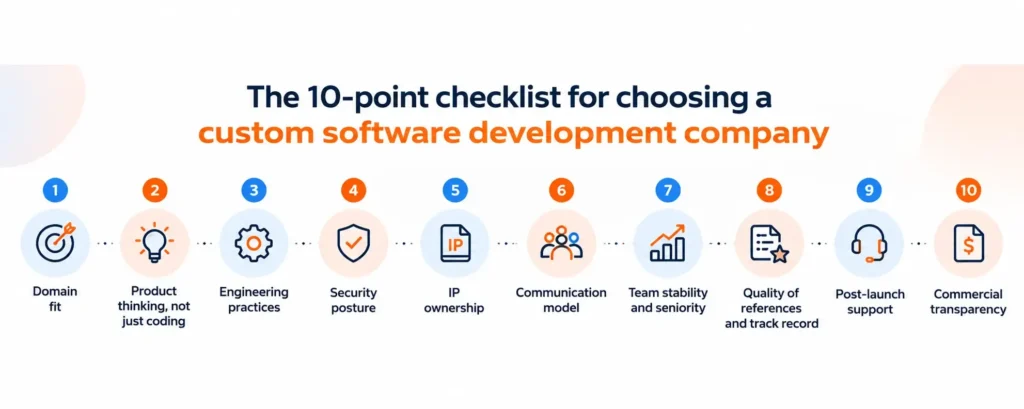
A good vendor does not need to have built your exact product, but they should understand your industry’s constraints: compliance, user behavior, data sensitivity, integration norms. Ask for relevant case studies and, better, a conversation with a client in a similar space. Domain fit shortens discovery and prevents expensive misunderstandings.
The strongest teams behave like a software product development company: they challenge assumptions, help you prioritize, and push for a smaller first release that tests the riskiest idea. If a vendor only wants to take your spec and start typing, you will own all the product risk.
Look for evidence, not adjectives. A credible IT software development company can explain how code gets from a developer’s laptop to production:
Ask to see a sample pipeline or a redacted pull request. Teams that work well are usually happy to show you.
Security needs to be included in the process and not just in the sales pitch. Ask how they manage secrets, access controls, dependency scanning, code reviews, and incident response. In case your application deals with regulated data, find out their experience with the respective regulations and how they isolate their environments and limit access to your data by their personnel.
Your agreement should clearly state that you own the code, the designs, and other deliverables that you paid for once they are delivered to you. Make sure that you can access the source code repository starting from the first sprint and not only at the end of the process.
Who do you speak to on a daily basis, how often will you see working software, and what happens in case of failure? Good practices involve having a delivery manager by name, demo sessions, a visible common backlog, and early notification about any problems. Time zone differences are secondary to consistent cycles and ownership.
Here you buy a team, not a brand. Find out who exactly will work on your project and what is their experience level, as well as what policy the vendor has regarding personnel changes. Seniority in architecture and reviews is better than sheer numbers of people.
Case studies are marketing. References are evidence. Speak to at least two past clients, ideally one whose project hit trouble. How a vendor behaves when things go wrong tells you more than a smooth success story. If you want a broader view of the market while you shortlist, our roundup of the top software development companies in the USA is a useful starting point.
Launch marks only the halfway point. What do you get post-go-live? Fixing warranty for bugs, monitoring, response times for incidents, security updates, and possibly even a retainer to keep making things better. A vendor who has no solid answer to this one is counting on you to hire someone else right away when the project is over.
An honest proposal spells out its assumptions, scope of work, change request process, and how it tracks progress. Overly vague numbers or trying to rush you into signing a contract quickly are red flags. We discuss budgeting in greater detail in our article about custom software development costs, so for now, just remember this: Beware of any quote that can’t justify itself.
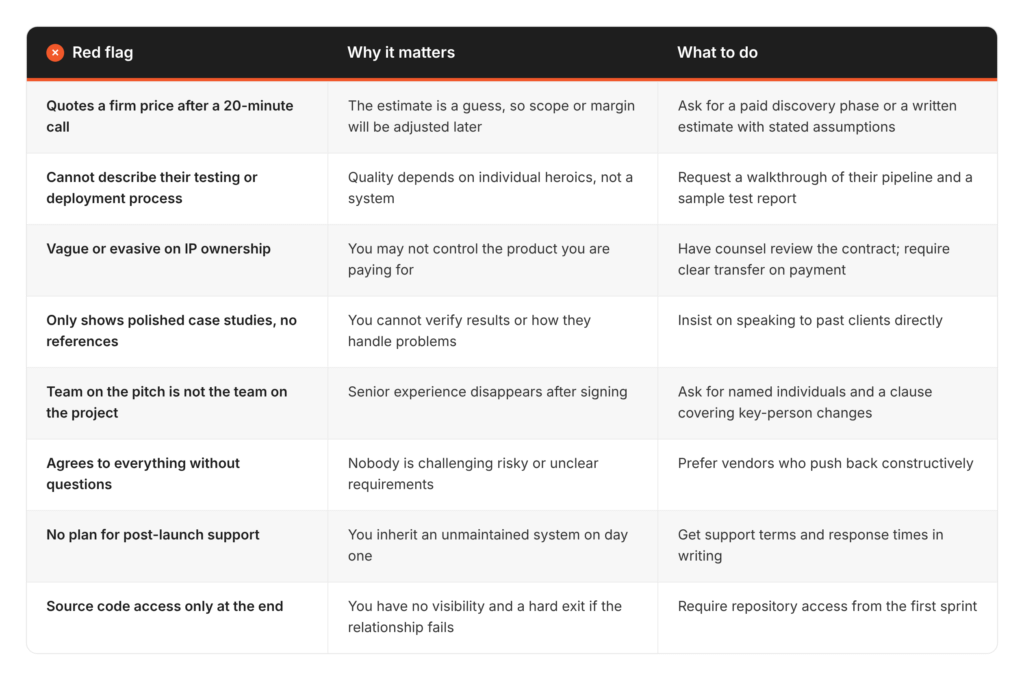
By the time you have talked to three or four vendors, patterns appear. Use this table to spot the problems early.
The discovery call is where you separate vendors who have a process from those who have a pitch. Ask these, then listen to how they answer.
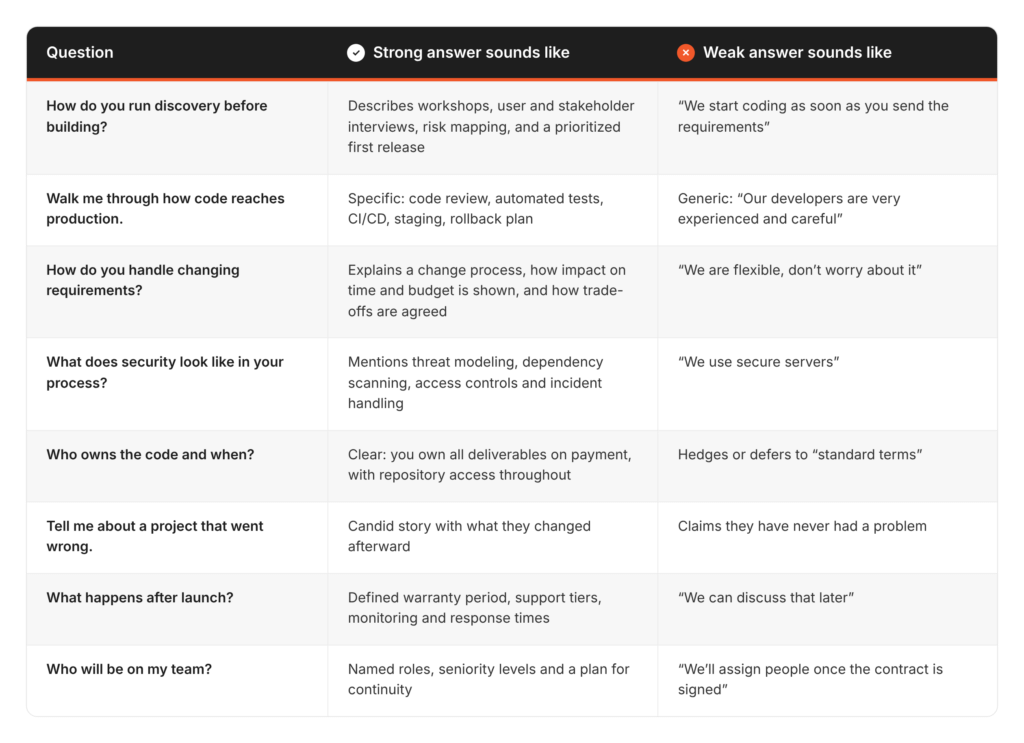
A useful rule of thumb: strong answers contain specifics, trade-offs, and examples. Weak answers contain reassurance. Vendors working on AI-heavy products should also be able to explain model evaluation, data handling, and monitoring; our guide on how to choose an AI agent development company goes deeper on those questions.
The commercial model you choose changes how risk is shared, so match it to how well you understand your own requirements. We are deliberately not quoting rates here, because they vary widely by scope, seniority, and region. Compare written proposals instead.
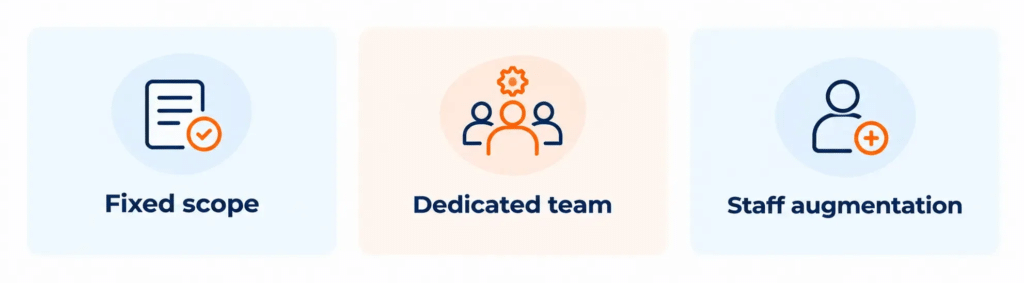
Many projects combine them: a short fixed-scope discovery phase, followed by a dedicated team for the build, and a lighter support arrangement after launch. Ask each vendor which model they recommend and why. A good answer ties the recommendation to your situation, not their staffing needs.
The best custom software development company for you is not the one with the biggest portfolio or the lowest estimate. It is the one that understands your domain, shows its engineering discipline, protects your data and IP, communicates predictably, and stays accountable after launch. Use the checklist, trust specifics over reassurance, and let a small paid first phase prove the relationship before you commit to the whole roadmap.
If you are comparing partners for a new software build or a rescue project, NextGenSoft can walk you through our approach to discovery, development, delivery, and ongoing support while answering the key questions outlined above. Book a discovery call with our team and bring your shortlist.
1. What criteria should I follow to select an appropriate custom software development company?
Answer: To find out about a company, check its experience in the target industry, knowledge of technologies, development methods, and approach to security. It will be helpful to check the company’s portfolio, understand the ownership of intellectual property rights, and proceed with a discovery call before making a decision.
2. How much does hiring a custom software development company cost?
Answer: The cost varies depending on the intricacy of the project, its specifications, software, technology, the experience of the developers, complexity of integrations, and requirements regarding security. Make sure to ask a company for an estimate of costs, as well as for a description of its assumptions and deliverables.
3. What questions should I pose to a software company before hiring it?
Answer: You should ask about the methods of handling the discovery process, testing, security, adjustments in requirements, deadlines, and implementation stages. In addition, find out who is the owner of the source code is, which developers will participate in the process, how and when the progress of work is going to be delivered, and what can be offered as post-launch assistance.
4. What should you look for as signs of an untrustworthy software development firm?
Answer: Some of the usual signals are making impossible promises, low-cost estimates, vague contracts, limited references from former clients, bad communication, lack of authentication on code ownership, and no evidence of testing or post-launch support. A reputable collaborator should be able to describe its approach through real-life examples.
5. What is the most suitable business model for custom software?
Answer: The answer strongly depends on the exact requirements of the project. A fixed-scope business model is applicable to projects with concrete descriptions, while dedicated teams can help with products going through a constant development process, and staff augmentation is a good option to involve needed experts.
6. What is the significance of post-launch support in the selection of a software development provider?
Answer: Post-launch assistance is essential for maintaining the functionality and safety of applications. It involves processes such as fixing bugs, monitoring performance, introducing security updates, responding to issues, and enhancing features. It is essential to establish the support conditions and the expenses before signing the contract.
 Prince Patel
Prince Patel is a skilled software developer with hands-on experience in building reliable and efficient applications. He focuses on creating practical solutions that support business goals and drive digital progress. With a strong grasp of technology and a clear, problem-solving mindset, Prince consistently delivers clean, scalable code tailored to real-world needs.
We’re ISO/IEC 27001:2022 certified, ensuring your projects are executed with globally recognized security standards.

INDIA
 sales@nextgensoft.io
 +91 81284 66678


