AI Agent Development Cost in 2026: What You’ll Actually Pay and Why
Pranav LakhaniNovember 6, 2026
Share this article


Let AI highlight what matters.
The first question in any budget discussion surrounding AI agents is ‘How much does it cost to create an AI agent? The truth is a range and it’s a big one. It’s possible to obtain an easy-to-setup support bot for less than $30,000. An agent which engages your CRM, ERP and compliance system might run you over $250,000. The disparity lies in scope, data, integrations and in what degree of autonomy you give.
This guide decodes all about the AI agent development cost including real prices,, the running costs that most teams overlook, and the moves that will help keep your budget in check. Read on.
The majority of projects are at three pricing levels:
The annual running costs after the launch are around 15%-25% of the build cost. That covers model usage, hosting, monitoring and updates. The actual cost of the AI agent is not only the invoice, it’s the build plus first year in service.
| Agent type | What it does | Typical build cost | Timeline |
|---|---|---|---|
| Simple | Answers FAQs, drafts replies, one data source | $15K–$40K | 4–8 weeks |
| Mid-level | Takes actions in 3–5 tools, uses retrieval over your documents | $40K–$120K | 2–4 months |
| Advanced | Plans multi-step tasks, handles exceptions, human approval flows | $120K–$300K+ | 4–9 months |
These are only indications and are based on a team that has been on this journey before. For first-time teams, rework can cost up to 30% to 50% more.
A simple agent calls 1 model, working on a script. A mid-level agent makes inferences about your own records and initiates actions, such as creating a ticket or updating a record. An advanced agent determines what to perform, learns from failures and can collaborate with other agents. If you’re on the path to going there, our multi-agent systems for enterprises will inform you when the extra expense makes sense.
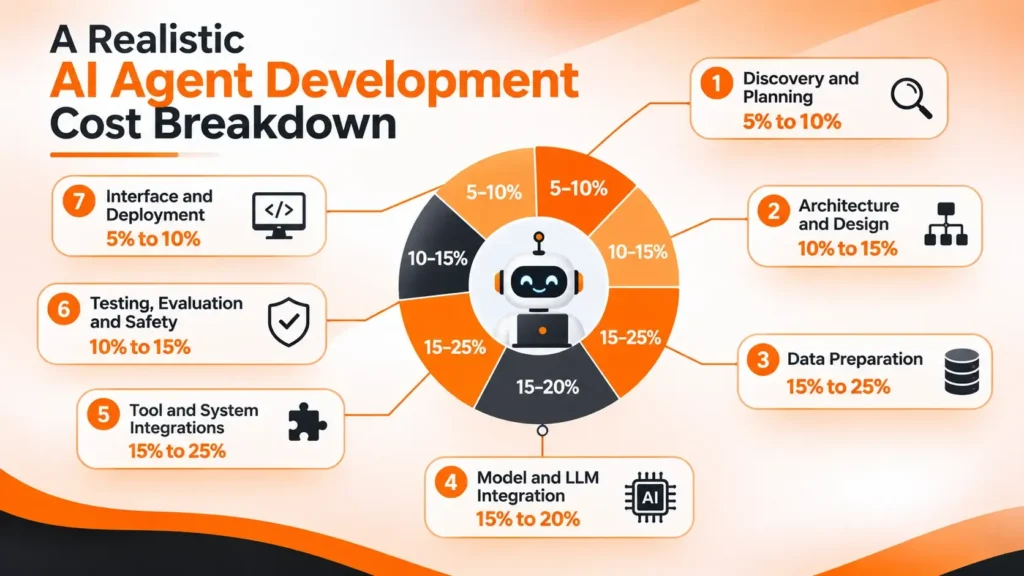
A price tag has no meaning until we understand where it has been spent. Below we highlight an example of a project divided between two levels: Mid Complexity – approximately $80,000.
This phase outlines use case(s), success criteria, data sources and risks. The no-cost quick-cut in the entire project. Discovery saves months of rebuilds 2-3 times a week.
You can control the agent’s reasoning, memory, and tool looking up and handing off to humans. Every subsequent cost depends on good decisions at this one. We’ve summarized the patterns that you should be familiar with before you sign off an AI agent design.
This is the amount of money people underestimate. It includes Document cleansing, construction of an index for retrieval and field mapping between systems can consume up to 20% of the budget. If you do not have a well organized knowledge base, the agent will not be either.
In this step the team chooses models, creates prompts, configures retrieval and links all together via APIs. If you will be using multiple models or running an LLM on your own server, work with a LLM integration specialist.
Costs for each connection to a CRM, helpdesk system, payment system or internal database is about $3000 to $15000, depending on the quality of the API. At the top of that range are legacy systems that don’t have a good API.
Agents can fail for a variety of reasons. Test sets, red team checks, guardrails and approval rules are required. The general guideline is to test for any number of real world situations ranging from 200 to 500 cases before launch.
This includes the chat window, Slack bot or voice channel, cloud setup, access control and logging.
Most of the differences between quotes are due to 6 factors.
The lowest bid is not necessarily the lowest 3-year AI agent development cost. Some cheap builds don’t pay attention to evaluation and monitoring, and that’s where issues resurface as support requests.
Building is a one-off cost. Running is permanent. There are four components to the monthly bill.
Let’s look at an example of a calculation. Your agent gets 10,000 conversations per month, with 6,000 tokens per conversation. That’s 60 million tokens. If the blended rate is $3 to $10 per million tokens, you will have to pay $180 to $600 each month. May seem like a minor detail, but planning, retraying and calling tools are typically 3-10x the number of tokens that a standard chatbot uses. It is not hard for a busy agent to reach thousands of dollars.
That’s why it’s important to be seen. Early adopters of LLM observability can gain insights into prompting tokens that waste, and answer tokens that get subpar, before costs add up.
When it comes to platforms with no-code agents, builders can cost a monthly subscription, typically ranging from a couple hundred dollars to a few thousand dollars. The drawback is that the control of logic, data handling and integrations is limited.
A custom build requires a higher initial price tag, but you own the logic, select the models and fit the agent to your workflow. Custom AI agent development cost is well worth it when the agent is essential to your competitive strategy, if you’re working with sensitive information, or if standard solutions cannot access your systems.
Best for well-defined scopes. You have a clear idea of the total cost once, but if there are any changes, they will get a new quote.
The number of hours worked defines the overall payment. It works well for developing projects, but requires careful tracking of the budget.
You pay for hours worked. It suits evolving projects, though it needs close budget tracking.
A monthly payment for a full team, typically $20,000 to $60,000 based on team size and geographic location. It is suitable for long programs that have continuous delivery.
If you’re soliciting quotes, ensure you are getting the same scope. When quoting the price of a custom AI agent development, the pricing sheet should indicate what features are covered for testing, documentation and post-launch support?
Expenditure is increasing and so are the questions asked. By 2028, Gartner estimates that less than 1 percent of enterprise software applications will have agentic AI, increasing to 33% by that time. In the same study, it forecasts that it will have to make 15% or more decisions on a daily basis independently. But Gartner also predicts that more than 40% of agentic AI initiatives will be discontinued by the end of 2027 due to increasing costs, unclear value and ineffective risk management.
So, the numbers of AI agent development cost 2026 provide clear insights for anyone monitoring the evolution of AI agent costs. This is because money is not the number one reason for project failures. Vague goals and missing controls are. When buyers define one measurable outcome, for instance 30% reduction in the average handling time, they are more likely to remain funded.
These are not commonly seen in the first quote:
Let’s start with a support team that gets 20,000 tickets per month. An agent that solves 40% of them automatically takes 8,000 tickets off their hands. That equates to $48,000 in an average monthly saving in handling costs, assuming $6 per ticket average handling cost. Despite a $90,000 build cost and $3,000 monthly operating expenses, the payback comes around the corner in about two or three months after the launch.
This is a math to customize according to your numbers; don’t approve any budget until you have created your own version of this. Add: Build cost, Running cost, Percentage of work automated and value of each task. That discipline helps you transform an AI agent development cost breakdown into a business case that your finance team will sign off on.
Plan on three numbers: the build price, the monthly running cost and the value each automated task returns. Once those three are removed, it becomes easy to make the decision. Establish a small scope of a first use case, plan for evaluation and monitoring, and broaden the scope once results validate the case.
For a scoped estimate for your use case, you need to talk with us at NextGenSoft, a seasoned AI agent development company where you will get all the assistance in taking your AI agents from pilot to production, with clear numbers along the way.
1. How much does it cost to build an AI agent from scratch?
Answer: The price of a simple agent is around $15,000. Mid-level agents, who have multiple integrations, make $40,000 to $120,000. The cost of a complex enterprise agent of this nature can cost more than $300,000, and the running costs can be as much as 15% to 25% annually.
2. How long does it take to build an AI agent?
Answer: Simple agents take 4-8 weeks. The processing time is 2-4 months for mid level builds and 4-9 months for advanced systems, including testing.
3. What is the biggest cost driver?
Answer: The integration and data preparation costs are typically 30% to 50% of the cost. Model fees are lower during construction, but increase over usage.
4. Can small businesses afford AI agents?
Answer: Yes. A few hundred dollars per month is the beginning price for narrow-scope agents deployed on managed platforms, and a custom pilot with a more focused scope begins at less than $25,000.
 Pranav Lakhani
Pranav brings over 20 years of expertise in software development and design, specializing in delivering enterprise-scale products. His unique ability to manage the entire product lifecycle ensures innovation and technical excellence across every project.
We’re ISO/IEC 27001:2022 certified, ensuring your projects are executed with globally recognized security standards.

INDIA
 sales@nextgensoft.io
 +91 81284 66678


