Multi Agent Systems for Enterprises: Patterns, Risks and When to Use Them
Yash BaravaliyaOctober 23, 2026
Share this article


Let AI highlight what matters.
Multi-Agent Systems: Multiple AI agents work together, each handling a specific task.
AI Agent Orchestration: Coordinates agents, assigns tasks, and manages workflows.
4 Architecture Patterns: Supervisor, Peer-to-Peer, Pipeline, and Blackboard.
Key Challenges: Communication loops, conflicting actions, higher costs, and shared errors.
When to Use: For complex tasks requiring independent expertise and collaboration.
Performance Evaluation: Measure accuracy, completion time, cost, and reliability.
Frameworks: LangGraph, CrewAI, and AutoGen support different orchestration needs.
A customer approaches a service representative requesting to cancel their order, which has already been dispatched to the warehouse. The representative is able to identify the order; however, fulfilling the request involves the status of the shipment, eligibility for a refund, and approval from the customer.
But the question is whether one agent should manage the entire process or whether they can delegate the customer request to several employees.
The answer completely depends on where the decisions will actually be made. Multiple agents can divide the responsibilities and deal with different questions independently. There is a possibility of additional effort, more time, and eventually unsatisfied deliverables.
So, here we are to help you with detailed insights into how multi-agent systems function in the realm of enterprise software and make decision-making easy and smooth.
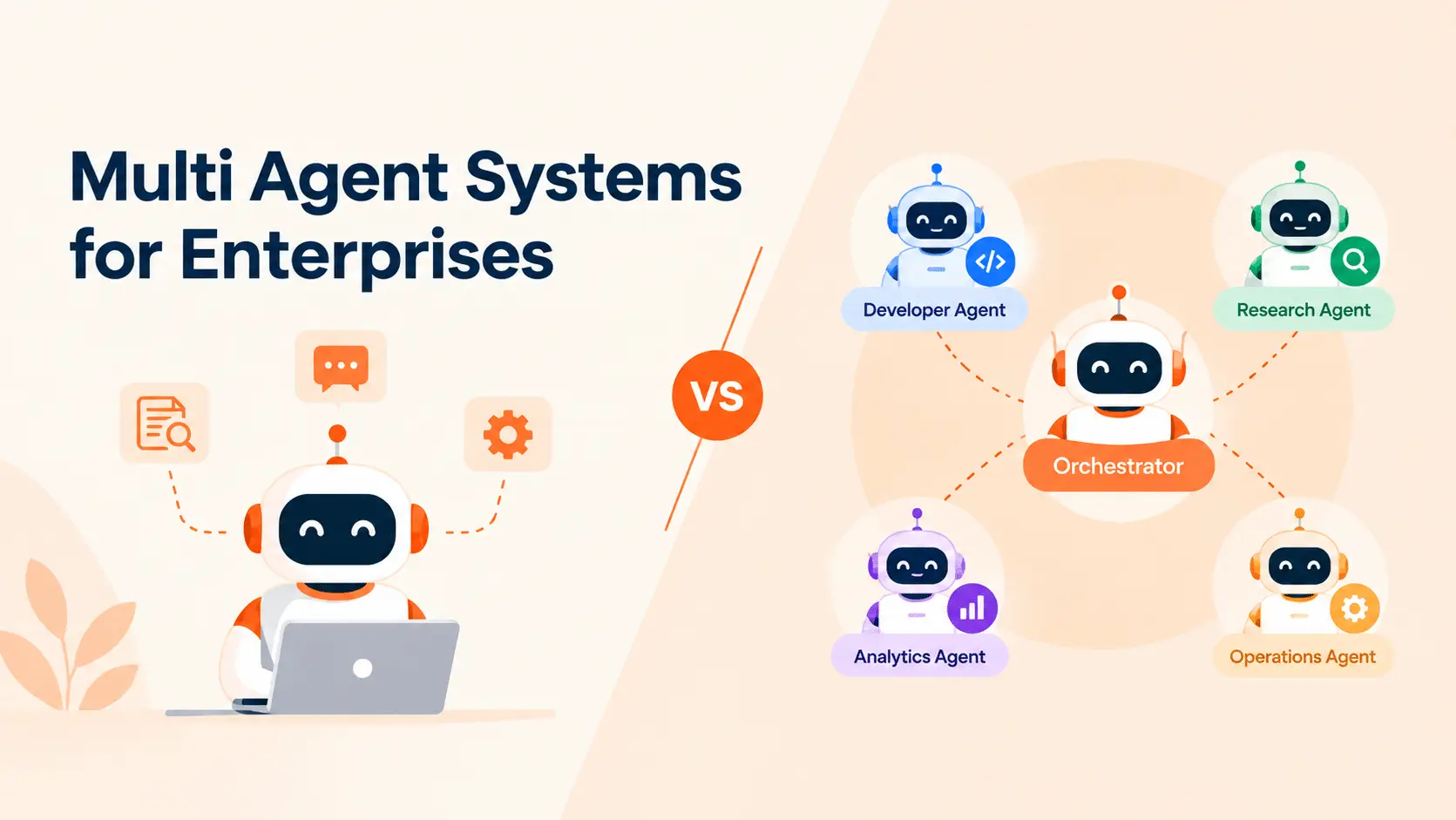
When it comes to multi-agent systems, they consist of two or more autonomous AI agents working together towards a common goal in enterprise LLM applications. Each agent has an assigned task and has the freedom to choose how to fulfill it, considering the data and capabilities at its disposal.
The defining feature is separate decision-making responsibility. One assistant that searches documents, checks inventory, and updates a CRM is still one agent if it controls all those decisions. Calling three APIs does not create three agents.
AI agent orchestration is the layer responsible for coordinating agents to complete a certain task, provide them with the necessary information, and determine when to stop the task.
A team of agents describes the participants. Multi-agent orchestration describes how their work is organised. For a deeper explanation of routing and handoffs, read our enterprise orchestration guide.
Better candidates have independent functions. A procurement review could analyze vendor qualifications, assess conditions of contracts, and see delivery records independently. There is a need for separate evidence for every expert, but it can be combined to enable final approval.
Some proof exists that this manner of operation can be beneficial. For example, Anthropic conducted an internal evaluation where its lead agent, Claude Opus 4, with some sub-agents, Claude Sonnet 4, surpassed a single Claude Opus 4 agent by up to 90.2%. Although this number is related to a specific case, it does not imply the overall productivity gain for any company.
The same report described roughly 15 times the token use of ordinary chats for its multi-agent workflows. Its single-agent workflows used roughly four times as many. These are observations from Anthropic’s environment, not universal cost ratios.
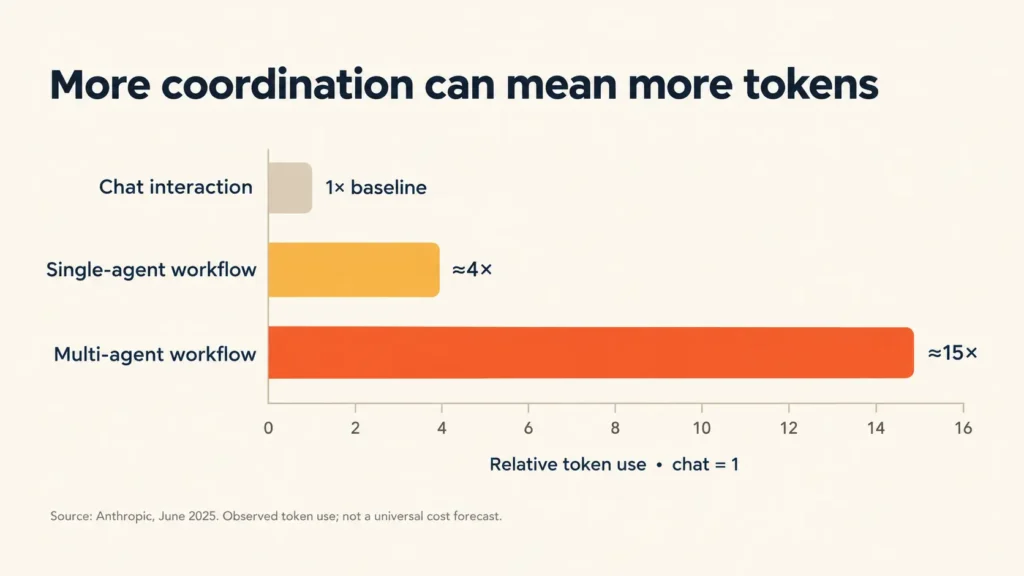
The business question is therefore practical: does the additional work improve accepted outcomes enough to cover coordination, infrastructure, and human review?
Topology is often used for describing the ways of job and information flow. Several models discussed below should be viewed as a point of departure, as in practice all these models can be combined with each other.
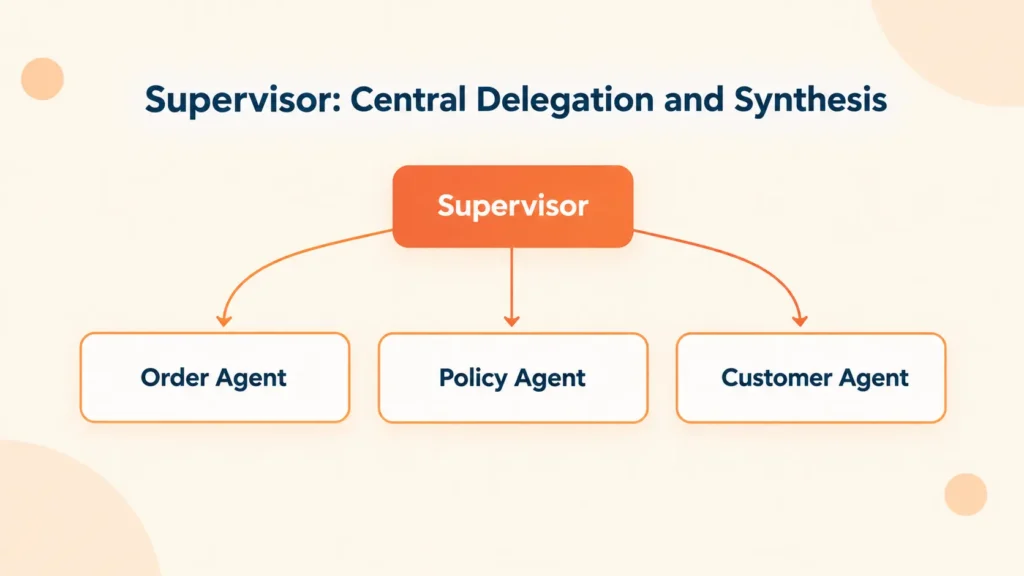
In this model, the supervisor receives the order and performs the necessary tasks. For instance, when it comes to order cancellation, the supervisor might contact different experts to get their opinion on this situation.
This pattern suits mixed requests that need central ownership. Its weakness is the supervisor: poor delegation can send two agents after the same evidence, and a failed coordinator can interrupt the entire run. Use explicit task scopes and recoverable workflow state.
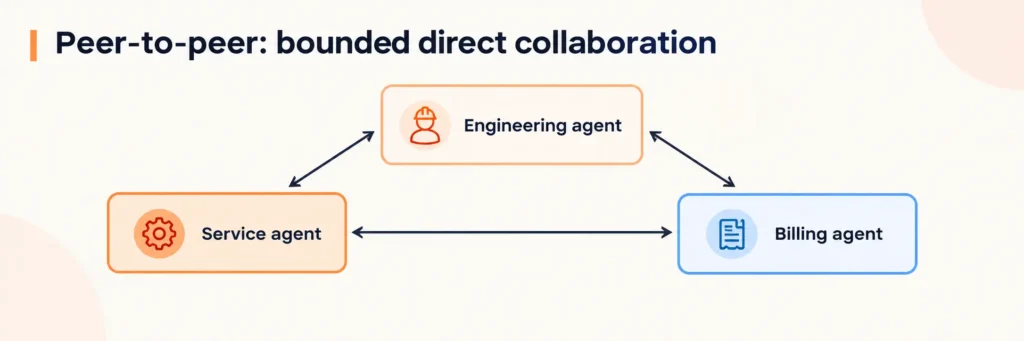
Agents communicate directly or hand responsibility to an appropriate peer. A service specialist might consult an engineering specialist and then a billing specialist as new evidence appears.
This fits investigations whose next step cannot be fixed in advance. Without routing boundaries, however, agents can keep passing the request around. Define permitted handoffs, an escalation owner, and a maximum number of exchanges.
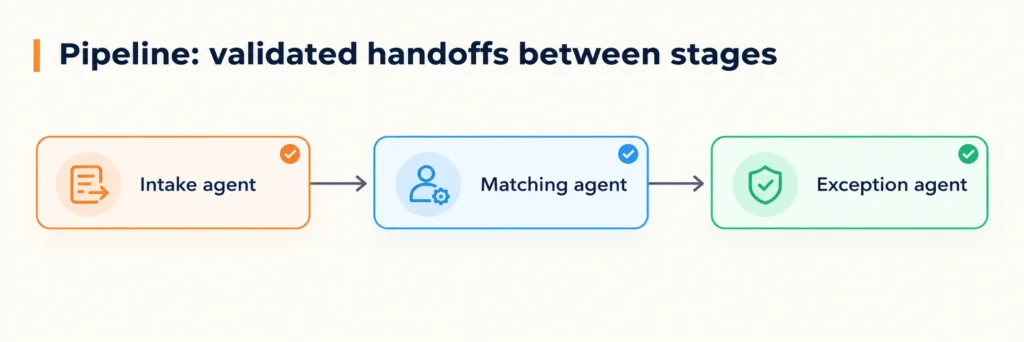
Work moves through defined stages. An intake agent interprets a document, a matching agent checks it against a purchase order, and an exception agent investigates discrepancies.
Such an approach fits tasks with repetitive actions and straightforward transfer procedures; each result must be checked at previous steps, as incorrect conclusions may spoil all subsequent results. When actions involve performing calculations or verification alone, there is no need to implement them via agents.
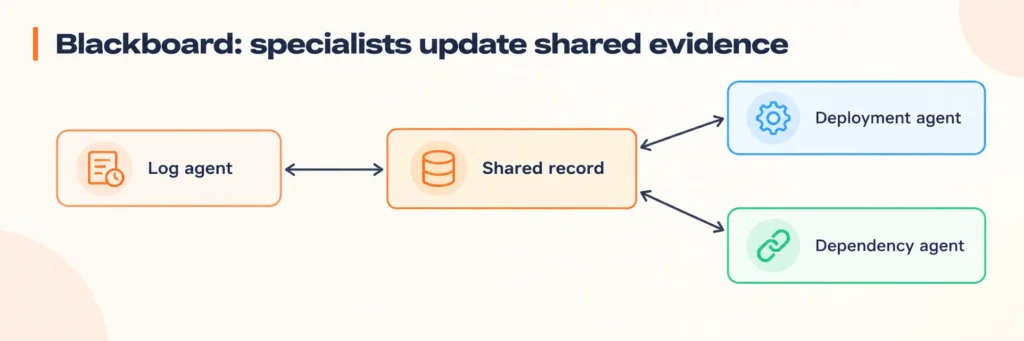
Agents get data from a common workspace known as a blackboard. In the context of incident response, experts can make notes in one common record and provide updates on various aspects of the incident.
This is the case when the issues being solved involve many recordings made simultaneously and out of order. There should be timestamps and information on different versions of each record; the management system has to manage operations of agents too.
In the scenario being described, a reviewer demands further proof, the researcher presents the same evidence and again inquiries from the reviewer arise again; thus the whole situation repeats again without any kind of advancement being made.
Set limits for communications made, number of retries, time taken, and consumption of tokens. Identify duplicate tasks and elevate unaddressed cases. AutoGen documentation can help you with termination controls on the number of messages, use of tokens, and timeouts.
One agent cancels an order whereas another one confirms that it has been dispatched. Though both may have acted in accordance with their local directives, the outcome is inaccurate.
Give one element responsibility for impactful actions. Adopt transaction methods, version checks of records, and IDs of messages, which would help prevent repeatable actions.
A supervisor launches unnecessary specialists. Each receives a long history, makes repeated tool calls, and produces another long response. The final answer may look reasonable while the economics fail.
Budget the whole run, including subagents. Pass relevant evidence instead of full transcripts, limit delegation depth, and measure cost per accepted outcome. Counting successful model responses alone hides expensive failures.
Different agents may repeat the same assertion over and over again until it seems to be backed up by the evidence for the clients. A reviewer who only looks at the first response will not be able to verify the proposition independently.
Make sure that evidence is available at the point of review and separate observations from conclusions drawn from them. Let the reviewers see the source material and pass problematic contradictions further. Just because different agents agree on something doesn’t mean there is independent evidence proving the point.
There are three questions to ponder when dealing with multi-agent systems:
If the answer to all questions is “yes”, then you should test the effectiveness of multi-agent collaborations on a small scale by comparing its performance with that of a single-agent implementation. Limit the use of tools, although the use of the same agent system is permitted.
For instance, one may only need to ask one specific question with respect to the leave policy to successfully satisfy the employee. On the other hand, conducting a review of a supplier in independent document collections may require a few specialists to work independently.
Start with representative cases, including exceptions. An illustrative evaluation set of 100 requests might include missing records, duplicate requests, contradictory documents, and tool failures. This is a proposed starting point, not a statistically sufficient sample for every deployment.
Compare the same cases under equivalent acceptance criteria:
Add one specialist at a time. Keep it only if the measured gain justifies the added operating burden. A team can answer faster while still requiring more correction.
Good agentic AI architecture makes these trade-offs visible through traceable handoffs, durable state, and clear ownership of external actions. It should be possible to identify which evidence supported a decision and recover without repeating completed operations.
Teams searching for “AI agent orchestration frameworks vendors” often encounter tools, open-source projects, and managed services in the same list. They solve different parts of the delivery problem. Begin with your workflow requirements rather than a product shortlist.
Evaluate persistence, tracing, access controls, deployment options, and human intervention. Run the same failure cases through candidate implementations. Our LangGraph, CrewAI, and AutoGen comparison explains the architectural choices to investigate.
Multi-agent systems make sense when separate responsibilities improve outcomes enough to justify handoffs, shared state, and additional execution cost. Begin with one capable agent, establish a baseline, and introduce specialists where the evidence supports them.
NextGenSoft’s AI Agent Architecture services focus on identifying repeated manual interventions and designing agents around existing systems. Consult now!
1. How is an agent different from a tool?
Answer: Tools perform certain operations at request, for example, retrieving orders, while agents carry out their tasks, making appropriate decisions and using tools if necessary.
2. Do all agents need different language models?
Answer: No, agents can work with the same model as long as they follow different guidelines, context, and permissions. In certain cases, different models are needed because of task capability, latency, or cost requirements.
3. Which topology should an enterprise use first?
Answer: The starting point is the supervisor, where tasks are given for completion to one performer who brings together all results. The pipeline is simpler to analyze, as all steps are usual.
4. Can several agents reduce response time?
They can perform tasks independently when they work at the same time. The coordination and review process contributes to the slowdown of a workflow featuring dependent stages, as it makes it longer. Use end-to-end latency instead of agent speed.
5. Can multiple agents prevent hallucinations?
Unfortunately, no. Agents are able to duplicate the mistakes of one another. In order to verify agents’ conclusions, it is important to rely on trustworthy evidence, perform independent verification, and take necessary escalation actions in those cases when conclusions cannot be grounded.
6. What should a production handoff contain?
The production handoff must have an identifier, scope, relevant evidence, structured results, and an outcome, in addition to noting uncertainties and still-uncertain subjects. Also, the receiving party has to verify necessary data before taking action.
 Yash Baravaliya
 specializes in exploring and building intelligent AI-driven systems, focusing on practical innovation and modern framework development. With a strong drive for experimentation and problem-solving, he turns complex AI concepts into clear, usable solutions.
We’re ISO/IEC 27001:2022 certified, ensuring your projects are executed with globally recognized security standards.

INDIA
 sales@nextgensoft.io
 +91 81284 66678


