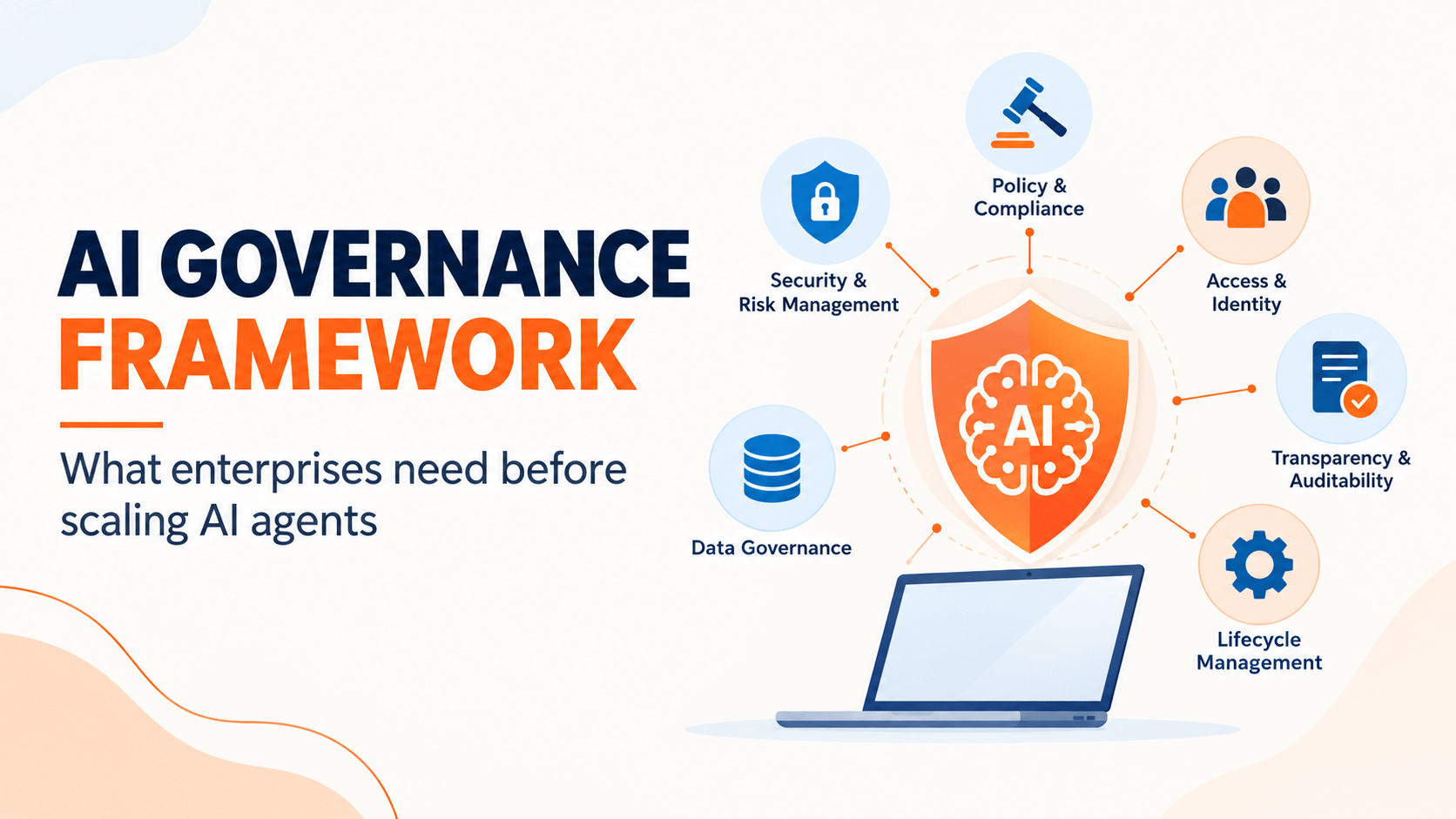
AI Governance Framework: What Enterprises Need Before Scaling AI Agents
Niraj SalotOctober 9, 2026
Share this article


Let AI highlight what matters.
An AI governance framework helps businesses manage AI agents safely, responsibly, and effectively in production.
It defines ownership, access permissions, human approvals, monitoring, and accountability.
Common risks include excessive permissions, unclear ownership, poor audit logs, and insufficient human oversight.
The article outlines six steps to implement AI governance: inventory AI systems, classify risks, enforce access controls, define approvals, test and record evidence, and monitor performance.
Integrating AI governance with DevSecOps strengthens security testing, identity management, and incident response.
A 30-day implementation plan helps businesses establish baseline controls, test AI behavior, and prepare for a controlled rollout.
Success should be measured through business outcomes, unauthorized actions, correction rates, approval delays, and cost per task.
An AI agent can do tasks correctly, but it still can be a source of trouble for your company. It may pull up a private document, process a refund without permission, or change a customer’s record with old information.
The production environment combines customers, data, interconnected systems, and decisions that can have financial implications for the business. This is where the AI governance framework comes into play. It helps you have an expert in charge to make the right decisions in terms of agent actions and ensures that everything related to it is under control.
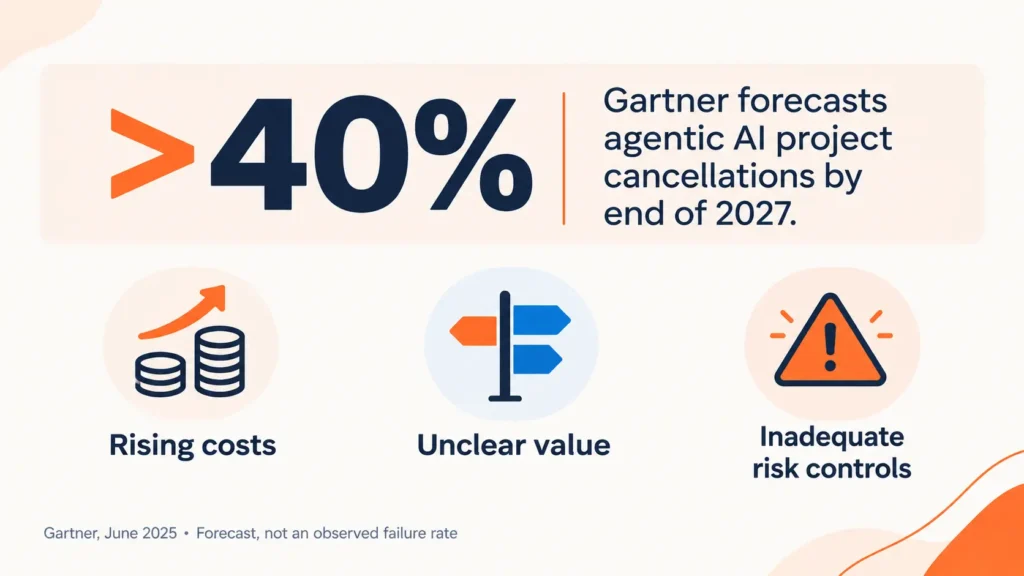
In June 2025, Gartner predicted that approximately 40% of agentic AI projects would be canceled by the end of 2027 as a result of the high implementation costs, lack of business value, and insufficient risk control measures. This is a prediction rather than the actual cancellation rate, but it emphasizes the reasons why operating controls should accompany technological decisions.
For a mid-size enterprise, the starting point can be manageable that includes assigning owners, restricting permissions, tests realistic failures, and creating a reliable approval and monitoring process.
What is AI governance? It is the system of responsibilities, rules, and controls used to oversee how an organization develops, deploys, and operates AI.
At the implementation level, this means answering practical questions:
Take a customer support representative, for instance. They might need access to the entire order history and can compose responses accordingly. However, changing one’s delivery address, processing refunds, or deleting an account are three different permissions. Each must have its own permission policy.
A policy saying, “The representative must act responsibly,” cannot enforce these separations. The system, identity authority, and APIs have to do it instead.
What does responsible AI mean? This means that AI must be developed and implemented in a way that takes into account safety, justice, privacy, dependability, and accountability.
Responsible AI frameworks translate these hopes and expectations into development processes and operational procedures. For instance, privacy turns into a restriction on available data, while accountability means that there will be an owner and a traceable approval system.
Read Also: AI Consulting in 2026: Why Boutique Specialists Are Winning Over Big Firms
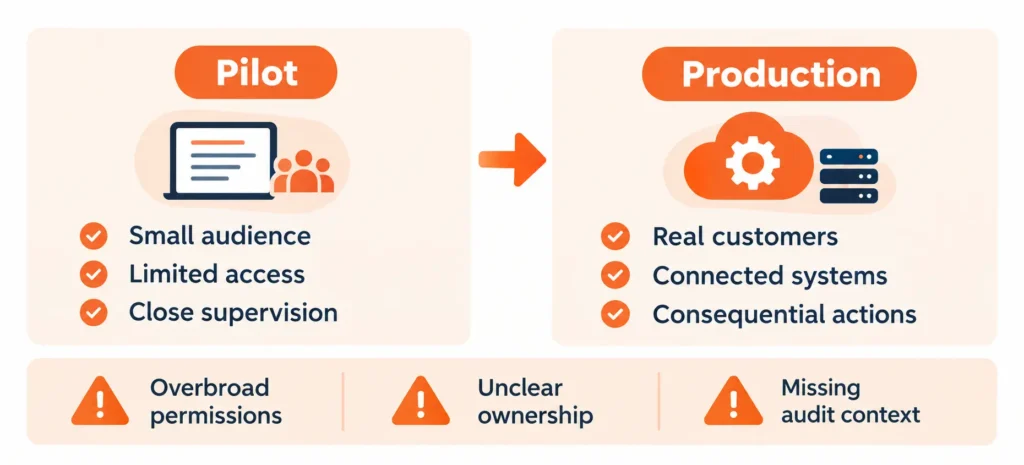
When implementing plans, a pilot is normally faced with a restricted number of stakeholders, a restricted set of authorities, and meticulous supervision. Subsequently, when moving from an AI pilot to the production phase, the situation changes significantly.
An agent may deal with a new and unprecedented request, complete tasks after working hours, and communicate with many systems before its actions get approved.
There are five governance gaps that require special attention.
OWASP names detrimental powers, permissions, and independence as reasons for excessive agency. Such shortcomings may allow unpredictable outputs of the model to trigger punishing actions.
Hence, the issue goes beyond whether an agent has finished its task. Companies also have to verify whether the agent is aware of the limits of the task it has to do.
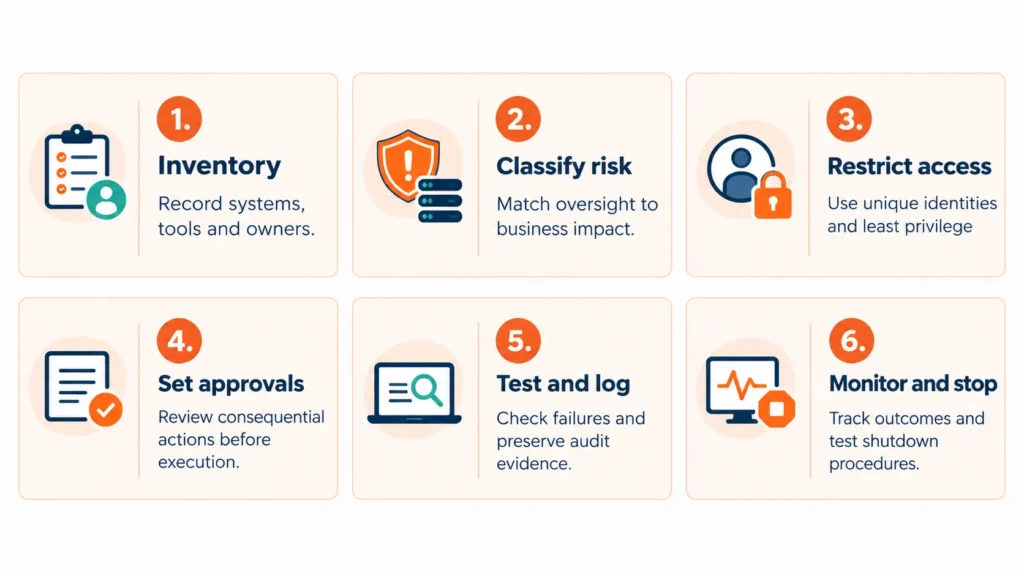
NIST’s AI Risk Management Framework organizes risk management around four functions: Govern, Map, Measure, and Manage. It is voluntary and provides a useful reference for structuring enterprise oversight.
The following six steps are a practical implementation approach, rather than an official NIST checklist.
Start with a shared register of deployed and proposed AI systems. A spreadsheet or existing service catalog can be sufficient initially.
For each system, record:
Use a simple internal classification to decide how much oversight each system needs.
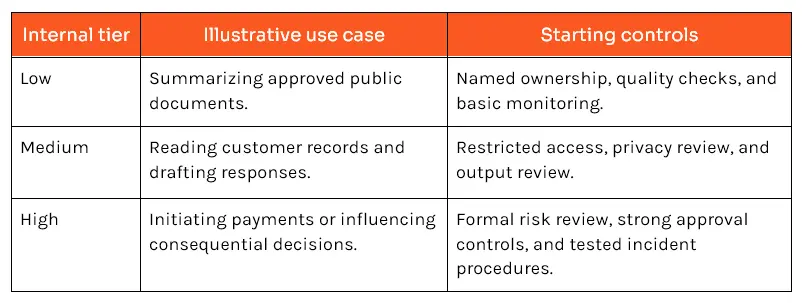
Give each production agent a distinct identity. Avoid shared credentials that obscure which system acted.
Then restrict access to the minimum required for its role:
Create an action matrix that distinguishes what the agent can do independently from what requires review.
For an illustrative support workflow:
Approval must happen before the consequential action executes.
Model risk review should cover the complete system: model, prompts, retrieved information, tools, permissions, and workflow.
Test normal requests alongside difficult scenarios:
A successful release is the beginning of oversight.
Monitor outcomes that matter to the business, including:
Responsible AI governance also requires clear intervention procedures. Teams should be able to disable tools, revoke credentials, pause workflows, and restore an approved configuration.
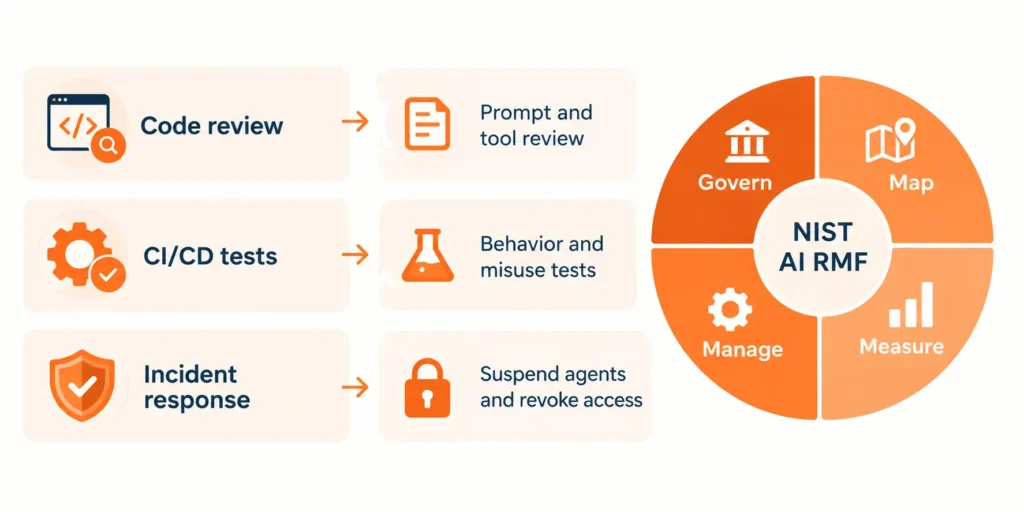
Enterprises can build on security practices they already use. Identity management, change review, automated testing, secrets management, and incident response all provide foundations for AI oversight.
NIST’s SP 800-218A extends secure development guidance for generative AI and dual-use foundation models. It is intended to be used alongside the Secure Software Development Framework, supporting integration with established development practices.
The practical connection looks like this:
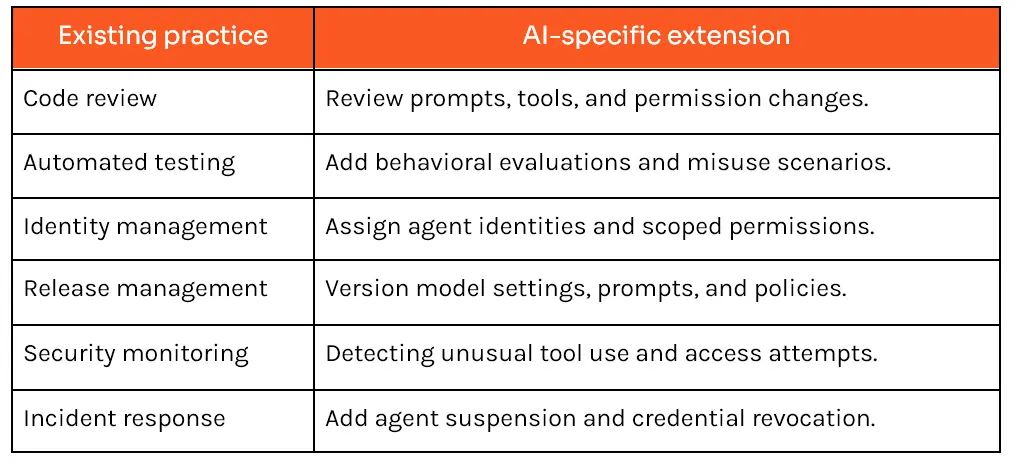
AI governance principles become more useful when they appear in everyday engineering decisions.
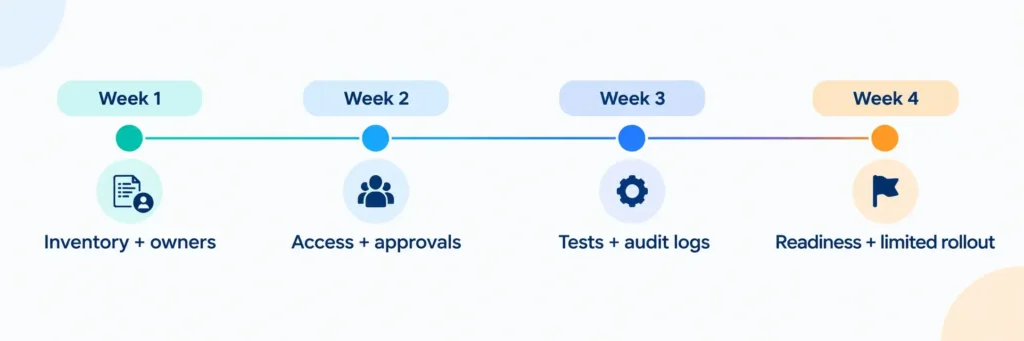
A focused 30-day effort can establish baseline controls for one bounded workflow. It should not be treated as a guarantee of production readiness for every use case.
Week 1: Establish visibility
Inventory systems, select the initial workflow, and assign business and technical owners.Week 2: Set boundaries
Classify risk, narrow permissions, and document approval requirements.Week 3: Test behavior
Run realistic evaluations, inspect audit records, and test failure handling.Week 4: Review readiness
Resolve blockers, approve residual risks, and begin a limited rollout with monitoring.
Your AI governance strategy should connect this work to a measurable business objective, such as reducing support handling time without increasing correction rates.
The most useful AI governance best practices are those teams can demonstrate. Before expanding access, ask for evidence that restrictions work, reviewers understand their role, and operators can stop the system.
When we talk about scaling agents, we mean making software more capable of impacting customers, information, and business activities. Organizations must have certain limits before granting that kind of power.
To begin with, implementing a successful framework requires ownership as well as risk classification. That means permissions, approvals, testing, audit processes, and response to incidents should all be aligned and integrated with the current delivery process.
As a result, the organization would then have a more solid foundation for determining which workflows can proceed without human input and which still need human intervention.
Our AI services are composed of readiness assessment, establishing processes, and providing aid in implementation. Companies that want to scale should think about using our AI agent-building services to talk about workflow development and production process management.
1. Who should own an AI governance framework?
Answer: The business owner is responsible for the relevant use case along with the engineering, security, privacy, and any appropriate risk teams. The ownership entails defining the limits and deciding when the operation must stop.
2. Does an AI governance framework require a dedicated platform?
Answer: In general, a separate platform is not required to begin with. Various service catalogs, identity tools, testing pipelines, or monitoring systems can be used when the actual number of deployed instances is very small.
3. How often should an AI governance framework require reviews?
Answer: The reviews should be planned contingent on risks, and additional reviews should be executed when models, rights, tools, data sources, or business needs change drastically. There should also be certain triggers for reassessment if significant incidents take place.
4. Can an AI governance framework support third-party agents?
Answer: Yes. It is necessary to learn the vendors’ practices regarding data, access control, logs, updates, and incident management. The organization must appoint someone internally accountable for the system usage.
5. How does an AI governance framework measure success?
Answer: Measure business outcomes alongside control performance. Useful indicators include task completion, correction rates, unauthorized actions, approval delays, and cost per successful task.
 Niraj Salot
Niraj Salot, with 20+ years of expertise in software architecture, specializes in delivering robust enterprise applications. His cloud optimization skills help clients cut costs while maximizing performance. As a key leader at NextGenSoft, he drives scalable, efficient, and high-performing solutions.
We’re ISO/IEC 27001:2022 certified, ensuring your projects are executed with globally recognized security standards.

INDIA
 sales@nextgensoft.io
 +91 81284 66678


