From AI Pilot to Production: Why Most Enterprise AI Projects Stall?
Niraj SalotAugust 21, 2026
Share this article


Let AI highlight what matters.
Almost every company has tested AI technology in some small way. But only a handful have successfully launched it in the workplace.
A test of an automated chat service impresses upper management. A prediction tool produces better-than-expected outcomes based on past data. A prototype of an intelligent assistant is praised by committee members. Then, the project was dropped. It remains stuck between the two statements of “the project has been successful” and “business practices have changed.”
This is a typical situation for enterprises that are starting to implement AI technology. The AI First companies surely have plans for AI as well as budgets for its implementation. They, however, don’t have the engineering cultures that can ensure the transformation of an AI pilot into a large-scale production system.
This blog analyzes the reasons for the stagnation of AI implementation in companies, its costs for enterprises, as well as the way of evolving an AI pilot into production.
The level of acceptance of Enterprise AI is gaining a lot of prominence today. Nonetheless, the distance to cover before settling on production is huge. Various independent studies undertaken by organizations such as MIT Sloan, Gartner, and McKinsey point to the sad truth to take note of: most Enterprise AI pilots die without turning into production. Usually, it’s not the model itself that stops the process, but the situation surrounding it.
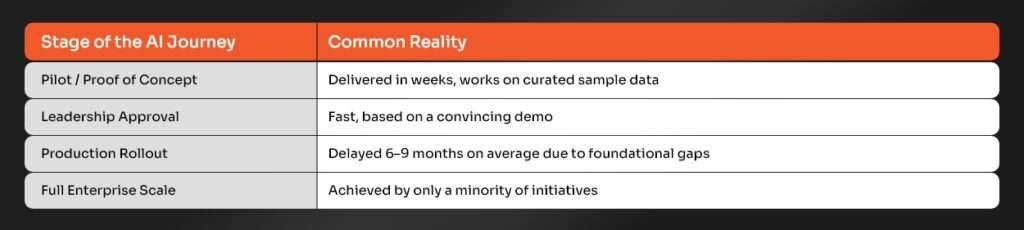
This is the pilot-to-production paradox: we have new ideas and enough money to support them on one hand and challenging issues with integration, governance, and data on the other.
There is nothing wrong with the model that is used in AI projects. The problem lies in the infrastructure that fails to provide the required support for the model.
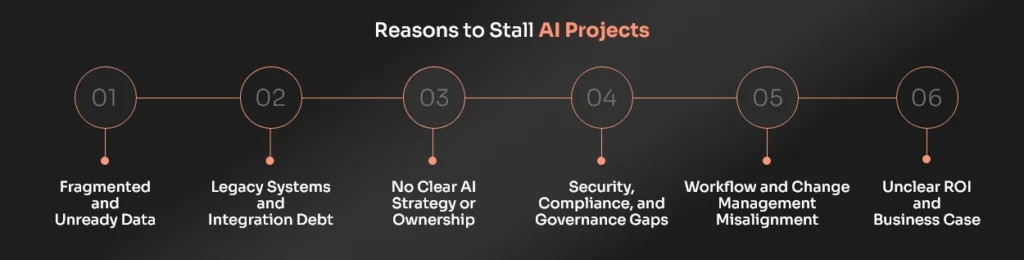
1. Fragmented and Unready Data
Most enterprises store data across ERPs, CRMs, spreadsheets, and departmental tools with no unified governance layer. A pilot can succeed on a clean, curated dataset, but production AI needs continuous, governed, near-real-time data. When that pipeline doesn’t exist, the model can’t be trusted at scale.
2. Legacy Systems and Integration Debt
Core business applications built years ago were never designed to expose data to AI systems or accept machine-generated inputs. Enterprise AI integration with legacy platforms, ERP, CRM, ticketing, and warehouse systems often needs new API layers before AI can plug in safely and reliably.
3. No Clear AI Strategy or Ownership
Pilots are frequently run by a single team, function, or vendor without a broader enterprise AI adoption plan. Without cross-functional ownership, IT, security, business operations, and leadership, a working prototype has no path to becoming a governed, budgeted, production system.
4. Security, Compliance, and Governance Gaps
Production AI touches sensitive data at a scale a pilot never does. Access controls, audit trails, data residency requirements, and model governance are often addressed only after a pilot succeeds, by which point retrofitting security into the architecture is expensive and slow.
5. Workflow and Change Management Misalignment
An AI copilot or automation tool that doesn’t fit how teams actually work will be ignored, regardless of its accuracy. Enterprise AI solutions need to be embedded into existing workflows, not layered on top of them, or adoption stalls even after a technically successful launch.
6. Unclear ROI and Business Case
Pilots are often approved on an innovation budget without a defined path to measurable value. When it’s time to fund production, infrastructure, integration, monitoring, and ongoing model management, there’s no business case strong enough to unlock that spend.
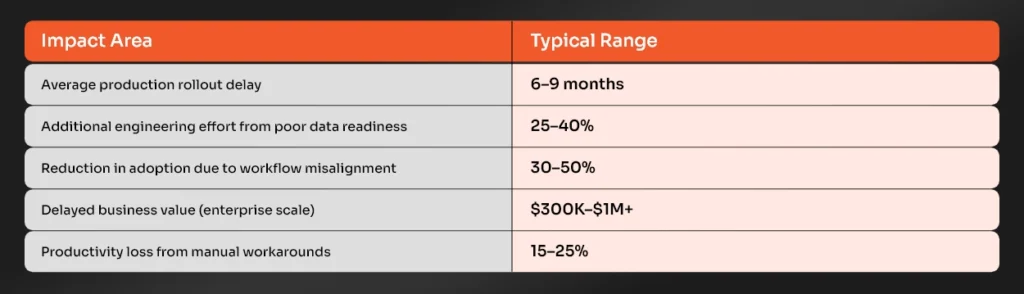
The cost of a stalled AI initiative isn’t limited to the original project budget. It compounds across delayed value, wasted engineering effort, and lost competitive ground.
Companies that manage to make the jump from AI pilot to production tend to do a few things differently than others. They take production readiness into account at the design phase from the very beginning rather than thinking about it once the pilot has been completed successfully.
Before embarking on any kind of project, advanced companies must examine their data, integration, security, and workflow readiness. This helps determine if the problem is correctly defined, if the data exists, and if a system is ready to be integrated with AI.
Rather than developing a prototype used just for demonstration and learning purposes, forward-thinking companies design their projects using production requirements, scalability, tracking, security, and integration right from the beginning. This decreases the time needed to move from a proof-of-concept to deployment.
Effective AI copilot development relies on understanding how teams work in practice, not on what the technology is capable of. Copilots that minimize the amount of work that needs to be done with already existing tools have much better prospects than independent AI interfaces that require teams to change their behaviors.
The establishment of access controls, security architecture, and audit trails must be integrated into the development process from day one, and not as an afterthought once the pilot is effectively implemented. This is even more necessary in regulated industries such as fintech, healthcare, or manufacturing.
Companies that successfully expand AI initiatives relate each stage of investment to measurable business goals, whether it is cost optimization, cycle time, or error rate, as opposed to technology measures. This helps to keep the stakeholders on the same page and allows obtaining the budget for implementation faster.
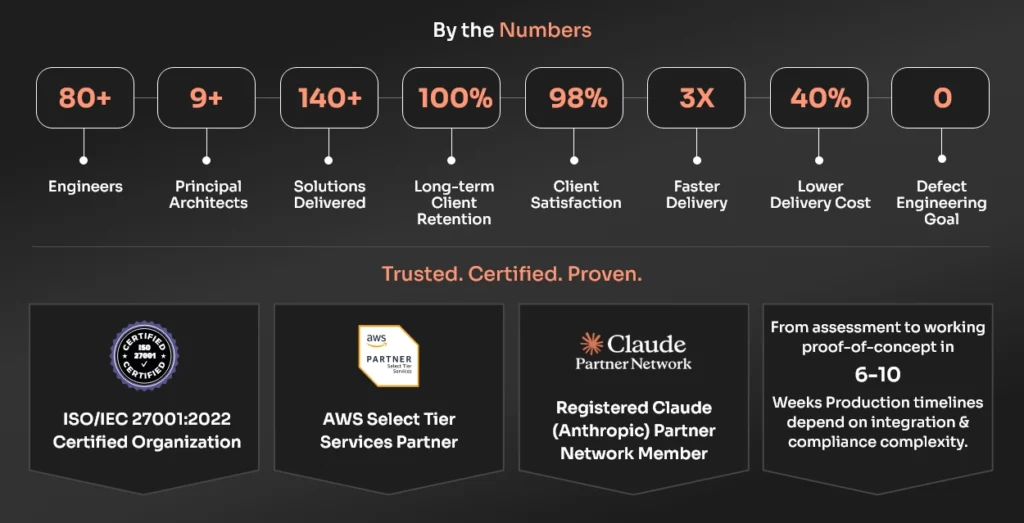
NextGenSoft is an AI-first digital engineering company built specifically to close the pilot-to-production gap. Rather than treating AI as a bolt-on feature, NextGenSoft combines AI implementation, agents, RAG, LLM integration, and AI copilot development with cloud architecture, DevOps, and product engineering under one integrated delivery model.
This matters because scaling AI in enterprises isn’t only an AI problem; it’s an architecture, data, and engineering problem. NextGenSoft’s approach includes:
Trust and verifiable credentials matter more in enterprise AI implementation than almost any other technology category, given the sensitivity of the data involved. NextGenSoft’s standing includes:
Evaluate this checklist for signs of scalability for your AI programs beyond the pilot phase:
The gap between an AI pilot and its fully functional state is not a gap in technology but readiness. Businesses focusing on important issues like data quality, security, integration, and process implementation can successfully transform their proof-of-concept projects into successful implementations.
If your organization is evaluating how to move an AI initiative from pilot to scaled deployment, an AI Readiness Assessment is the logical first step, before the next quarter’s AI budget goes toward another pilot that stalls at the same barriers as the last one.
Talk to NextGenSoft’s AI engineering team to assess your enterprise AI readiness.
1. Why do most enterprise AI pilots fail to reach production?
Answer: The failure to initiate enterprise AI projects is mostly dependent on the surrounding environment, specifically data quality, system integrations, security mechanisms, and overall alignment with the workflow. The results of the pilot may be promising since the model has been tested using data in determined conditions; however, production requires continuous, governed data and stable integration, which is something different from piloting.
2. How long does enterprise AI implementation typically take from pilot to production?
Answer: The exact time of implementation would greatly depend on the readiness of data, complexity of the integration, and regulatory requirements. Many organizations experience delays in the implementation of their technology from 6 to 9 months as a result of finding out that they have serious structural issues after the pilot. However, if a structured approach to implementation is applied and an assessment is performed, these timelines can be drastically shortened.
3. What is the difference between an AI copilot and a full AI agent for enterprise use?
Answer: An AI copilot aids a human user with recommendations in real time, execution of various tasks, and decision-making processes, and works with existing processes, while AI agents can work more autonomously and achieve multi-step goals. Many businesses initiate the development of AI copilot as a safe starting point for scaling towards full-blown agentic automation.
4. How can enterprises reduce the cost of scaling AI from pilot to production?
Answer: The most effective way to keep costs down is to conduct an AI readiness assessment before the production budget is formed. This enables companies to understand what gaps exist with regard to data, interfacing, and security before they start costing too much.
5. What role does data readiness play in enterprise AI adoption?
Data readiness serves as the biggest hindrance to the implementation of AI in business. AI needs data that is accurate and provided in almost real time. When the data is isolated or updated only occasionally, the performance of the model is negatively affected regardless of how successful the pilot was.
 Niraj Salot
Niraj Salot, with 20+ years of expertise in software architecture, specializes in delivering robust enterprise applications. His cloud optimization skills help clients cut costs while maximizing performance. As a key leader at NextGenSoft, he drives scalable, efficient, and high-performing solutions.
We’re ISO/IEC 27001:2022 certified, ensuring your projects are executed with globally recognized security standards.

INDIA
 sales@nextgensoft.io
 +91 81284 66678


