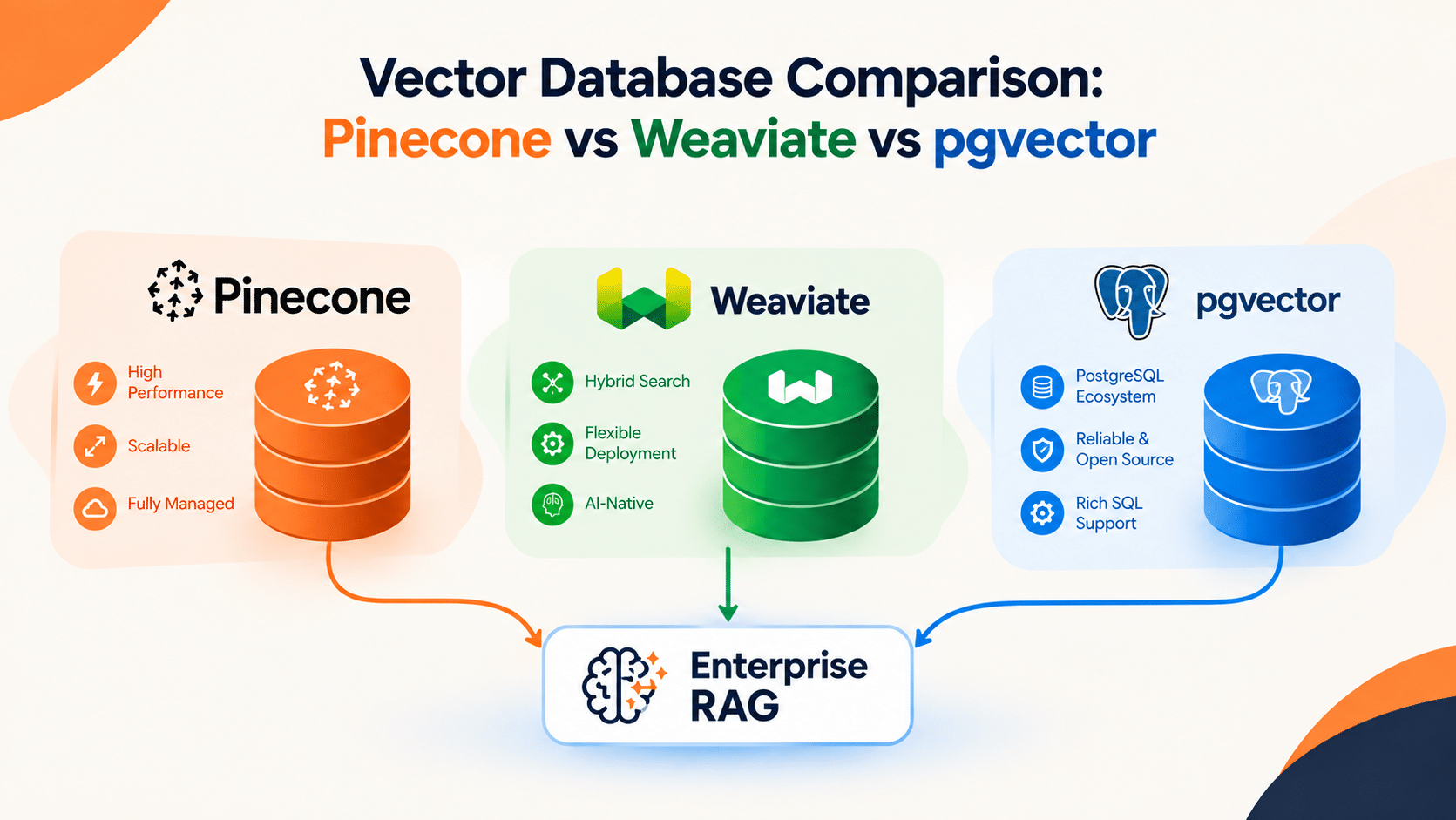
Vector Database Comparison: Pinecone vs Weaviate vs pgvector for Enterprise RAG
Pranav LakhaniSeptember 23, 2026
Share this article


Let AI highlight what matters.
Pinecone is the best fit for teams that want managed scale with minimal database operations. Weaviate suits enterprises that need vector-native features with cloud or self-hosted deployment control. pgvector is usually enough when PostgreSQL already holds the source data and retrieval demand is moderate. This vector database comparison explains where each option works, what it costs operationally, and how to choose for enterprise RAG without adding unnecessary infrastructure.
A RAG Development pipeline splits source documents into passages and converts each passage into an embedding: a numerical representation of meaning. The user’s question becomes an embedding too. The vector store finds the closest passages and sends that evidence to the language model, which uses it to compose an answer.
The database does not perform the final reasoning. It acts as the system’s memory index. In production, it must also store metadata, apply tenant and permission filters, process updates and return relevant context within a latency target. A useful vector database comparison must therefore examine retrieval quality, security and operations together.
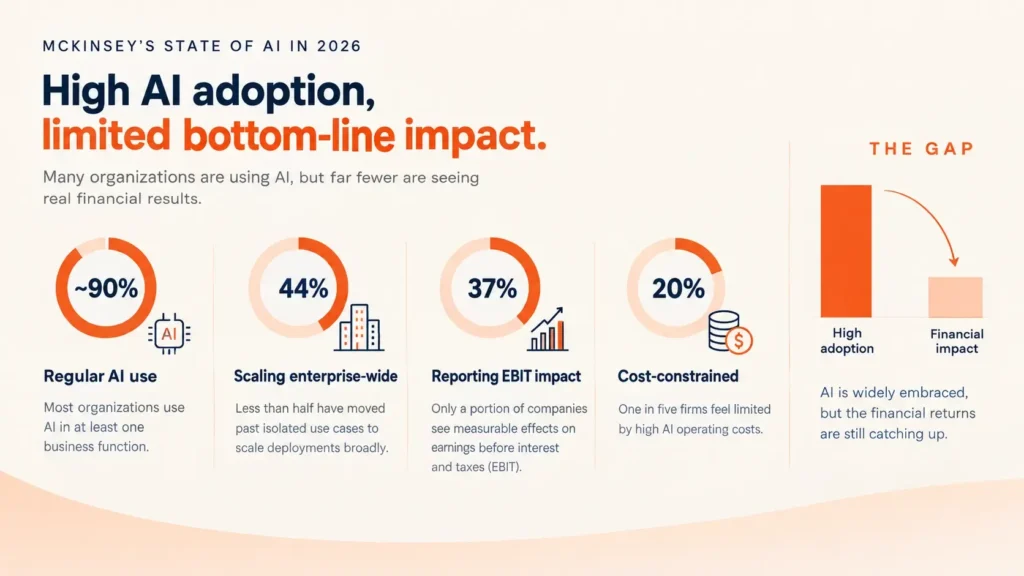
McKinsey’s August 2026 survey found that nearly nine in ten respondents reported regular AI use, but only 44% said it was scaling enterprise-wide. Just 37% reported a positive EBIT contribution, and one in five said operating costs constrained AI use. Weak relevance, slow search, and avoidable infrastructure costs can stop a promising RAG demo from becoming a dependable product.
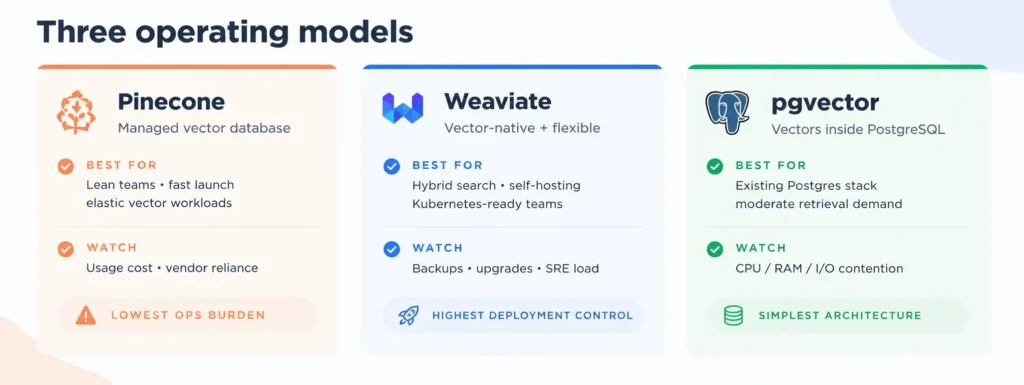
The main distinction between Pinecone vs Weaviate is ownership. Pinecone is a fully managed vector database. Weaviate is an open-source vector database available as a managed service. pgvector is an extension of PostgreSQL that provides a way to store vectors along with relational data.
This vector database comparison reduces the choice to three operating models:
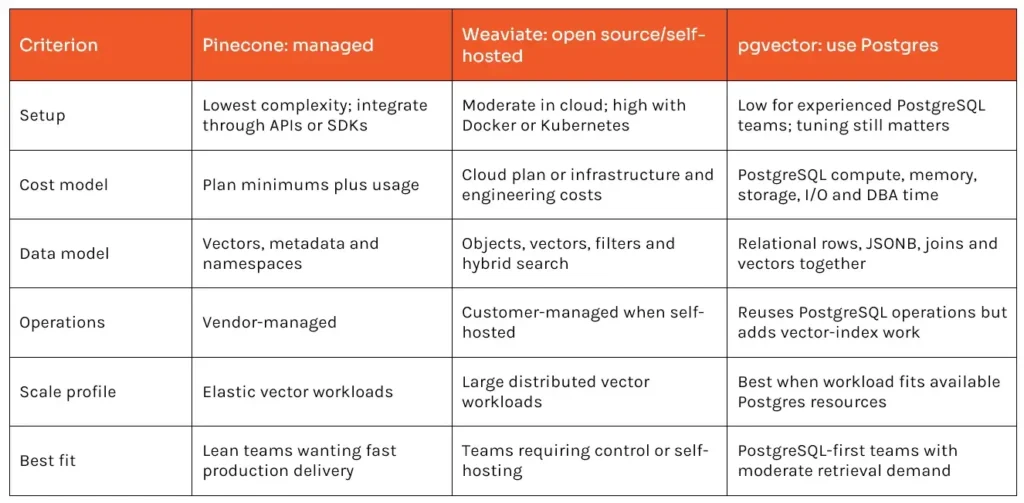
There is no universal “million-vector” cut-off. Dimensions, updates, concurrency, filters, recall, and p95/p99 latency all influence capacity. Benchmark production-shaped data.
Read Also: AI Agent Orchestration: Why 12 Agents Still Work Alone
Pinecone eliminates most of the cluster management tasks. As of September 2026, the company is working on different plans, including:
In this vector database comparison, Pinecone is the best option for a small development team working on a RAG application with heavy traffic. Engineers can concentrate on the quality of the retrieval instead of the cluster health.
Of course, the drawback is the dependence on the vendor and the cost that depends on usage. It is essential to evaluate reading, writing, storing, transferring, and support before launching production.
Weaviate is characterized by a combination of keyword and vector search, filter search, and hybrid search. Teams may utilize its cloud capabilities or make use of Docker and Kubernetes for deployment, making it appealing in cases where portability or management of the technology stack is key.
According to Weaviate’s pricing as of September 2026, a free offering is available with up to 100K objects, 1GB RAM, and 10GB disk space. The fees for Flex start from $45 per month, while the premium version is advertised from $400 and indicates the possible uptime of as much as 99.95%.
For Pinecone vs. Weaviate, choose Weaviate when control is worth the responsibility. This vector database comparison must count backups, replication, monitoring, upgrades, and incident response. Open source does not mean free to operate.
pgvector adds vector similarity search to PostgreSQL. It supports exact search and approximate HNSW and IVFFlat indexes, multiple distance functions, joins, and ACID transactions. Customers, permissions, documents, metadata, and embeddings can remain in one system.
Exact search provides perfect recall but becomes costlier as data grows. HNSW offers strong query performance but uses more memory and builds slowly. IVFFlat builds faster with less memory but needs careful tuning.
In this vector database comparison, pgvector wins on architectural economy. Teams reuse SQL skills, monitoring, backups, and row-level security. However, vector search competes with transactional workloads for CPU, memory, and I/O.
Choose pgvector when:
This vector database comparison should not force a dedicated service into every architecture. An internal assistant or early B2B product may run well on pgvector. Another database adds synchronization, security, and on-call work without necessarily improving answers.
Consider a dedicated database when concurrency, ingestion, hybrid retrieval, or strict tail latency becomes material. Migrate because measurements show a problem, not because of a fashionable threshold.
Use this vector database comparison in five steps:
Benchmark candidates with the same embeddings, documents, permissions, and questions. Measure recall@k, grounded answers, latency, throughput, and cost.
Read Also: Agentic AI Frameworks Compared: LangGraph vs CrewAI vs AutoGen
The phrase vector database semantic reasoning comparison is slightly misleading. These databases retrieve mathematically similar records; they do not reason like an LLM. Answer quality also depends on the embedding model, chunk boundaries, metadata, hybrid search, reranking, prompts, and evaluation.
A fair vector database comparison asks whether the store retrieves the evidence the model needs. Test acronyms, product codes, temporal questions, restricted documents, and answers spanning multiple passages.
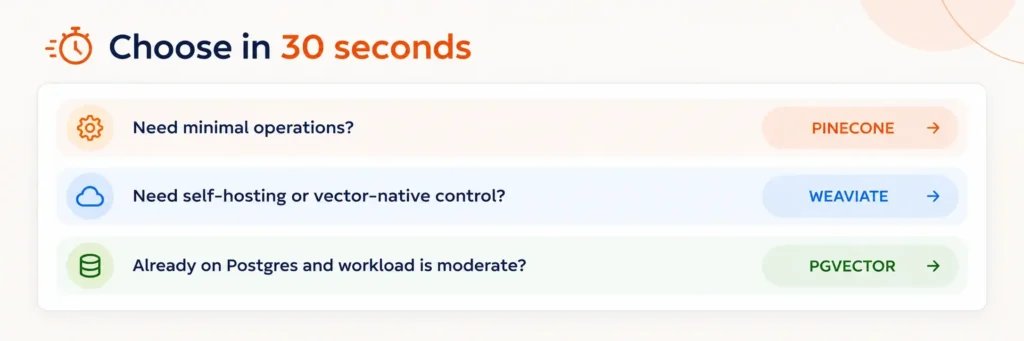
For Pinecone vs Weaviate, select Pinecone when rapid delivery and managed operations outweigh infrastructure control. Select Weaviate when self-hosting, portability, or configuration flexibility is required. Select pgvector when PostgreSQL meets measured retrieval targets and avoiding another datastore has real value.
The best vector database comparison ends with a benchmark, not a universal winner. Compare relevance, tail latency, effort, and 12-month cost.
Pinecone offers the cleanest managed path; Weaviate provides the greatest deployment control, and pgvector keeps the architecture simple for suitable PostgreSQL workloads. The right choice follows the corpus, permissions, traffic, latency targets, compliance requirements, and team capacity.
NextGenSoft helps enterprises evaluate vector stores and build secure retrieval systems through its RAG Development Services. The work covers ingestion, chunking, hybrid retrieval, reranking, evaluation, and deployment. For the broader model strategy, read RAG vs Fine-Tuning.
1. Is Pinecone better than Weaviate for enterprise RAG?
Answer: Pinecone suits teams prioritising managed operations. Weaviate is stronger when self-hosting, portability, or configuration control is essential.
2. Is pgvector a real vector database?
Answer: pgvector is a PostgreSQL extension for vector similarity search rather than a standalone database. It supports exact search plus HNSW and IVFFlat indexes.
3. How many vectors can pgvector handle?
Answer: There is no universal limit. Capacity depends on dimensions, RAM, storage, index design, filters, concurrency, latency, and recall targets.
4. Can Weaviate run on-premises?
Answer: Yes. Weaviate documents Docker and Kubernetes deployments in addition to its managed cloud service.
5. What should an enterprise benchmark?
Answer: Measure recall@k, grounded-answer quality, p50 and p95/p99 latency, throughput, ingestion speed, filter behaviour, recovery, and total cost.
6. Will changing the database stop RAG hallucinations?
Answer: Not alone. Hallucination control also requires reliable sources, good chunking, suitable embeddings, reranking, citations, evaluation, and guardrails.
 Pranav Lakhani
Pranav brings over 20 years of expertise in software development and design, specializing in delivering enterprise-scale products. His unique ability to manage the entire product lifecycle ensures innovation and technical excellence across every project.
We’re ISO/IEC 27001:2022 certified, ensuring your projects are executed with globally recognized security standards.

INDIA
 sales@nextgensoft.io
 +91 81284 66678


