Managed Cybersecurity Services vs In-House DevSecOps: Which Fits For Enterprises?
Pranav LakhaniSeptember 7, 2026
Share this article


Let AI highlight what matters.
Security budgets got tighter this year. Headcount plans got shorter. And the question landing on more CTO desks isn’t “How do we get better security?” it’s “How do we get better security with less?”
That question is showing up everywhere from LinkedIn threads to board decks right now: do you hire and build an in-house DevSecOps function, or do you bring in managed cybersecurity services and let someone else own the tooling and the 2 a.m. alerts?
There isn’t a universal right answer. There’s a right answer for your company at your size and at your current level of security maturity. This piece walks through the real trade-offs—cost, control, speed, and talent access; gives you a framework to make the call, and shows how a hybrid model (the approach we use with clients at NextGenSoft) often ends up being the practical middle ground.
Read Also: Building a DevSecOps Maturity Framework: A High-Level Playbook for Enterprises
A few things are converging at once:
That combination- flat or shrinking budgets, a growing attack surface, and rising compliance pressure is exactly why “managed cybersecurity services vs. in-house DevSecOps” has become a live debate instead of a theoretical one.
Both paths can get you to a secure, compliant, well-monitored environment. They just get you there differently, and the differences matter more at some company stages than others.

A few of these deserve a closer look, because the summary table hides some nuance.
It’s Not Just Salary vs. Retainer
The obvious comparison is “one senior DevSecOps hire costs about what a managed services retainer costs.” That’s often roughly true on paper. But the real cost comparison includes the following:
Managed services convert a lot of that into a single predictable line item. In-house DevSecOps converts it into a long-term capital investment that pays off if — and only if — you keep the team long enough to realize the value.
The Trade-Off People Underestimate
This is where in-house wins cleanly. If your product has unusual architecture, strict data residency requirements, or highly custom infrastructure, an in-house team that lives inside your codebase every day will make faster, better-informed calls than an external provider working from a standard playbook.
But “control” only matters if someone is actually using it. A lot of companies that insist on full in-house control don’t have the headcount to exercise it well, which means security reviews get skipped, patches get delayed, and the “control” is theoretical rather than operational.
Managed Services Wins Early, In-House Can Win Later
Early on, managed cybersecurity services almost always win on speed. You’re plugging into existing tooling and existing playbooks instead of building both from scratch.
Once a company reaches real scale—deep, product-specific infrastructure; multiple engineering teams; its own release cadence—an experienced in-house team that knows the codebase can often move faster than an external provider that has to re-learn context every engagement.
The Constraint Nobody Can Fully Solve
Security talent, especially people who understand both application security and DevOps pipelines, is genuinely scarce. Managed providers solve this by spreading specialized talent across multiple clients. In-house teams solve it by competing for a small pool of candidates, often against companies with bigger budgets.
Neither option fully removes this constraint. It just moves where the constraint shows up.
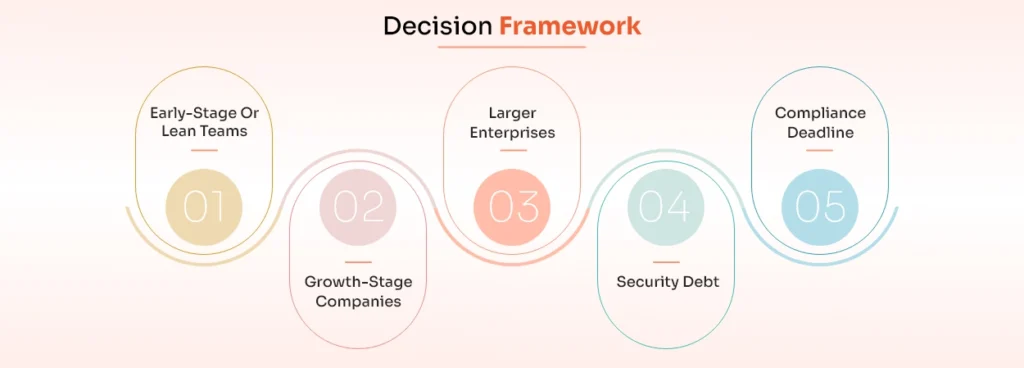
Instead of treating this as an all-or-nothing choice, map your company against two dimensions: size/complexity and current security maturity.
Under ~100 engineers, limited security tooling in place
Managed cybersecurity services are usually the right starting point. You get coverage fast, without a multi-month hiring cycle and without committing budget to a function you don’t yet have the scale to justify building internally.
Scaling fast, compliance requirements increasing, but no dedicated security function yet
This is where the hybrid model earns its place. You need speed and specialized coverage now, but you also need security decisions made by people who understand your specific architecture — not a generic checklist.
Complex, proprietary systems, dedicated engineering leadership, budget for a full function
In-house DevSecOps, often supported by specialist partners for niche coverage (penetration testing, specific compliance audits, surge capacity during incidents), tends to deliver the best long-term outcome.
Managed services first, to close gaps quickly and pass the audit or questionnaire, while a longer-term in-house or hybrid plan is built in parallel.
If you’re not sure where you land, the honest test is this: if a critical vulnerability was found in production tomorrow, who owns fixing it, and how fast could they actually move? If the answer is “we’re not sure” or “it would take a while to figure out ownership,” that’s a maturity signal on its own.
In practice, most of the companies we work with don’t fit neatly into “fully managed” or “fully in-house.” They need the speed and specialized coverage of managed services, combined with security that’s actually built into how their engineering team ships code—not bolted on afterward.
That’s the model behind our DevSecOps Services: security embedded directly into your CI/CD pipelines, architecture, and cloud environments from the start, rather than treated as a final gate before release.
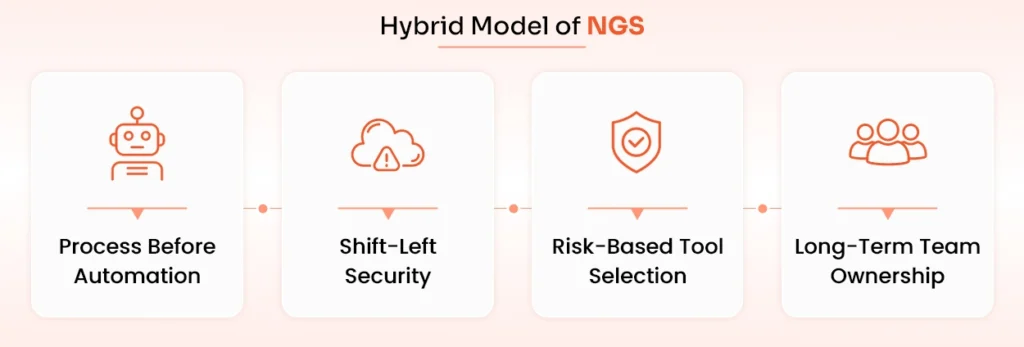
In practice, that means:
This is the practical middle ground between the two ends of the comparison table above: the speed and specialized expertise of a managed approach, applied in a way that builds toward a system your own team can eventually own and extend.
There’s no single correct answer to “managed cybersecurity services vs. in-house DevSecOps”—only the answer that fits where your company is right now. What matters is being honest about your current maturity, your growth trajectory, and how much security “control” you can actually exercise with your current team.
If you’re weighing this decision for your own organization, it’s worth walking through your specific environment with someone who’s done this integration before, rather than guessing from a generic framework.
Talk to NextGenSoft about your DevSecOps approach; we’ll look at your current pipeline, flag where security is creating risk or slowing releases, and show you what a right-sized hybrid model could look like for your team. Explore our services.
1. Is managed cybersecurity cheaper than building an in-house team?
Answer: Usually, in the short term. Managed services convert recruiting time, tooling costs, and training into a single predictable cost, while in-house teams require upfront investment before they deliver full value. Over a longer horizon, a well-utilized in-house team can be more cost-effective — but only if the company has the scale and stability to keep it fully staffed and busy.
2: Can managed cybersecurity services support compliance audits like SOC 2 or ISO 27001?
Answer: Yes. Most managed providers work with compliance frameworks regularly and can help implement the controls, monitoring, and evidence collection auditors expect. It’s worth confirming which specific frameworks a provider has direct experience with before signing on.
3: What’s the biggest risk of going fully in-house too early?
Answer: Underutilization. Building a full DevSecOps function before you have the engineering scale to keep it busy often means expensive talent spending significant time on work that doesn’t match their skill level, while coverage gaps still appear elsewhere.
4: How do I know if a hybrid model is right for us?
Answer: If you need fast, specialized security coverage now but also want that security embedded into your own architecture and understood by your own engineers over time, a hybrid model is usually the better fit than picking one extreme.
 Pranav Lakhani
Pranav brings over 20 years of expertise in software development and design, specializing in delivering enterprise-scale products. His unique ability to manage the entire product lifecycle ensures innovation and technical excellence across every project.
We’re ISO/IEC 27001:2022 certified, ensuring your projects are executed with globally recognized security standards.

INDIA
 sales@nextgensoft.io
 +91 81284 66678

 Brijesh Shah
CEO, NextGenSoft
Brijesh Shah
CEO, NextGenSoft
 Vrajlal Chhuchhar
Sr. BDM, NextGenSoft
Vrajlal Chhuchhar
Sr. BDM, NextGenSoft


