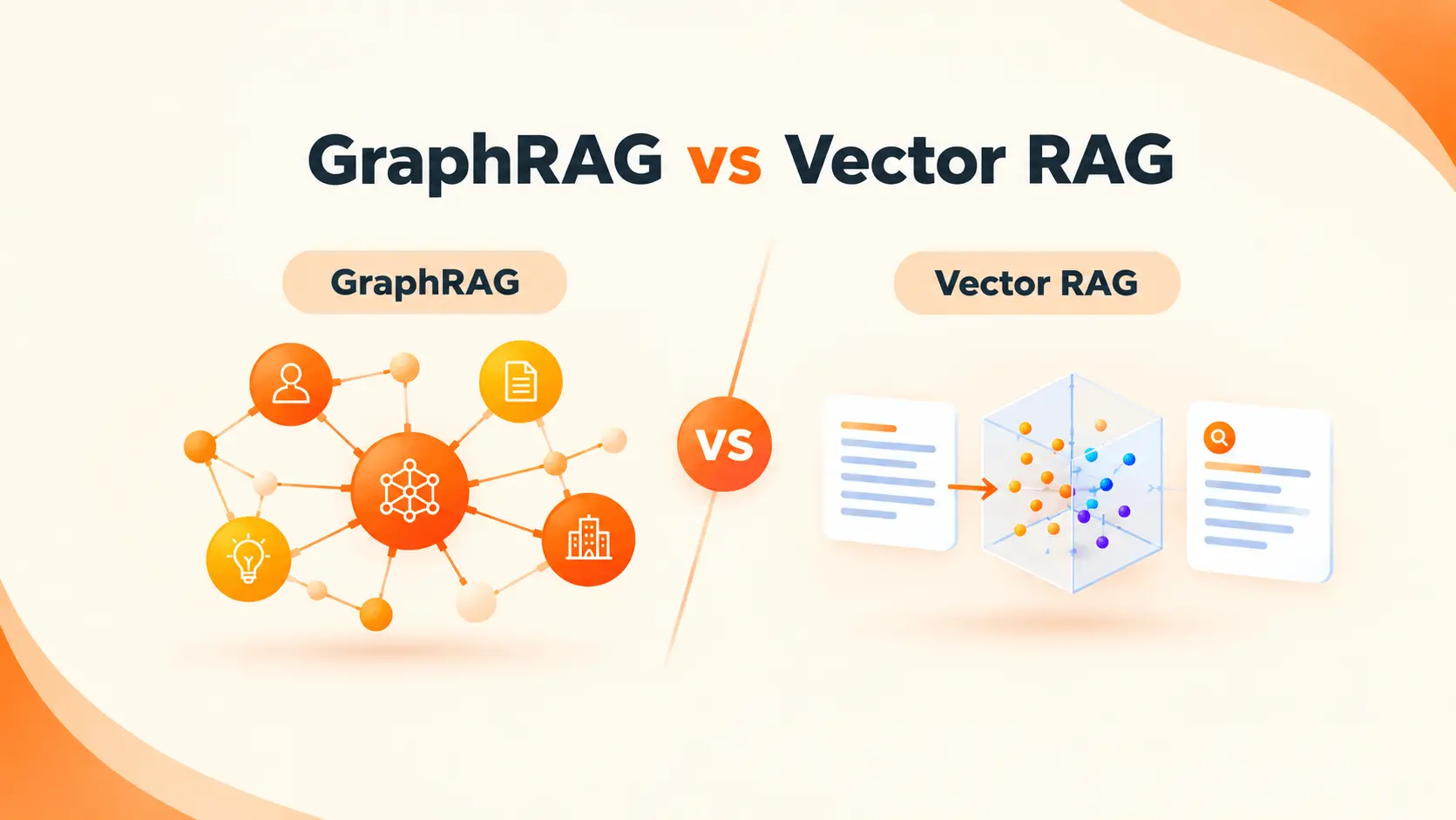
GraphRAG vs Vector RAG: Key Differences and When to Use Each
Niraj SalotOctober 29, 2026
Share this article


Let AI highlight what matters.
Your AI assistant identifies appropriate documents. It collects relevant data, condenses information, and replies to direct questions. Everything functions correctly until someone poses a question that involves mult-departmental information.
A regular retrieval process will locate a supplier list, income reports, and shipping updates, but aggregating these documents into one coherent answer presents a different problem.
This is where GraphRAG becomes useful.
Instead of treating each document as an isolated piece of information, it recognizes connections between supplier, product, location, contract, and a number of business events. The distinction is significant because enterprise knowledge is seldom contained in one document.
This does not mean that any enterprise must own a knowledge graph. For lots of cases, vector search can be implemented faster, is easier to maintain, and can serve for answering common questions.
What matters is to understand when document similarity is enough and when your AI must know how information is connected.
Graph RAG is an approach that is an augmented retrieval generation form that is utilized for the AI system to obtain the relevant knowledge.
This knowledge is represented through two main aspects:
A traditional search engine is based on searching for relevant information while a graph-based retrieval also works on finding how this information is connected.
Its main advantages include:
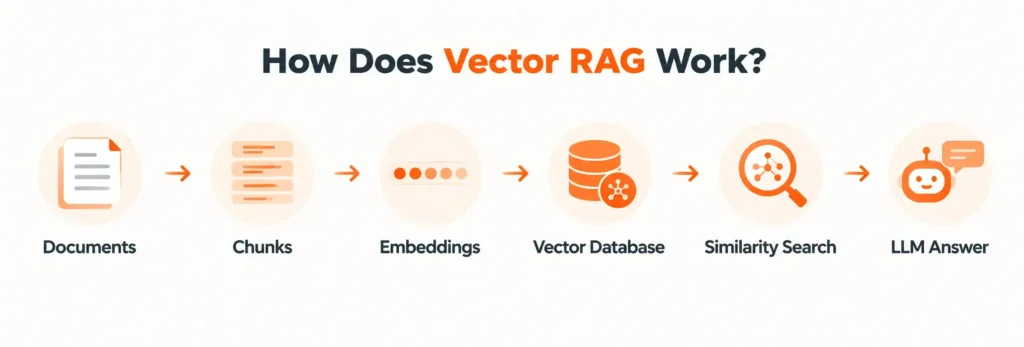
Vector RAG gets any information by comparing the meaning of a user’s queries with stored documents.
This approach breaks documents down into smaller, searchable text chunks called embeddings. This enables the application to find relevant content based on meaning rather than relying on the user’s particular words.
There are generally quite a few steps that one would need to go through when retrieving information:
Such structures work especially well for questions such as “What is our employee leave policy, Sir?” or “How do customers request refunds?”.
In both instances, the actual queries are likely to have answers within a couple of other documents that would be useful.
The challenge appears when the system must connect information that is scattered across different sources.
For a deeper explanation of ingestion, embeddings, retrieval, and generation, read our enterprise RAG pipeline guide.
| Comparison | Vector RAG | Graph RAG |
| Knowledge structure | Text chunks and embeddings | Entities and relationships, often linked to source text |
| Retrieval method | Semantic similarity | Entity matching and graph traversal |
| Initial setup cost | Generally lower | Generally higher |
| Best question types | FAQs, document lookup, semantic search | Multi-hop, dependency, and cross-document questions |
| Relationship handling | Indirect; needs extra retrieval logic | Explicit connections |
| Maintenance burden | Document updates, reindexing, embeddings | Entity resolution, relationship updates, graph quality |
| Query latency | Often lower for simple searches | Can increase with traversal depth and processing |
| Explainability | Source-document citations | Source citations plus relationship paths |
| Technical complexity | Low to moderate | Moderate to high |
| Best starting point | Most document-centric applications | Relationship-heavy enterprise applications |
Let us consider a situation where an organization has 50,000 internal documents.
In the case of vector-based systems, one requires document extraction, chunking, generating embeddings, indexing, and setting up retrieval operations.
In the case of the graph-based implementation, one will have to do the following too:
If database selection is still an open decision, our Pinecone vs Weaviate vs pgvector comparison explains the trade-offs between managed infrastructure, self-hosting, and PostgreSQL-based vector storage.
Here are some practical situations in which basic vector-only search may fail.
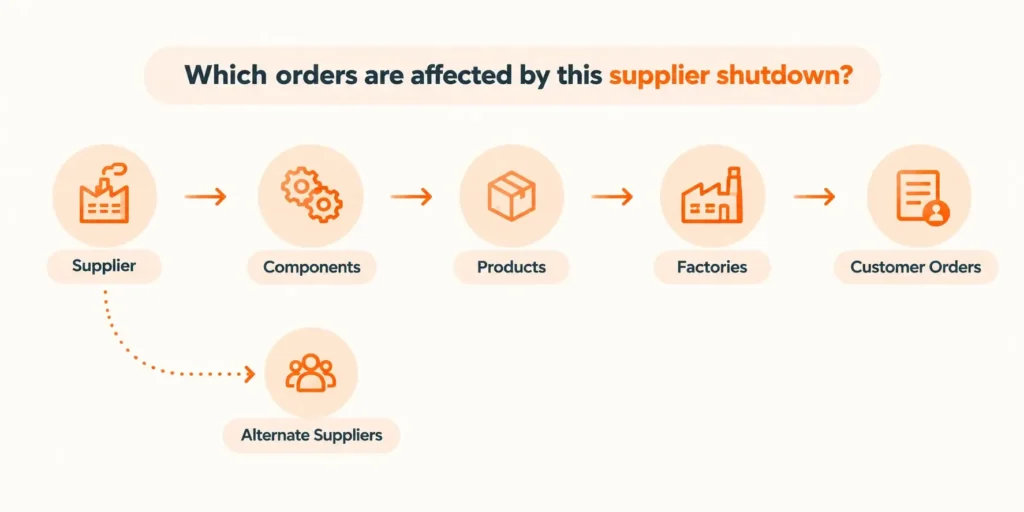
Imagine that a company has relationships with 120 suppliers operating in 8 countries. One of the suppliers makes the announcement about its temporary stop in production.
Now, the operation team would like to know:
“Which orders will be affected by the shut-down of this supplier?”
Answering the question will involve the link-up of several pieces of data:
Think of a financial agency monitoring the transactions of thousands of companies.
An analyst poses the question:
“What transactions might be related to companies connected to a flagged company through common directors or ownerships?”
The necessary information may be found in various documents, such as ownership declarations, company documents, directors’ profiles, and transactions history.
A company has found a significant flaw in an internal authentication system.
The security department inquired:
“Which public-facing applications make use of this system, and who is responsible for them?”
The required information can be located in application registries, IT documentation, service dependence diagrams, and engineering team contact lists.
The knowledge graph can link:
Instead of just getting the information about the compromised service, the system can find out what is going on with it.
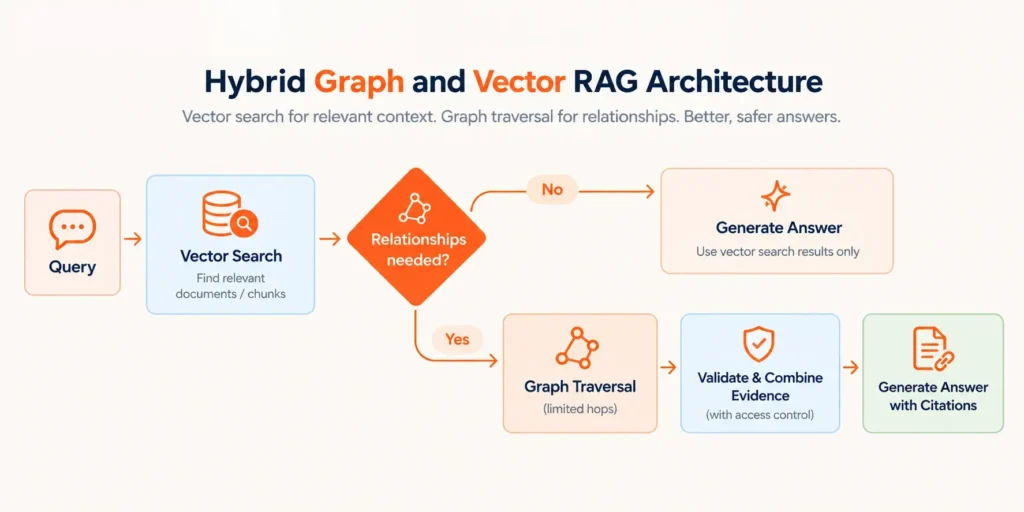
A company does not always have to use only one retrieval tool.
Hybrid architecture combines semantic search with structured relationship retrieval, which allows them to use both methods correctly.
One realistic design incorporates the use of a vector retrieval process initially and graph traversal next when the inquiry is associated with connected proofs.
Theoretical structure of vector-first architecture. Complicated questions demand further graph retrieval operations.
The retrieval phase is divided into five steps.
At this stage, the solution first employs a semantic based search to provide documents relevant to the inquiry.
In terms of the inquiry about supply disruptions, the outcome could contain updated event reports, components data, and records of suppliers.
A router evaluates the adequacy of the received data.
Queries involving relationships as joint connections can cause graph data retrieval to be conducted.
The system identifies relevant graph nodes and follows permitted relationships.
Graph traversal can be restricted to a specific number of hops to control cost and prevent irrelevant connections from entering the result.
The relationships that are retrieved are confirmed by the supporting documentation. All duplicates, redundant information, and irrelevant data are eliminated.
The access rights must apply to both graph and vector information.
The language model will obtain the evidence and create an answer referencing the sources.
This way, it is possible to avoid sending every question through the complicated graph-based mechanism.
If the task is graph-intensive, a different approach may work better: the teams may start with the entity search and then employ the vector search to get the supporting material.
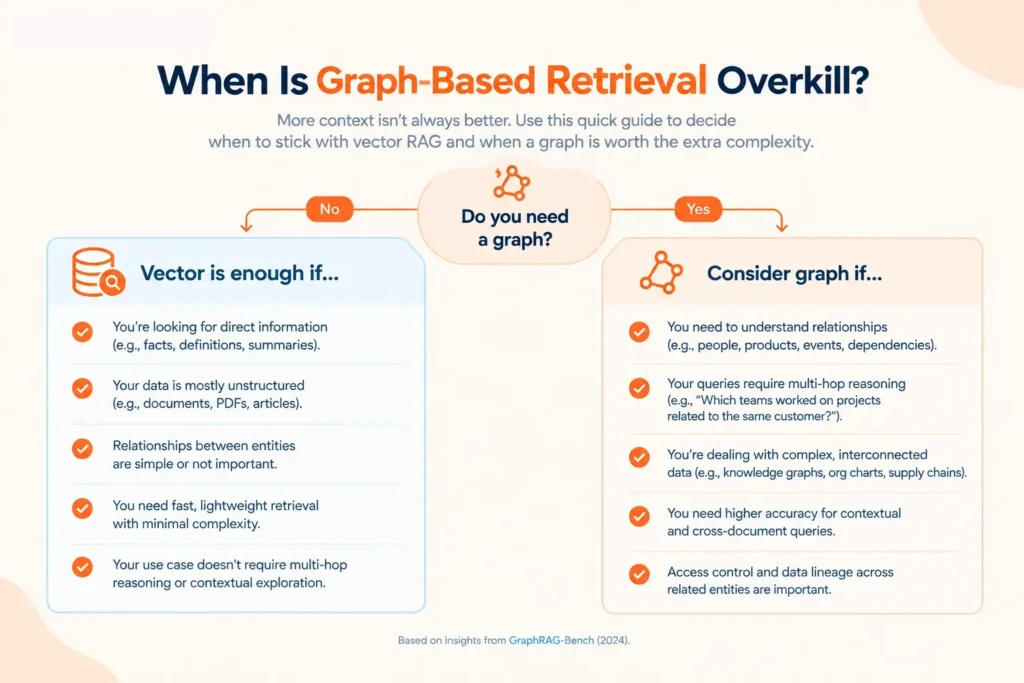
The fact that the architecture gets more complicated does not mean that it will operate better.
As mentioned in the 2025 research that introduced the GraphRAG-Bench framework, there is one main drawback: graph-based methods might perform worse than usual retrieval techniques in some situations.
For that, the authors created a test set that provides information on fact-based retrieval, more complex reasoning, and summarizing tasks.
This is important for the business perspective assessment which is important to consider.
A graph may be unnecessary when:
Before making any decisions regarding a new retrieval architecture, it is important to evaluate both methods with actual corporate inquiries.
A practical pilot study may consist of 100 representative queries.
For example, the evaluation group may divide the queries into 40 queries for general factual research, 30 queries involving multiple documents, 20 queries that require multiple jumps, and 10 analytic queries.
This serves as an example of how distribution can be mentioned, but the actual distribution must be in line with the requests and needs of the certain company.
The evaluation should include:
| Metric | What to Evaluate |
| Retrieval recall | How often the system finds the required evidence |
| Answer correctness | Whether the final answer satisfies the question |
| Relationship accuracy | Whether entity connections match verified records |
| Citation accuracy | Whether sources support the claims made |
| P95 latency | Response time at the 95th percentile |
| Query cost | Retrieval, database, and model processing expenses |
| Maintenance effort | Time required to keep indexes and relationships current |
A reliable enterprise AI system must do more than just couple a language model to the document database, they need to have a retrieval solution in place, effective pieces of evidence, an appropriate access mechanism, and a measuring system that will indicate whether the answers to the questions still remain valid when the information changes.
At NextGenSoft, we provide RAG Development Services to assist companies with their retrieval needs and their system development process.
Contact us to learn more about our services and discuss the retrieval issues you need to resolve.
1. What is Graph RAG in simple terms?
Answer: It is a technique for connecting artificial intelligence systems to data organized around entities, etc. Instead of retrieving only relevant documents, the system can also follow the connections between people, products, organizations, etc.
2. Is Graph RAG better than vector RAG?
Answer: Not for every application, because graph RAG is effective in some cases, such as multi-hop queries and dependency focus. On the contrary, vector RAG tends to perform better on semantic searches, FAQ, and simple documents.
3. Can vector RAG answer multi-hop questions?
Answer: The answer is yes, a vector-based system is capable of multi-hop problem solving by performing query decomposition and multiple retrieval and reranking.
4. Does Graph RAG require a graph database?
Answer: Not always. Some implementations use graph databases, others utilize relational databases or other indexes to uphold relationships.
5. What is the biggest challenge in implementing Graph RAG?
Answer: One of the biggest issues is correctly maintaining the relationships. The answers might be skewed due to mistakes during entity extraction, duplicates, outdated relationships, and missing information.
 Niraj Salot
, with 20+ years of expertise in software architecture, specializes in delivering robust enterprise applications. His cloud optimization skills help clients cut costs while maximizing performance. As a key leader at NextGenSoft, he drives scalable, efficient, and high-performing solutions.
We’re ISO/IEC 27001:2022 certified, ensuring your projects are executed with globally recognized security standards.

INDIA
 sales@nextgensoft.io
 +91 81284 66678


