DevOps Consulting Services Explained: Scope, Pricing, and Red Flags
Pranav LakhaniSeptember 1, 2026
Share this article


Let AI highlight what matters.
A founder I talked to last year had a deploy problem that everyone at his company just called “Fridays.” Not because they deployed on Fridays; nobody had for over a year, out of fear. Because every deploy, whenever it happened, took the same one engineer, four hours, and a fair amount of luck. He was the only person who understood the release process. He hadn’t taken a real vacation in two years.
That’s not a tooling problem. That’s what most people are actually asking for when they say they need DevOps Consulting Services, even if the RFP talks about Jenkins and Kubernetes.
This guide covers what these engagements really include, how the pricing models differ, the questions worth asking before you sign anything, and the flags that tell you a vendor is going to sell you tools instead of fixing the problem.
Ask five vendors what DevOps Consulting means, and you’ll get five different answers, and at least two of them will just be a list of tools. That’s the problem with the term now: it’s been stretched to cover everything from “we’ll set up your CI/CD pipeline” to “we’ll embed three engineers with you for a year.”
Both of those are legitimate. They’re just not the same thing, and a lot of buyers don’t find that out until they’re three weeks into a contract they didn’t want.
Here’s a cleaner way to think about it. Good DevOps Consulting Services sit at the intersection of three things: the tooling (pipelines, infrastructure, monitoring), the process (how code actually moves from a laptop to production), and the people side (who owns what, and what happens when the person who knows everything is on a plane). Vendors who only touch the first one aren’t wrong, exactly. They’re just doing a third of the job.
A mid-size fintech I heard about spent four months and a real budget on a “DevOps transformation” that installed a beautiful CI/CD pipeline nobody used, because the actual blocker, one team gatekeeping every deploy through a Slack approval, was never touched. The tools were fine. The consulting wasn’t.
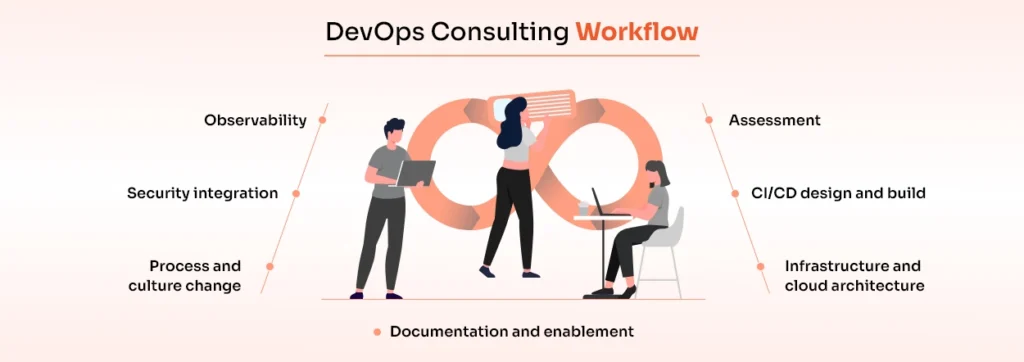
If a proposal only mentions tools, that’s usually the first sign it’s incomplete. A full engagement generally covers:
Notice culture change is on that list, not as a footnote. A lot of DevOps Consulting Companies skip it entirely because it’s harder to scope and bill than “migrate to Kubernetes.” It’s also usually the actual bottleneck.
Read Also: MLOps Best Practices: Scaling Machine Learning Applications with Confidence
Nobody wants a vague answer here, so let’s be direct about what varies and why, without inventing numbers that don’t mean anything outside a specific engagement.
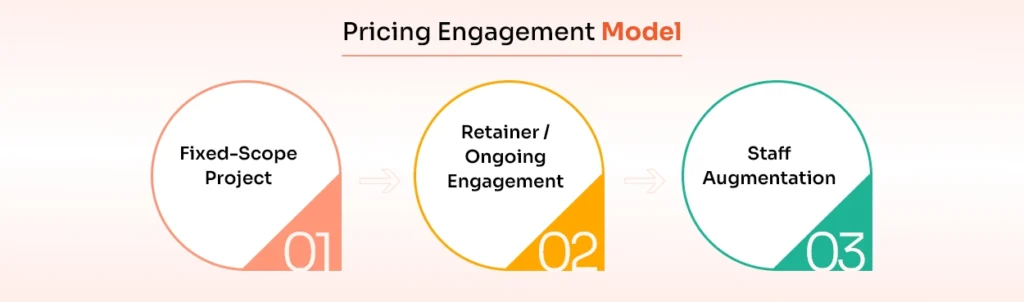
There are generally three models:
Send these to any vendor on your shortlist. The answers tell you more than the case studies will.
1. Walk me through your last engagement that didn’t go as planned. What happened? Answer: Everyone has a case study. Not everyone has an honest answer to this one. If they claim nothing’s ever gone sideways, that’s the red flag, not a good sign.
2. What does week one actually look like?
Answer: Strong answer: shadowing, reading past incidents, talking to the engineers who’ll be affected. Weak answer: “We start configuring your pipeline.”
3. How do you handle the people and process side, not just the tools?
Answer: This is the fintech example above. If they can’t describe how they’d approach a deployment-ownership problem without touching a single YAML file, they’re a tooling vendor wearing a consulting label.
4. What do we own when you leave?
Answer: You want documentation, runbooks, and a team that can maintain what was built, not a black box that only makes sense to the consultants.
5. Which of you actually did the hands-on work on your last three projects?
Answer: Sometimes the senior people who ran the sales call aren’t the ones who show up to do the work. Ask directly.
6. What’s the smallest version of this we could start with?
Answer: A partner confident in their process will usually suggest a scoped pilot before a company-wide commitment. One who pushes straight for the biggest contract on offer is optimizing for something other than your outcome.
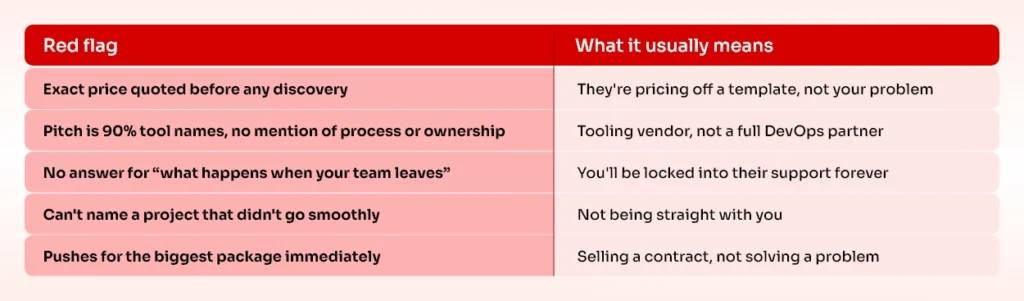
We’d rather earn this section than just claim it, so here’s how we map to the checklist above in practice.
We start every DevOps Consulting engagement with an actual DevOps Maturity Assessment, not a sales call dressed up as one, because you can’t fix a pipeline you haven’t actually looked at. From there, the work spans the same ground covered earlier: CI/CD design, cloud infrastructure, containerization, DevSecOps integration, and yes, the process and ownership work that most DevOps services companies quietly skip.
We’re an AWS Select Tier partner and an Anthropic registered partner, which matters less as a badge and more as a signal: the infrastructure and AI-adoption sides of modern engineering aren’t separate problems anymore, and a partner who only understands one of them will eventually hand you a pipeline that can’t support what you’re building next.
If you want the short version: talk to us before you sign anything, even if you don’t end up working with us. A 30-minute conversation about your actual bottleneck costs you nothing and will make you better at evaluating whoever you do choose.
Most DevOps consulting engagements that fail don’t fail on the tooling. They fail because nobody touched the actual bottleneck, usually a process or ownership problem wearing a technical disguise. Ask about week one, ask what you’ll own when they leave, and be wary of anyone who can price the job before they’ve seen it.
If you’re evaluating DevOps consulting services right now, happy to be one of the conversations you have before you decide; reach out– no pitch required.
1. What do DevOps consulting services typically include?
Answer: Assessment, CI/CD pipeline design, cloud infrastructure and IaC, observability, security integration, and the part most vendors underdeliver on: process and culture change around deployment ownership.
2. How much do DevOps consulting services cost?
Answer: It depends heavily on scope, team size, and which pricing model fits (fixed-project, retainer, or staff augmentation), so be cautious of anyone quoting a number before discovery. Budget for the engagement itself plus the internal time your team spends working alongside the consultants.
3. Is DevOps consulting worth it for a small startup?
Answer: Often yes, in a scoped-down form. A short assessment plus a focused fix (usually CI/CD and one infrastructure bottleneck) can solve the “one person holds all the keys” problem without a company-wide retainer.
4. What’s the difference between DevOps consulting and just hiring a DevOps engineer?
Answer: A DevOps engineer solves the problems you already know about. A consulting engagement, done well, finds the ones you don’t, and leaves your team able to maintain the fix after they’re gone.
5. How is DevOps consulting different from DevSecOps consulting?
Answer: DevSecOps is DevOps with security built into the pipeline from the start rather than added at the end. Most solid DevOps consulting services already include this; if a vendor treats security as a separate add-on, that’s worth asking about.
 Pranav Lakhani
Pranav brings over 20 years of expertise in software development and design, specializing in delivering enterprise-scale products. His unique ability to manage the entire product lifecycle ensures innovation and technical excellence across every project.
We’re ISO/IEC 27001:2022 certified, ensuring your projects are executed with globally recognized security standards.

INDIA
 sales@nextgensoft.io
 +91 81284 66678


