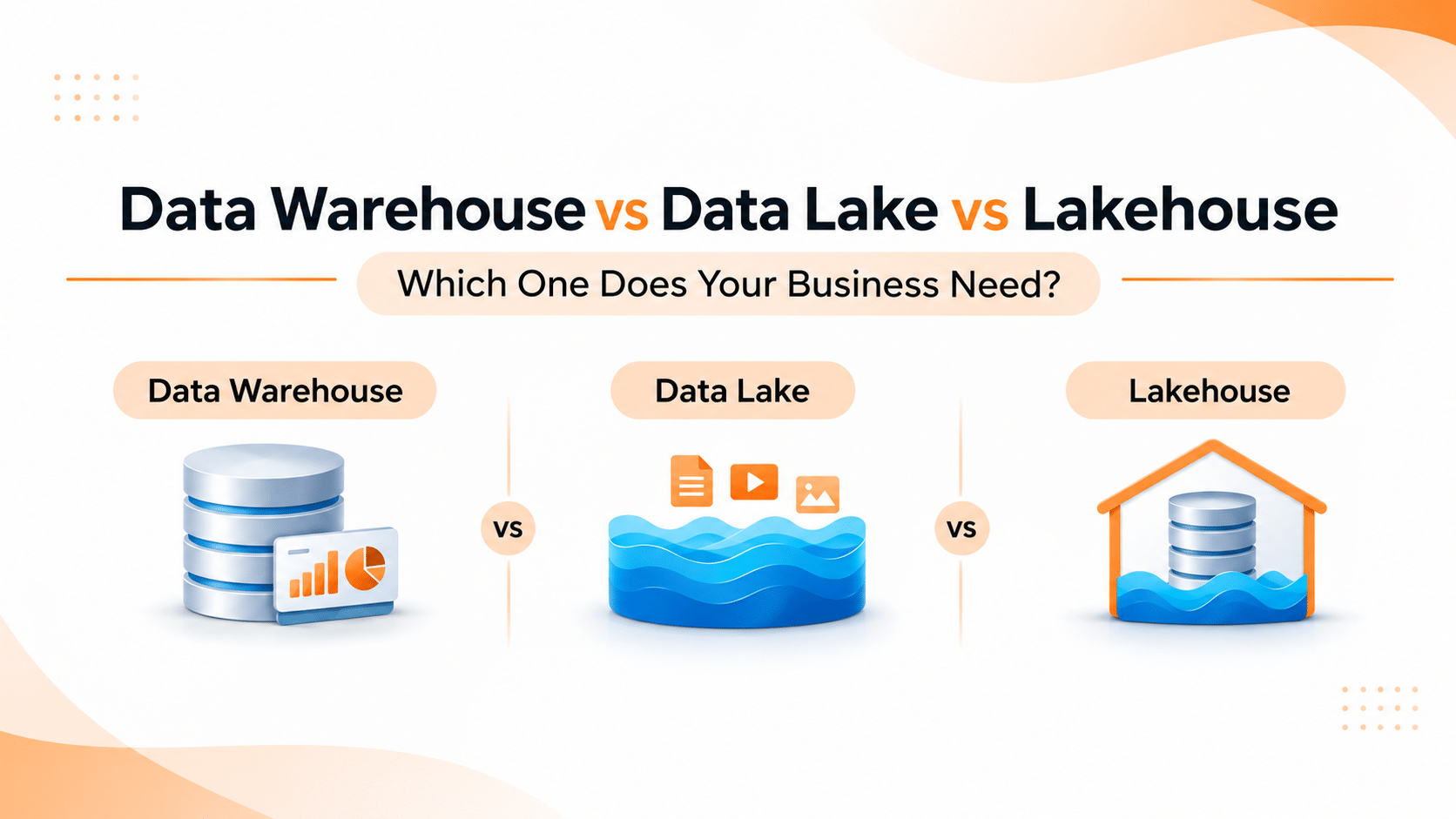
Data Warehouse vs Data Lake vs Lakehouse: Which One Does Your Business Need?
Aman MishraNovember 4, 2026
Share this article


Let AI highlight what matters.
Data Warehouse: Best for structured data, business reporting, and dashboards.
Data Lake: Stores large amounts of raw data in different formats.
Data Lakehouse: Combines data lake flexibility with warehouse analytics capabilities.
Architecture Selection: Choose based on data types, business needs, and team expertise.
Cost Management: Consider storage, processing, maintenance, and infrastructure costs.
Performance: Evaluate reporting speed, data accuracy, and accessibility.
Modernization: Upgrade existing data systems gradually without disrupting reports.
Best Practice: Test performance, security, scalability, and costs before choosing a platform.
Your finance team needs monthly reports they can rely on. Your product team focuses on examining customer behavior. Data scientists use historical information to create appropriate forecasts. While these inquiries can be based on similar customer information, their requirements could be very different in terms of data platform performance.
Incorrect architecture selection leads to various issues at the operational level. The analysts spend hours compiling reports, engineers are occupied with duplicating pipelines, and the cloud service charges keep rising while reports remain less helpful.
The data warehouse vs. data lake decision starts with three questions: What data do you collect? Who will use it? How quickly must they get an answer?
A data warehouse is a solution for structured reporting, while the data lake enables different data to be kept for different purposes. A lakehouse is a combination of data lake storage with a number of transactional tables and analysis features. However, it is possible to mix several solutions instead of going for one definite platform.
Here, we are going to explain the differences, how to assess the lakehouse promise, and how to modernise an existing warehouse without disrupting reporting.
A data warehouse collects data from various business platforms and stores it in a data warehouse. The most common input channels are accounting records, customer relations management programs, stock systems, and order systems.
The team sets the links and reporting guidelines so that the departments measure results in the same way. One example can be finance and sales determining how to report returns when calculating revenue.
The retailer may take orders over three years, product pricing, and customer records to track the monthly profit.
Data warehouses are thought of as appropriate for structured data only, while modern data centers are also able to deal with semi-structured data.
A data lake is used for storing data in its original state, or in an almost untouched state, using either cloud storage or very similar alternatives.
The data that is stored can comprise various transaction data, such as JSON events, application logs, photographs, and texts. Having a copy of the original data allows an organization to obtain new insights from it at later points in time.
For instance, an industrial company might elect to preserve the readings from sensors together with the data on maintenance done on the equipment for subsequent analysis of possible faults.
However, data alone is not enough, as a company has to either provide access to necessary information and control it, or employees will not be able to recognize the required files.
A data lakehouse describes the model of a data lake together with table storage technology.
A data lakehouse is an advanced model of a data lake that employs table storage systems that allow the data to be transformed into a new format. Apache Iceberg, Delta Lake, and similar technologies are capable of supporting features that collections of files are incapable of.
These features help teams update analytical tables while other users read them. They do not automatically supply accurate business definitions, secure permissions, or fast dashboards.
| Data warehouse | Data lake | Data lakehouse |
| Structure: Modelled analytical tables; modern platforms may also support semi-structured data. | Structure: Raw and processed files across structured, semi-structured, and unstructured formats. | Structure: Managed analytical tables over lake storage, alongside raw files where required. |
| Cost model: Storage, query processing or reserved compute, ingestion, and platform operations. | Cost model: Object storage, requests, processing engines, transfers, and engineering operations. | Cost model: Lake storage plus query engines, catalogues, table maintenance, and platform operations. |
| Best-fit workloads: Recurring dashboards, financial analysis, departmental reporting, and governed SQL analytics. | Best-fit workloads: Raw-data retention, exploratory processing, logs, document pipelines, and machine-learning preparation. | Best-fit workloads: Shared analytical datasets supporting SQL reporting and data-science workloads. |
| Governance: Managed database controls provide a foundation; teams still define ownership and business rules. | Governance: Requires controls across storage, catalogues, processing tools, and consumption paths. | Governance: Requires coordinated catalogue, table, engine, and storage permissions; coverage varies by implementation. |
These are architectural tendencies, not guarantees attached to product labels. Benchmark your actual reports and pipelines before committing.
A lakehouse deserves consideration when reporting and data science repeatedly depend on the same datasets.
Consider an online retailer that combines orders, browsing events, and support interactions. Analysts need customer-level summaries, while data scientists need detailed histories. Shared curated tables can reduce duplicate preparation.
Nonetheless, the existence of a lakehouse does not indicate that all tasks utilize a single engine or that every document gets converted into a table. For instance, documents like images and PDF files can continue to be stored as objects, while their metadata is passed into analytical tables.
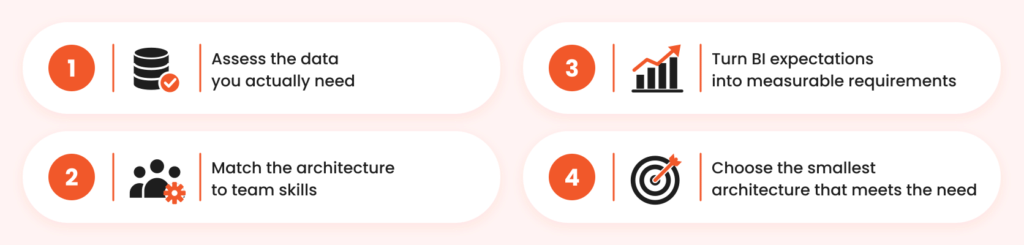
Here are some of the factors that can help you make your choice with complete clarity:
1. Assess the data you actually need
Inventory sources, formats, daily growth, retention requirements, and business owners.
A company analyzing orders, invoices, and CRM records may find a warehouse suitable. Another business storing audio recordings and application logs may benefit from having a lake in addition to its reporting platform.
2. Match the architecture to team skills
Enumerate who will be responsible for ingestion, transformation, access, monitoring, and incident recovery.
A team of two SQL analysts may have a better situation with a managed warehouse than with an architecture that would require them to work with unknown distributed processing tools.
When evaluating data engineering consulting services, ask for an ownership plan covering both implementation and ongoing support.
3. Turn BI expectations into measurable requirements
Replace “fast dashboards” with acceptance criteria. For example, your pilot could require:
Our business intelligence consulting guide states that this assessment has to be accompanied by reporting and metric-definition work.
4. Choose the smallest architecture that meets the need
Use a warehouse if the main objective is reliable structured reporting. Use a lake if preserving diverse source data solves a specific problem.
Examine a lakehouse if common analytical tables are capable of covering both reporting and data science without excessive operational complexity.
Co-existence is a legitimate option; IBM makes explicit use of architecture involving two or all three approaches, and indicates that modernization is possible without replacing everything at once.
Cheap storage can support an expensive platform. Make sure your assessment includes ingestion, transformation, query execution, storage, transfer, license costs, upkeep, and engineering time.
Google BigQuery, for instance, distinguishes computing from storage costs. This is how “warehouse pricing” cannot be simplified into a singular storage charge.
The way queries are designed also makes a difference. In one example, scanning 2 TB each hour totals 48 TB processed per day. By changing every scan to 100 GB, the total is then brought to 2.4 TB, which is a decrease of 95%.
Make a head-to-head comparison of solutions for the following year, following the same growth patterns.
When reviewing a data engineering services company, request separate estimates for migration, recurring infrastructure, and operational support.
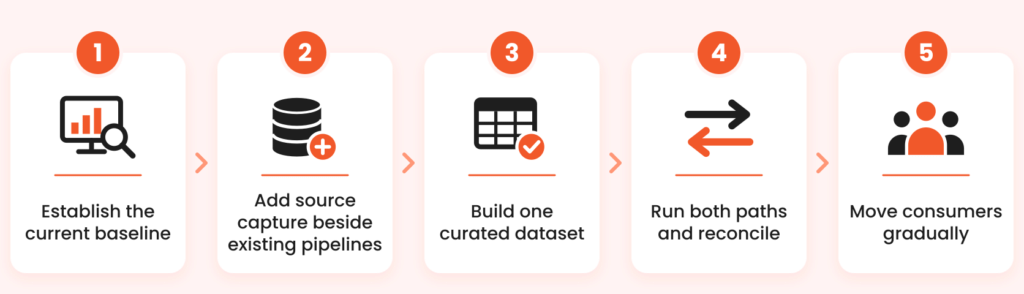
Take an incremental approach to implementation and proceed step by step.
Step 1: Establish the current baseline
Record pipeline runtimes, dashboard performance, reporting costs, and known quality issues. Identify critical reports and their dependencies.
Step 2: Add source capture beside existing pipelines
Store selected source information in secure object storage while the existing reports continue to run. Set the rules for retention and accessibility before the ingestion process advances.
For databases that change often, consider incremental extraction or change data capture instead of taking the full databases multiple times.
Step 3: Build one curated dataset
Select a precise use case, for instance, profitability of the orders, standardise identifiers, deal with duplicates, and document the metrics.
If you are introducing a lakehouse, choose the table format and catalogue only after making sure it is compatible with the target engines.
Step 4: Run both paths and reconcile
Compare the number of records, total financial figures, finally submitted records, deleted records, and records with amendments. Make sure to use the same cut-off time for both procedures.
In a finance workflow, validation must cover one complete reporting cycle, like month-end, and not just the success of a few daily runs.
Step 5: Move consumers gradually
Change one dashboard or downstream task once it has the required features. Have the rollback option planned and abandon the old pipelines only after dependency checks are done.
When scoping data engineering services, require reconciliation, rollback, and decommissioning deliverables alongside pipeline development.
The data lake vs data warehouse choice should follow your reporting needs, data formats, and operating capacity. A lakehouse becomes useful when its shared-table approach solves a measurable problem.
Prior to buying a platform, you must first establish three deliverables: source systems, workload acceptance criteria, and the staged implementation strategy.
NextGenSoft’s Data Science Services will serve as the basis for preparation for discussions about the data architecture, engineering, analytics, and reporting demands. Seek advice from the current sources and the challenges with reporting, as well as the expected workloads.
1. Is a data lake cheaper than a warehouse?
Answer: It may be cheaper to store data in a data lake than in a warehouse; however, all costs depend on how much processing, moving, maintaining, and staffing is needed to get the data processed and stored into the data structure. Thus, it is better to compare workloads, not storage capacities.
2. Does a lakehouse replace a warehouse?
Answer: A lakehouse can replace particular workloads only. If the business intends to keep reporting processes in mind, it can keep a warehouse.
3. Where does a data mart fit?
Answer: A data mart refers to a certain amount of data that is stored in certain fields of business. It is a narrower definition of one of the data storage types and does not imply that a data mart is equal to a data lake.
 Aman Mishra
, a DevOps Engineer with over 8+ years of experience, specializes in AWS, Azure, Kubernetes, CI/CD pipelines, and more. Passionate about learning new technologies, he continuously explore cloud innovations and automation to drive efficiency and scalability.
We’re ISO/IEC 27001:2022 certified, ensuring your projects are executed with globally recognized security standards.

INDIA
 sales@nextgensoft.io
 +91 81284 66678


