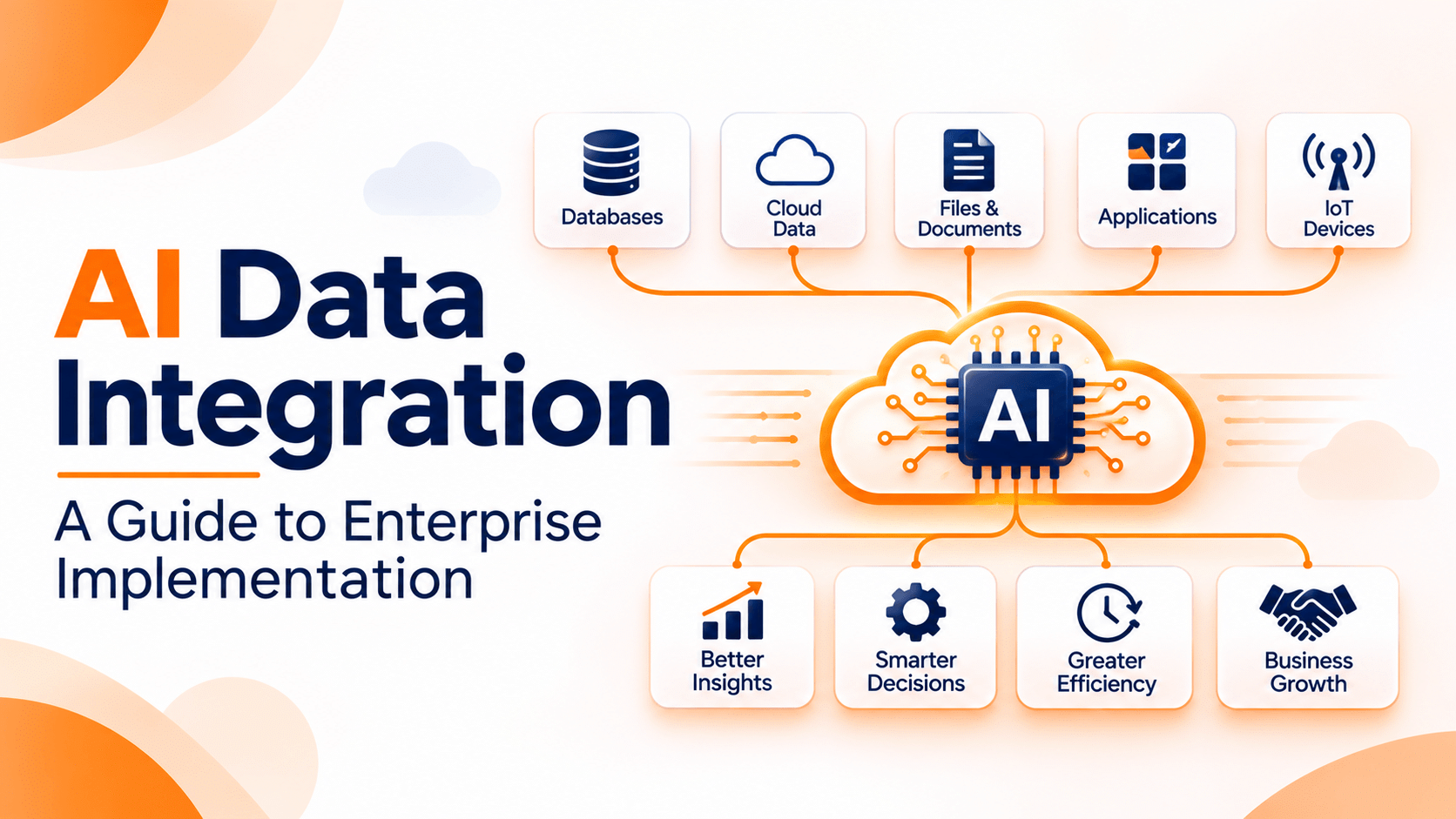
AI Data Integration: A Guide to Enterprise Implementation
Yash BaravaliyaNovember 20, 2026
Share this article


Let AI highlight what matters.
Organizations may collect helpful data on consumers over the years. However, if the AI systems cannot analyze that data well, even the most powerful AI models will bring nothing to the business.
Salesforce’s 2026 Connectivity Benchmark Report indicates that 94% of experts from the IT sphere think that the future of AI technologies will require a change towards API architecture model. There is a huge number of companies, 49%, that consider governance vital across the applications.
Therefore, the challenge is not only selecting an AI model but also preparing data infrastructure that would ensure effective functioning of AI applications.
AI data integration allows companies to connect the dispersed pieces of information, build trustworthy data connections, and give business data to AI systems.
Here we are going to explain how enterprises can implement an effective integration strategy, select the right architecture and avoid common mistakes when moving AI applications into production.
AI data integration refers to the practice that encompasses data collection, connection, conversion, and transmission from various channels to the AI systems in a coherent, secured and usable manner.
Moreover, the technique can improve access to machine learning models, large language models (LLMs), AI agents as well as prediction analysis applications to the corresponding business information.
This information can come from:
AI-powered data integration can also utilize machine learning for the automation of tasks, including schema matching, anomaly detection, duplicate detection, and data classification.
According to research conducted by Salesforce in 2025, 89% of the leaders of data and analytics in India think that organizations should move their data strategies into the new era to derive real value from AI.
This presents a real issue. Many businesses have started working with AI without solving the issues connected with their existing data architectures.
Enterprise AI data integration eliminates these issues by allowing:
A successful AI data integration architecture involves a set of layers that work together to manage data from the initial source to its final integration into an AI model.
Enterprise AI integration systems: governance, protection, and monitoring are integrated in all layers.
This layer combines structured, semi-structured, and unstructured data via batch processing, API connectors, event stream processing, and Change Data Capture (CDC).
Organizations can select the approach to ingestion depending on the volume of data and latency requirements of applications.
Incoming data is cleansed, validated, deduplicated, normalized, and enriched.
ETL (Extract, Transform, Load) and ELT (Extract, Load, Transform) are used to prepare the data for downstream applications.
Data warehouses, data lakes, lakehouses, feature stores and vector databases support different AI workloads.
Traditional machine learning applications may require structured features, whereas generative AI applications frequently depend on searchable documents and vector embeddings.
This layer connects prepared information with AI models through APIs, retrieval-augmented generation (RAG), model-serving infrastructure and other integration mechanisms.
Access controls, encryption, data lineage, audit logs and monitoring protect enterprise information throughout its lifecycle.
Organisations can leverage specialised data science services to develop the underlying infrastructure required for reliable AI applications.
Successful implementation requires a phased approach. Rather than integrating every available data source at once, enterprises should prioritise business requirements and gradually expand their infrastructure.
Start by determining what the AI application needs to accomplish. A customer support chatbot, fraud detection system and procurement assistant will each have different data requirements.
Define the required information, expected response time, accuracy standards and measurable business outcomes before selecting the technology.
Evaluate existing data sources, infrastructure and governance practices.
The assessment should identify:
This exercise helps enterprises estimate implementation complexity and identify potential risks early.
Not every AI application requires real-time information. Historical sales forecasting may work with daily batch processing, while fraud detection may require continuous event streaming.
Select an integration approach that balances performance, infrastructure costs and business requirements.
Develop scalable pipelines that collect, transform, validate and deliver information automatically.
Introduce schema validation, automated quality checks, error handling and pipeline recovery mechanisms to prevent unreliable data from reaching production AI systems.
Connect the selected AI models to prepared datasets and operational applications. Depending on the use case, this may involve REST APIs, vector search, model-serving endpoints or MCP servers.
Enterprises can use professional artificial intelligence services to manage model selection, system integration and production deployment.
Don’t limit your testing of the system to controlled demonstration situations, rather look at real-life situations that the business goes through.
Keep an eye on data freshness, accuracy of response, delays in processes, calculating costs of the infrastructure and failures in the pipeline. Growing use of the implemented solution can start only after the first case of implementation is successful.
For LLMs to perform specific-to-business tasks they need data that will go beyond their training data.
For example, an AI procurement assistant may need to find supplier contracts, check what is in stock right now and order supplies. Each of these processes will require a different integration solution.
RAG looks for relevant data from the enterprise knowledge base before providing it to LLMs, which makes it more contextually relevant and less likely to give wrong answers without an additional large number of updates.
Read this enterprise RAG pipeline implementation guide to understand the underlying process.
The Model Context Protocol provides a standardized interface for the purpose of enabling AI applications to discover external resources, tools, and services.
This is also beneficial in scenarios where several AI applications need to have reusable integration with enterprise applications.
However, the use of Protocol of Model Context for a simple integration can create complexity issues. Enterprises should assess the decision framework before making an investment in this architecture.
Direct APIs continue to be useful for structured data access and executing business actions.
In addition, RAG, Protocol of Model Context, and APIs are not always competing technologies. One application can employ all approaches to fulfil multiple requirements.
Go through this exhaustive study of comparison of Protocol of Model Context vs RAG vs APIs to pick the right option for your enterprise.
Enterprise information environments are rarely uniform. Several technical and operational challenges can affect implementation.
| Challenge | Recommended solution |
| Data silos | Establish reusable connectors and governed data access. |
| Poor data quality | Automate validation, cleansing and anomaly detection. |
| Legacy infrastructure | Introduce API gateways, adapters and incremental modernisation. |
| Data security risks | Implement least-privilege access, encryption and audit trails. |
| Schema changes | Introduce versioned data contracts and schema monitoring. |
| High processing costs | Optimise pipelines, caching and compute allocation. |
| Outdated information | Establish incremental synchronisation and freshness thresholds. |
| Unauthorised AI actions | Apply tool-level permissions and approval controls. |
Addressing these AI data integration challenges early helps prevent expensive architectural changes after deployment.
The right technology stack depends on the existing infrastructure, data volumes, security requirements and available engineering resources.
| Tool | Primary application |
| Apache Kafka | Real-time data streaming |
| Apache Airflow | Workflow orchestration |
| Fivetran | Automated data ingestion |
| Airbyte | Extensible data integration |
| dbt | Data transformation and testing |
| Databricks | Data engineering and AI workloads |
| Snowflake | Cloud data storage and analytics |
| Pinecone | Vector search and retrieval |
| LangChain | LLM application orchestration |
| Great Expectations | Data quality validation |
Businesses ought to assess AI data integration solutions by taking into consideration the presence of connectors, scalability, observability, flexibility of deployment, security and overall costs instead of just relying on popularity.
The creation of a functioning pipeline is just the beginning. Ensuring its effectiveness as conditions change is a continuous engineering process.
Some recommended practices include:
Enterprises should establish measurable acceptance criteria before production deployment.
| Performance metric | Illustrative target |
| Pipeline availability | 99.9% |
| Pipeline execution success | 99% or higher |
| Mandatory field completeness | 99% or higher |
| Operational data freshness | Within 5 minutes where required |
| RAG retrieval recall@5 | 90% or higher on a labelled test set |
| Unauthorised data access | Zero successful violations during security testing |
NextGenSoft is an AI-centered digital engineering company, helping companies integrate their infrastructures for data, applications and AI in a unified approach towards engineering.
The AI data integration provided by NextGenSoft involves different phases of enterprise implementation including data readiness, architecture, modeling and deployment.
NextGenSoft assists the business in:
NextGenSoft develops AI data integration solutions using its expertise in data engineering, artificial intelligence, cloud architecture, and DevOps.
In the process of implementing enterprise AI, the choice of a model alone does not guarantee success.The effectiveness of an AI application primarily depends on the nature and availability of information.
A well-behaved AI data integration strategy has direct implications in preventing the emergence of diverse information ecosystems and providing firms with a starting point for effective implementation of AI.
A large investment in high quality data pipelines, data integration methodologies, and governance policies is necessary regardless of the fact whether an enterprise implements a new AI agent for the first time or achieves a new level of growth with its existing agents.
By coming to NextGenSoft organizations can rely on advanced security, reliability, and effectiveness of their AI integration solutions.
1. What is AI data integration?
Answer: AI data integration enables data from various sources to be merged, processed, and delivered securely to AI applications that accept it.
2. What is the difference between traditional data integration and AI data integration?
Answer: Conventional techniques only enable reporting and analytics while AI techniques also enable the processing of both structured and unstructured data for AI powered applications.
3. What are the best AI data integration tools?
Answer: Apache Kafka, Airflow, Fivetran, Airbyte, Databricks, and Snowflake are among the highly rated tools in various forms of integration.
4. How does RAG help with AI data integration?
Answer: RAG can learn all the pertinent information of enterprise data and pass it to the language model which will help in generating better responses.
5. How can enterprises implement AI data integration?
Answer: Organizations should first evaluate their readiness for data integration after which they will create scalable data pipelines, integrate AI technology, and monitor its performance consistently.
 Yash Baravaliya
 specializes in exploring and building intelligent AI-driven systems, focusing on practical innovation and modern framework development. With a strong drive for experimentation and problem-solving, he turns complex AI concepts into clear, usable solutions.
We’re ISO/IEC 27001:2022 certified, ensuring your projects are executed with globally recognized security standards.

INDIA
 sales@nextgensoft.io
 +91 81284 66678


