How to Choose a Generative AI Development Company (2026 Buyer’s Checklist)
Brijesh ShahNovember 3, 2026
Share this article


Let AI highlight what matters.
The product manager tests AI assistants with ten questions. If the information received looks fine, and so does the interface, the team will move towards the piloting stage. However, the team members upload the wrong documents and ask the system unexpected questions. The demo is not very helpful in the following situations.
In order to choose a generative AI development company, one needs to find out how the company will face the stated challenges. One needs to get the assurance that the company will provide adequate ROI, ensure data security, and offer reasonable fees.
The sound approach is to evaluate several developers at the same time and give them the same situation, data, and requirements.
Here we are going to feature ten criteria of evaluation, alert signals, questions for conducting an interview, and a scoring system.
An adept partner will link a modeling approach to the software and personnel involved in your process. This covers the phases of analysis, design, implementation, assessment, and support.
When you are looking at generative AI development services, you will want to evaluate the original construction of the system separately from its ongoing process maintenance. After launching a solution, all tasks associated with document loading, model upgrades, system tracking, and incident management must be assigned to someone.
For a document assistant, the result must be more than just a working chat window. It is intended that the delivery will include proper access, source disclosure, evaluation results, as well as instructions for using the solution.
If you are still deciding what to build, explore these generative AI solutions for enterprises before requesting proposals.
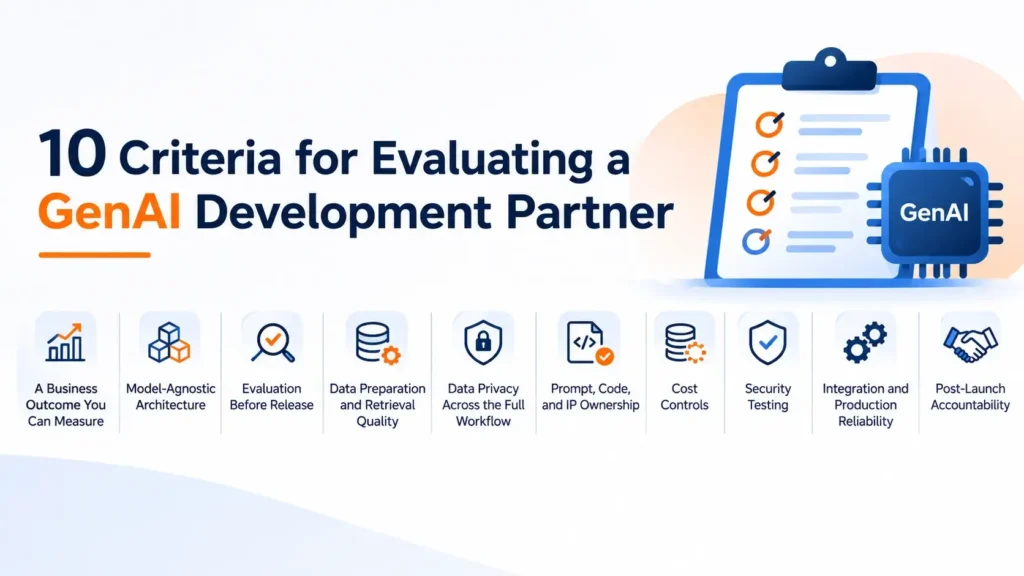
Inquire how the supplier perceives success given the present-day procedure.
To provide an illustration, if we assume that staff members take 20 minutes to finish a report, see if the new application is capable of reducing that time along with the review. Moreover, a draft that is produced in 30 seconds won’t yield much in terms of value if we need to spend another 25 minutes modifying it.
Ask for three items that are associated with the project – current performance levels, desired improvements, and measurement methods.
The team needs to provide an explanation of how this works when it comes to model selection.
Ask about the number of available model options when working on several tasks. Assess the quality of the responses provided, the speed of their production, processing abilities, and pricing. Identify which aspects depend on the provider.
The model-agnostic paradigm cannot be viewed as a paradigm in which one model can replace another. There might be differences in prompts, format, security policies, etc. A reasonable offer would lay out all those relations along with a rough estimate of what investment would be needed for the transition.
Determine how the supplier verifies the provision of service after the live demonstration.
It is advisable to propose a group of 50-200 different examples, which include standard contingencies (ambiguous input, missing input data, and conscious information misuse). The amount of the examples should depend on your project and risk level.
In case the installed software presents an assistant, you should verify the source and whether the answer is complete. In the case of structured extraction tools, you should check whether the fields are correct and properly formatted.
Investigate how the system will deal with outdated documents, replicas, scanned sources, and contradictive requirements.
Retrieval-augmented generation or RAG implies that users need to feed the model with the necessary data before posing the question. It works if the right materials are found and access restrictions are observed.
Ask for a test involving two workers with different permissions – they should only see what they are allowed to view.
When assessing the custom development of generative AI, make sure that document preparation, retrieval testing, and regular update of sources are included in the scope of work.
Get a data-flow diagram detailing the locations of all data flow and storage.
It should include models for requests, input files, embedding, logs, back-ups, and monitoring equipment. Request information on retention rates, disposal, area of the implementation, and contractors’ names.
The statement “Your data is safe” does not offer enough information. All parameters relating to the solution must be clearly defined by the vendor.
Introduce a destruction test as part of acceptance: get rid of a file and see if the solution has stopped retrieving it together with making separate notes about backups’ tracing.
Confirm ownership before starting work on development.
In the contract, it must be known what is your data and what belongs to the vendor, along with any involved third parties.
Ask explicitly about:
The system must be arranged in a manner that will involve retrieval, monitoring, inference, storage, and human actions of retrieval, monitoring, inference, storage, and human actions.
The effectiveness of the system could be defined as its cost per task. The frequency of retries and corrections impacts the performance negatively.
Some of the measures can include limiting the requests and retries, trimming the context, proper modeling of the task, and setting up spending alerts. It is also worth discovering what happens when the budget is spent out.
The vendor has to investigate possible attempts to manipulate the system via the messages sent by users and the content retrieved.
According to OWASP, prompt injection is a significant risk when applying LLM apps and RAG and fine-tuning cannot fully prevent this risk, which is why the proposal must cover controls that go beyond wording.
Request an architectural presentation on subjects such as authentication, APIs, timeouts, retries, and recovery from failure. Service interruption during a CRM upgrade should not contain double records due to an application retry.
A proposal put forth by the Generative ai software development services must expound on the many operational requirements and how its team will test these before the software release.
Ask who investigates a wrong answer, who grants permission for a model upgrade, and who maintains the evaluation set. For a generative AI development services company, delivery responsibility should extend to an agreed-upon operating and handover plan.
If your application also takes actions across business systems, use our AI agent development company checklist for additional questions about tool use and oversight.
| Red flag | Why it matters |
| “We guarantee completely accurate answers.” | The claim ignores uncertainty and unfamiliar inputs. |
| Every project uses the same model. | The recommendation may overlook your requirements. |
| Evaluation begins after launch. | Users become the first meaningful testers. |
| The quote excludes operating costs. | Monthly spend remains unclear. |
| Ownership is described as “standard terms.” | Important assets may be excluded. |
| Security answers mention only encryption. | Permissions and misuse remain unaddressed. |
| Partnership badges replace delivery evidence. | Credentials do not establish project suitability. |
Here are some of the essential questions that you must consider asking so the delivery team can prepare specific answers:
When seeking generative AI development services in USA, management needs to check operational hours, contracting options, and availability of support. Simply learning an office address will not suffice.
Apply the above-mentioned 10 points of comparison and assess every vendor by assigning score from zero to 3:
The maximum score is 30. These are general terms of procurement and do not correspond to the accepted industry standard scoring.
Technology partnership information at NextGenSoft indicates that we are an AWS Select Tier Service Partner and are members of Anthropic’s Claude Partner Network. This is what should be evaluated by users.
AWS describes Select Tier partners as dedicated individuals who have gone through training and gained vast experience in working with customers. This knowledge is intimately tied to the cloud delivery and operational requirements described in this checklist.
Claude Partner Network registration is also important when assessing a Claude-based application. Nevertheless, buyers should always ask for project-specific architecture, evaluation, and cost estimates.
The services we offer include readiness assessment, model selection, RAG, application integration, deployment, etc. The services align with different aspects of the checklist and result in a solid foundation for detailed technical discussions.
Use the discovery process to answer three vital questions: can the proposed solution deliver on your expectations of quality, can your organization implement it properly, and do the potential gains justify the costs needed to establish the solution?
For the discussion, bring one workflow, relevant sample data, expected usage, and the reference baseline that you currently have. This information will assist you in defining the necessary scope and acceptance criteria.
Explore NextGenSoft’s Generative AI Development Services to discuss your requirements, delivery options, and the evidence needed before moving into a production build.
1. What should I look for in a generative AI development company?
Answer: Check whether they possess relevant production experience, effective assessment techniques, data protection procedures, and the documentation of ownership.
2. Does every GenAI project need a fine-tuned model?
Answer: This is not true. First, find out if there is any model that has already been built and is good enough when it comes to usage in your case.
3. How much do generative AI development services cost?
Answer: It all depends on the difficulty of processes involved, cost of data preparation, different integrations and security issues, and usage.
4. Who should own the prompts and code after delivery?
Answer: Your contract should specify the project-related code ownership along with the prompts, various methods for evaluation and configuration.
5. How can I check whether a GenAI pilot is ready for production?
Answer: This should be done based on acceptance criteria set in advance. Evaluate its output quality, restrictions in its work, speed, failures, and cost per task done.
 Brijesh Shah
Brijesh is an IIM Ahmedabad alumnus with 22+ years of experience in software development and management. As the visionary leader of NextGenSoft, he drives the company toward becoming a global leader in software services and digital transformation. He also serves as Vice President of the PMI Gujarat Chapter.
We’re ISO/IEC 27001:2022 certified, ensuring your projects are executed with globally recognized security standards.

INDIA
 sales@nextgensoft.io
 +91 81284 66678


