Enterprise Architecture Framework: What It Is and How to Choose One
Niraj SalotOctober 21, 2026
Share this article


Let AI highlight what matters.
A fundamental aspect of enterprise architecture is the fact that it efficiently bridges the gap between business objectives and decisions regarding technology, applications, and data, since many projects rely on the same data, system, or budget.
Let us say that a distributor is upgrading its order system while the finance department is going through the process of upgrading its ERP system. In both cases, the two projects rely on customer records and inventory information.
If they do not agree on what system should be used, a situation may arise when each of the projects develops an independent solution to address the problem. By using enterprise architecture, it is possible to establish the need for a common decision before both approaches are used.
In this article, we are going to examine the main approaches to using enterprise architecture, when consulting is useful and what can be achieved in the first 90 days.
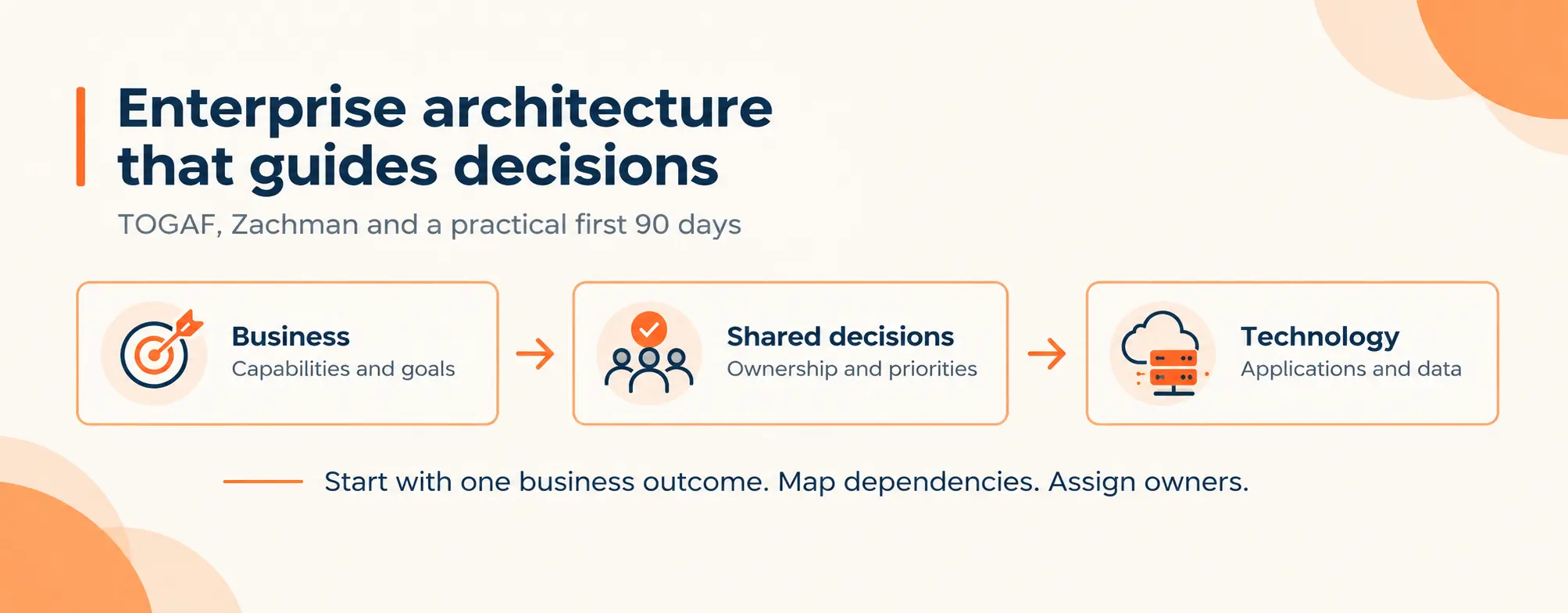
An enterprise architecture framework provides ideas, methods, or classifications for describing the organization and making changes. Depending on the approach taken, enterprise architecture facilitates the understanding of the current position of the organization and what it wants to achieve.
For a mid-size company, the starting point can be one business capability: an ability the business needs, such as fulfilling orders or onboarding customers. Map the people, processes, information, and systems supporting that capability before expanding the scope.
Useful decisions include:
EA is not mandatory for documenting all systems prior to implementing changes. It serves as no substitute for product management, project execution, or proper implementation design. The usefulness of a diagram arises if it assists in making a decision, has an owner, and is kept up to date.
Enterprise Architect links organizational goals with decisions taken across systems and teams. This position examines interconnections, assesses compromises and helps management schedule investments. For example, the architect might establish customer data ownership before sales and billing initiatives clash.
This position must be supported from above. The architect can clarify the situation, but business people in charge of budgets, ownership and priorities should approve the changes.
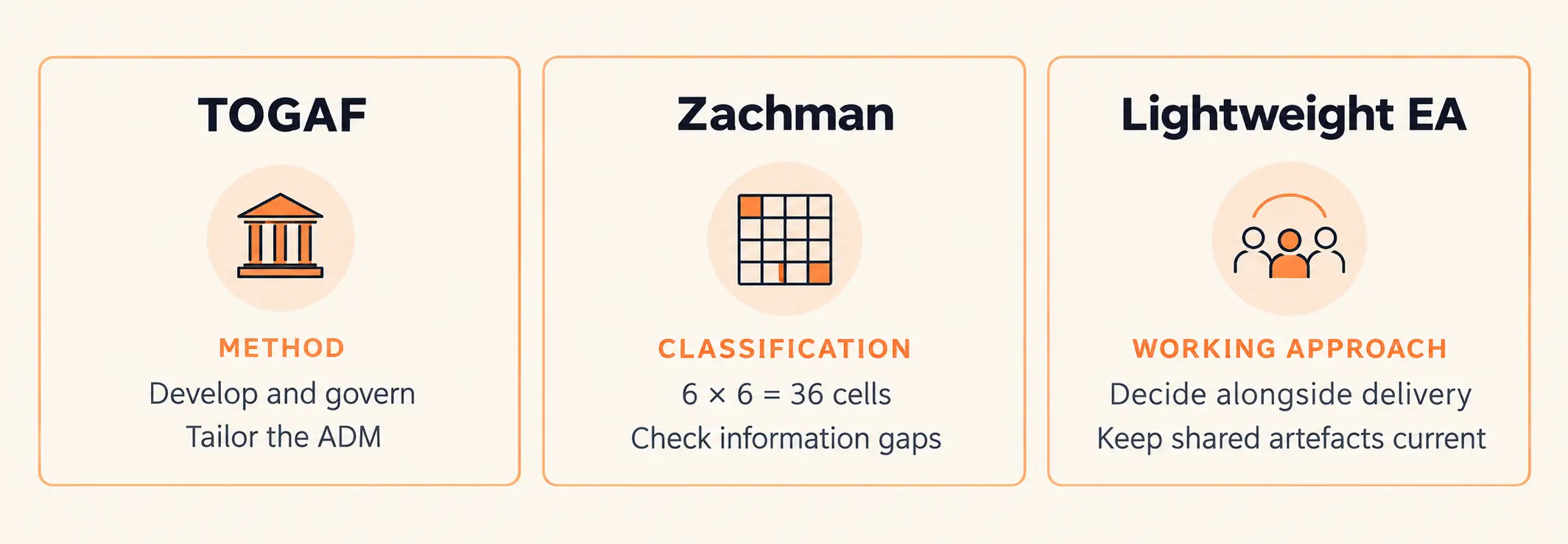
Choose your enterprise architecture framework according to your decisions to be made and the capabilities to use it.
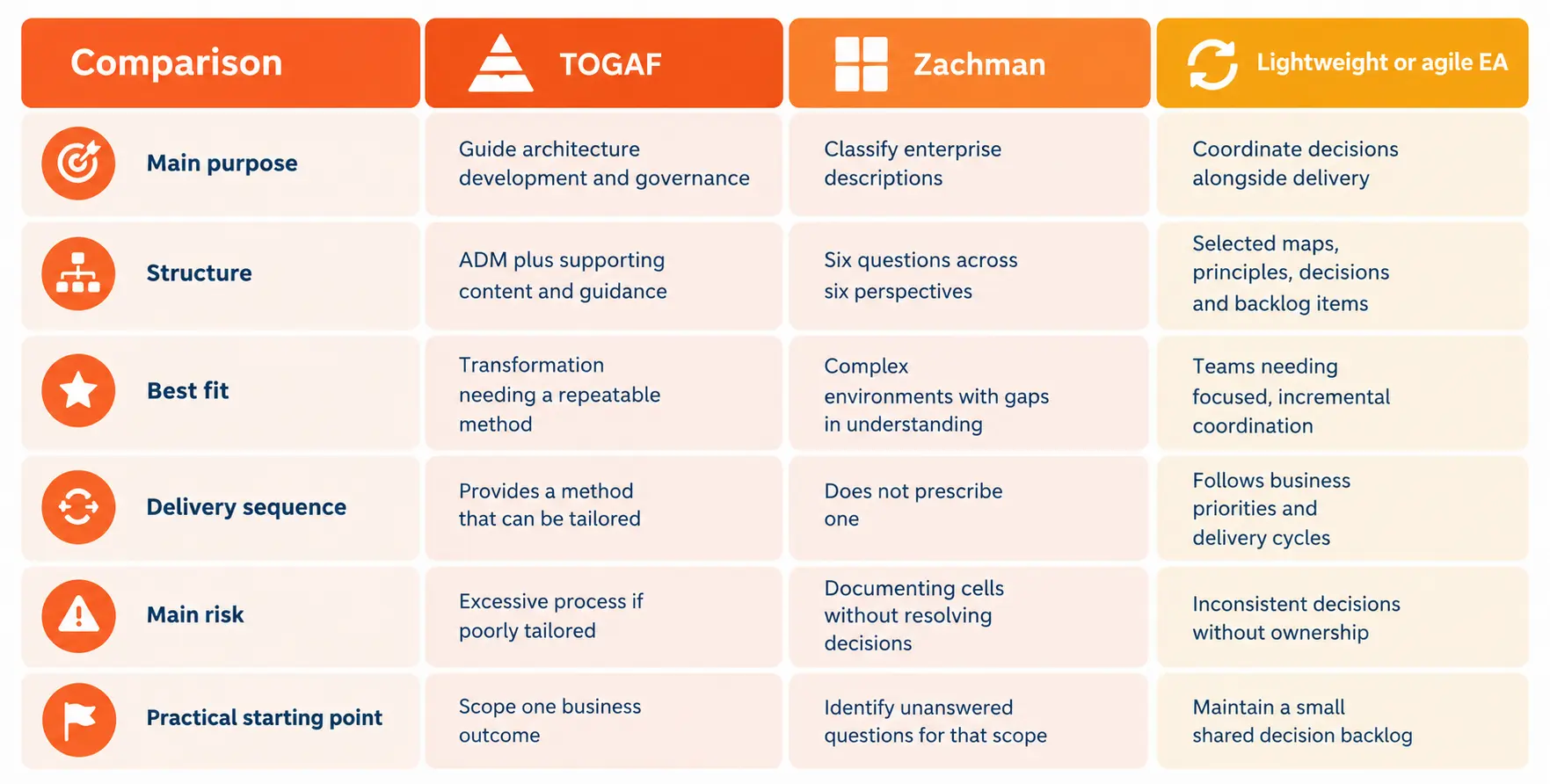
The Open Group’s TOGAF Standard, 10th Edition, separates Fundamental Content from supporting Series Guides. Its Architecture Development Method, or ADM, provides an iterative approach to developing and governing architecture.
TOGAF addresses four architecture domains: business, data, application, and technology, which includes infrastructure and cloud architecture. Its ADM includes Phases A through H, with requirements management operating throughout, alongside a Preliminary Phase. These phases cover vision, architecture definition, transition planning, implementation governance, and change management.
A mid-size business can tailor the method around a specific transformation. For an ERP replacement, that could mean documenting affected capabilities, agreeing on data ownership, and sequencing migrations without producing every possible template.
The Zachman Framework uses a 6-by-6 structure: six questions across six perspectives or transformations. Its columns ask What, How, Where, Who, When and Why. The resulting 36 cells classify different descriptions of an enterprise.
Zachman is an ontology, meaning a structure for organizing concepts; it is not an implementation methodology. It can expose missing information, such as a process with no accountable owner, but it does not prescribe a project sequence. Its rows are not implementation stages.
Lightweight or agile EA describes a way of working rather than one universally defined standard. Teams maintain enough shared direction to coordinate delivery, then update it as evidence changes.
A practical starting set might contain five artifacts: a capability map, an application inventory, a dependency map, decision records, and a prioritized roadmap. This is a recommended starter set, not a formal framework requirement.
Enterprise architecture consulting comes in handy if the issue violates barriers between various domains of business, projected budgets or joint ICT systems. A solutions architect usually aims at delivering the specified technical solution within predetermined organizational restrictions. Positions differ; therefore, focus on duties and not only on the title of the position concerned.
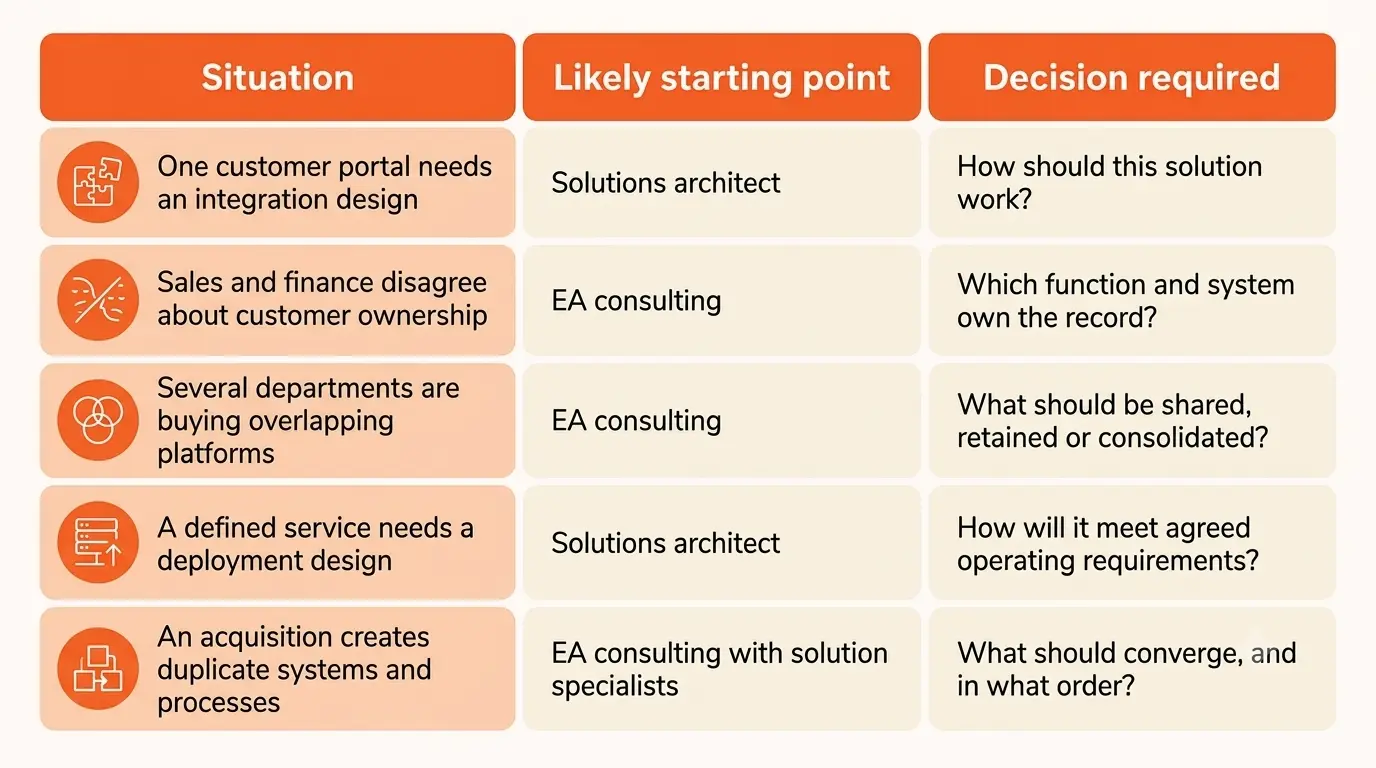
Look for recurring coordination failures:
Advisers need to leave internal stakeholders empowered to execute decisions independently. No outside report can replace missing stakeholders and/or missing executive sponsors.
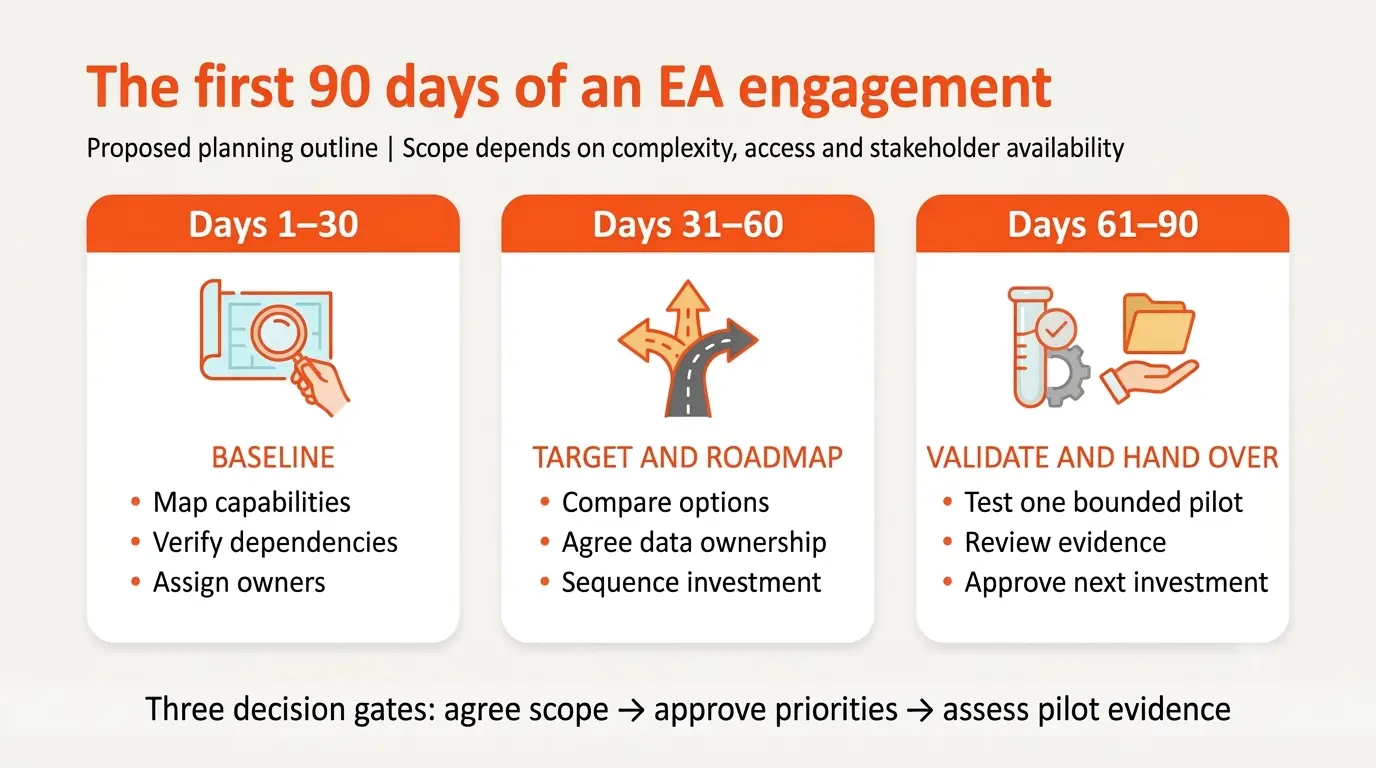
Below is a proposed engagement plan, not a guarantee of NextGenSoft delivery. The exact scope of the project depends on accessibility, its complexity, and the availability of stakeholders. While 90 days is sufficient for establishing the most important directions and conducting limited transformations, it will not lead to enterprise transformation completion.
Pick a single business outcome that you wish to tackle (for example, the reduction of manual order reconciliation). Identify the sponsor, the scope, the decision rights, and the pieces of evidence that you have available.
Speak with the business and technology owners. Inventory all the relevant applications, interfaces, data owners, and contractual restrictions you have. Do not treat an incomplete inventory as verified facts; make sure to state the sources of noise present in it when it comes to uncertainty.
Outputs: A capability map, current-state dependency view, risk register, and baseline measures.
Decision gate: The sponsor agrees which problems the engagement will address and who owns them.
Compare options against business value, cost, risk, and delivery capacity. Define target capabilities, authoritative data sources and the standards teams need to share.
An enterprise architecture strategy should explain sequencing. For example, agree customer identifiers before migrating records, then validate dependent interfaces before retiring an old application.
Outputs: A targeted-state view, an evaluation of options, records of architecture decisions, and a phased implementation plan.
Decision gate: Leadership approves priorities, open trade-offs, and accountability.
Check out our application modernization guide to explore execution considerations.
Test one controlled modification, e.g., ensuring synchronization of customer records across systems. Acceptance criteria must be established in advance: data matching, access rights, failure recovery, and managing the process.
Evaluate the pilot against a baseline. The successful pilot replicates the target activity, not all connected activities.
Outputs: Proof of pilot success, backlog of delivery, and transfer to responsible parties.
Decision gate: Evidence and unmapped risks determine the next investment.
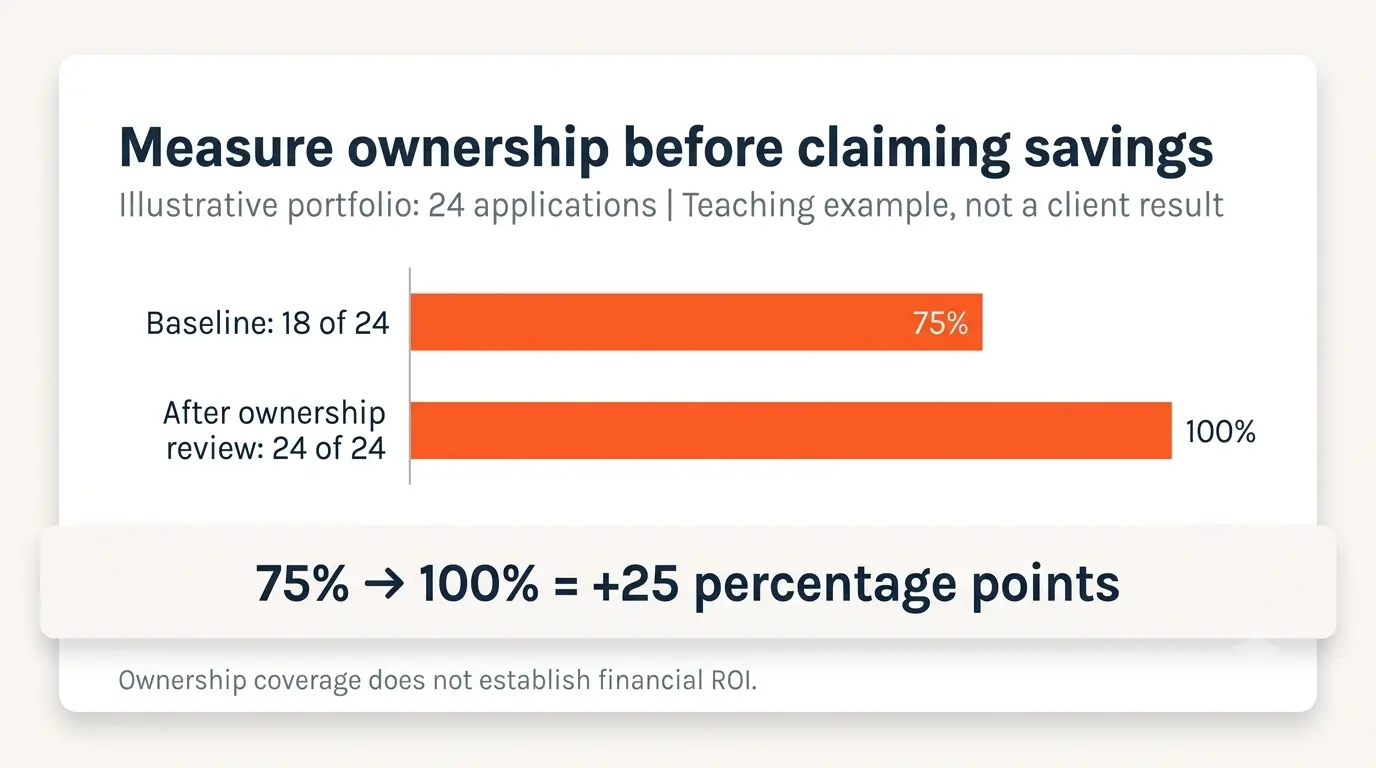
Evaluate an enterprise architecture framework through decisions and outcomes, not diagram counts. Track application-owner coverage, unresolved cross-team decisions, manual reconciliation effort, and dependencies blocking delivery.
In an illustrative portfolio containing 24 applications, ownership confirmation for 18 means that this corresponds to an ownership coverage of 75%. The coverage will be lifted to 100% upon raising the number of confirmed applications to 24, which is a 25-point increase. While ownership coverage improvement increases accountability, it doesn’t guarantee cost savings.
In the same manner, by retiring two of six overlapping subscription services, the number of subscriptions is decreased by one-third. However, for financial savings, one has to analyze licensing agreements, migration expenses, and remaining commitments.
It must be noted that NextGenSoft’s Enterprise Architecture Services offer a wide range of possibilities, starting from requirements analysis and architectural planning and ending with the information technology selection and implementation plan creation.
Engagement models proposed by the company include project-based assignments, work of dedicated teams, staff augmentation, and governance consulting. Consider which model best suits your assignment needs and capabilities. Always ask for clear deliverables, decision-makers, and acceptance criteria when signing the engagement agreement.
A suitable enterprise architecture framework enables leaders to make interlinked decisions on business priorities, systems, and investments. Identify a specific problem, select the suitable architecture, and leave it to internal stakeholders to oversee the process.
If conflicting goals or joint dependencies are causing delays, consider contacting NextGenSoft‘s Enterprise Architecture Services team. Share the expected business outcome, systems in question and other relevant information, so that the discussion of the architecture framework can be conducted efficiently.
1. Which Enterprise Architecture Framework Suits a Mid-Size Company?
Answer: A very good approach could be to create a personalized approach and adopt TOGAF for the architecture framework in delivery.
2. Can TOGAF and Zachman Be Used Together?
Answer: Yes. TOGAF is able to assist in the development of architecture, whereas Zachman ensures that the information is defined in a proper way. One should use descriptions that reinforce decisions rather than consider all the cells as compulsory project outcomes.
3. When Should a Company Hire EA Consulting?
Answer: You should consider seeking external assistance when decisions involve different departments, commonly used systems, or the investment portfolio, and internal teams have not been able to resolve trade-offs. For simple problems with well-defined scope, the assistance of a solutions architect would be enough.
4. What Should an EA Engagement Deliver in 90 Days?
Answer: A good engagement might result in a verified baseline, designed state of affairs, established priorities, and some proof obtained during a small pilot project. However, it is not easy to determine the deliverables without knowing the complexity of the system as well as the availability of resources and stakeholders.
5. Does Enterprise Architecture Require an Expensive Tool?
Answer: Not at all. For initial low-scale purposes, you can use already available spreadsheets, documentation, and process maps. However, if you want to build a repository that supports relationship control, traceability, and timely updates, the solution should be reconsidered.
 Niraj Salot
, with 20+ years of expertise in software architecture, specializes in delivering robust enterprise applications. His cloud optimization skills help clients cut costs while maximizing performance. As a key leader at NextGenSoft, he drives scalable, efficient, and high-performing solutions.
We’re ISO/IEC 27001:2022 certified, ensuring your projects are executed with globally recognized security standards.

INDIA
 sales@nextgensoft.io
 +91 81284 66678


