What Do Application Maintenance Services Include? A Guide to SLAs and Costs
Aman MishraOctober 15, 2026
Share this article


Let AI highlight what matters.
Application maintenance services help keep software reliable, secure, compatible, and efficient through ongoing support and improvements.
The four main types of maintenance are corrective, adaptive, perfective, and preventive maintenance.
Effective maintenance includes bug fixes, security patches, performance monitoring, incident management, testing, backups, and documentation.
A clear Service Level Agreement (SLA) should define response time, restoration time, resolution time, support hours, escalation procedures, and service availability.
Software maintenance costs depend on code quality, documentation, technology stack, support coverage, release frequency, integrations, and security requirements.
Businesses should consider legacy system modernization when recurring issues, outdated components, and growing maintenance efforts affect reliability and business operations.
NextGenSoft provides application support and maintenance covering onboarding, monitoring, incident response, controlled changes, performance monitoring, and backup restoration.
One must act immediately if there is a failed checkout process. A slow reporting screen can wait until the next business day. Both are in need of maintenance but differ in the response time required, skills used, and finances needed.
Application maintenance services help retain current running programs. This includes fixing mistakes, updating compatibility, and improving performance. Also, there should be a clear understanding of how incidents have to be managed and managed.
There are three questions that need to be clarified for companies looking for providers: what is offered, what is written in the SLA, and what affects the cost. Let’s get a complete understanding of it.
Application modernization services include a remedy for current problems as well as engineering improvements done for programs in the future. The agreement should state the application involved, environments, and responsibilities.
Most maintenance work fits into four categories:
Categories like this help to distinguish types of tasks but do not mean that every improvement will be done within monthly contracts, as a new major feature will need a separate estimate.
A practical involvement should include responsibilities like:
This includes environment management, access management, vendor management, and reporting of the services.
The management of cloud applications can include reviewing the usage levels, configurations, capacities, and dependencies of cloud services. You should check whether the maintenance provider takes care of the specific tasks or the internal/external team does.
The SLA, or service level agreement, is an agreement that states what services have been offered. When it comes to application maintenance, the SLA should be matched with the urgency of the issue and the level of impact.
Thus, payment failure and purely cosmetic malfunction should not enter one and the same list with the same priorities and due dates.
The various phases of the process are:
Being committed to a 15-minute response does not mean that the system will be rectified in that time period.
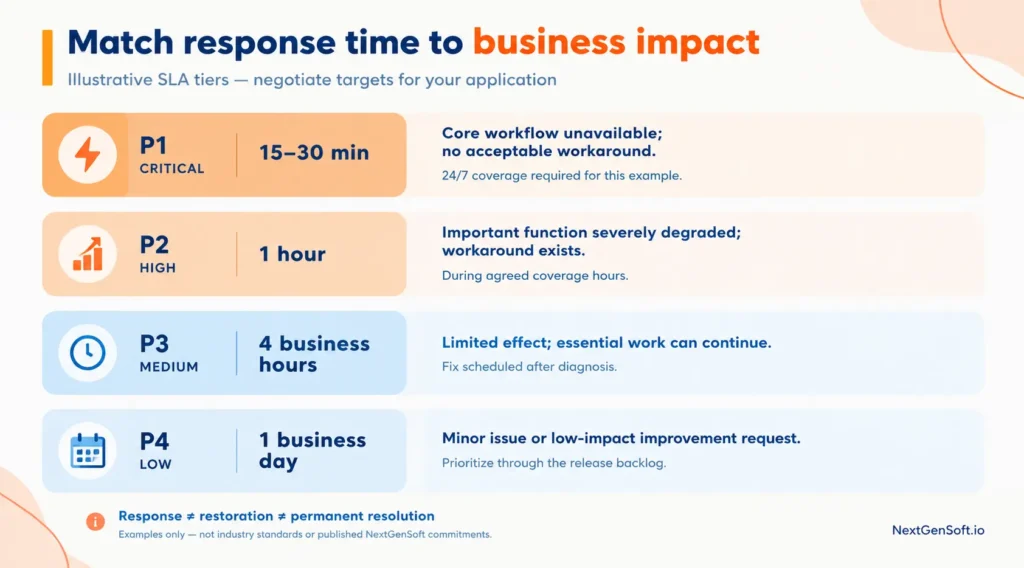
The following pointers are a starting point for negotiation.
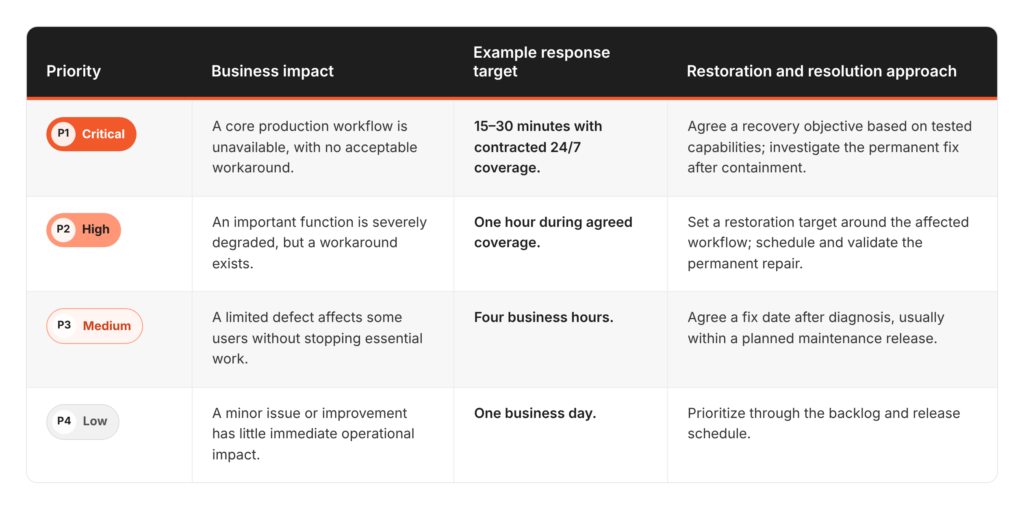
A worldwide transaction platform can require 24/7 incident management. An internal application that is used only during business hours can fit in the business hours coverage if the company is comfortable with the overnight downtime.
The levels of support differ from incident priorities. The first level is usually the one with the first requests. The second level works on configuration issues and environment issues; the third level deals with coding issues. Serious incidents may involve immediate third-level assistance.
The contract should clarify:
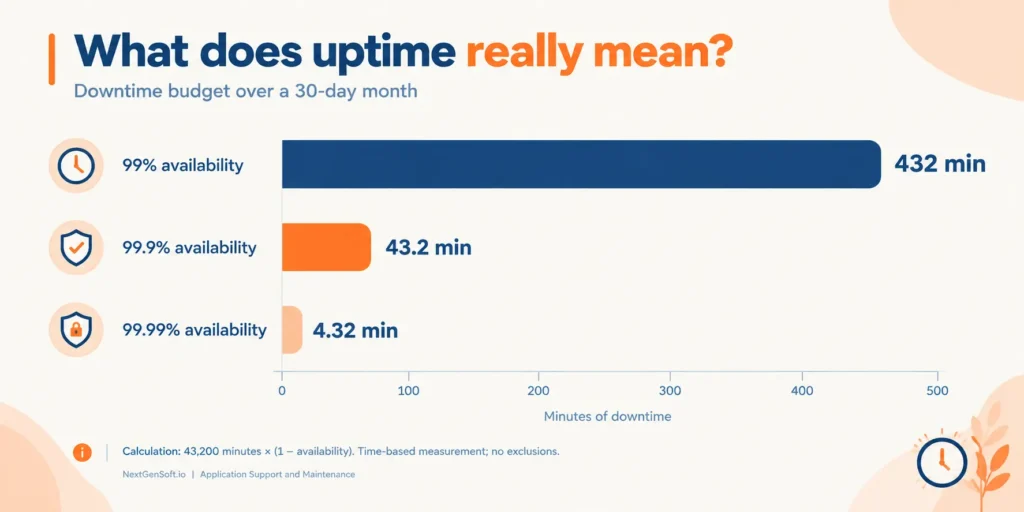
The term availability must also be clearly explained. According to the time-based calculations, if the level of availability is 99.9%, it implies that there will be about 43.2 minutes of downtime during 30 days. The most valuable indication would be to measure if a user is able to perform the necessary transaction rather than simply measure whether the server provides a response. Google Cloud Blog
For recovery planning, one must determine the recovery time objective (RTO) and recovery point objective (RPO). RTO refers to the period within which restoration should occur, while RPO means the acceptable time lapse for data loss. It is necessary to check if a technical arrangement works as planned.
Software maintenance cost depends on the amount of effort and preparedness required to support a specific application. A price is reasonable only when the scope, assumptions, as well as exclusions are specified clearly.
Quality code, helpful documentation, and automated testing make investigation easier.
An application without documentation and with tightly coupled elements requires a lot of time to figure it out and test. A small change implemented in one part of a system probably affects a lot of other elements in it.
The idea that software maintenance costs are solely determined by age is erroneous. In fact, reliable technologies are safe for use.
The situation becomes more complicated when framework authors stop providing updates, compatibility tools become unavailable, and the knowledge of specialists fades away. Emergency solutions may require backtracking later.
Regular support requires different staffing requirements than a 24/7 service.
Short response times necessitate having engineers available for escalation, constant monitoring, and some operational training during off-busy hours. Companies pay for both readiness and closing tickets.
Frequent releases result in an increased number of tests, deployments, and control. Automation may help reduce the amount of manual effort needed.
Less frequent releases may be costly in an indirect way, as when changes are accumulated, it leads to complicated deployments. The essential question is how fast and reliably this could be achieved.
External payment services, identity providers, databases, and partner APIs introduce dependencies outside the application itself.
Compare proposals using the same assumptions: included engineering hours, environments, patching duties, testing, reporting, onboarding, and out-of-hours work. Keep cloud bills, software licenses, and major development projects visible as separate items where applicable.
Read Also: Architecting for Success: Essential System Design Principles for Developers
Maintenance guarantees that a program is operational in its existing form. Legacy system updates involve altering technology, design, or delivery models in cases when such maintenance is a repeated hindrance for business.
The assessment can be initiated if:
There are no symptoms that can independently justify the system replacement. All options need to be evaluated while comparing the costs of changes to the continuation of the support process. Maintenance activities have to be carried out during the transition, and ownership of old and new systems should be clarified.
NextGenSoft’s support methodology consists of onboarding, monitoring, response to incidents, controlled changes, reporting, and continuous improvement. Our scope of delivery includes user support, access management, code fixes, performance monitoring, and backup restoration.
We offer engagement models as per request: fixed monthly and limited mixed time charges. The specific number of covered hours, response targets, and inclusions must be defined in the proposal and agreement.
When assessing application maintenance services, make sure to prepare an application inventory list, history of incidents during the past period, release schedule, and list of business-critical processes.
The strongest maintenance plan makes responsibilities clear, sets achievable service targets, and reserves time to prevent recurring problems. Its value should show in dependable workflows, safer releases, and fewer repeated incidents.
Explore NextGenSoft’s Application Support and Maintenance offering to discuss application maintenance services aligned with your application’s condition, operating hours, and business priorities.
1. What is included in application maintenance services?
Answer: Application maintenance services usually involve fixing bugs, upgrading security, improving usability, adjusting system compatibility, and carrying out preventive maintenance.
2. What is the difference between an SLA response time and a resolution time?
Answer: Response time shows the speed with which the support team recognizes the problem and starts solving it. Resolution time indicates the duration needed to address the problem’s cause and check if it is solved.
3. What factors affect software maintenance cost?
Answer: Software maintenance costs depend on several factors, such as code quality, presence of documentation, status of technology support, existence of integrations, coverage time, and frequency of releases.
4. Does every application need 24/7 maintenance support?
Answer: Not necessarily, as the coverage should comply with the periods of application use and outage consequences. A global customer-oriented platform might require urgent issue resolution at any time.
5. When should a business consider legacy system modernization?
Answer: Businesses need to think about upgrading legacy systems when there are repeated failures in the system, outdated technology is in use, or its structure prevents normal operation.
 Aman Mishra
, a DevOps Engineer with over 8+ years of experience, specializes in AWS, Azure, Kubernetes, CI/CD pipelines, and more. Passionate about learning new technologies, he continuously explore cloud innovations and automation to drive efficiency and scalability.
We’re ISO/IEC 27001:2022 certified, ensuring your projects are executed with globally recognized security standards.

INDIA
 sales@nextgensoft.io
 +91 81284 66678


