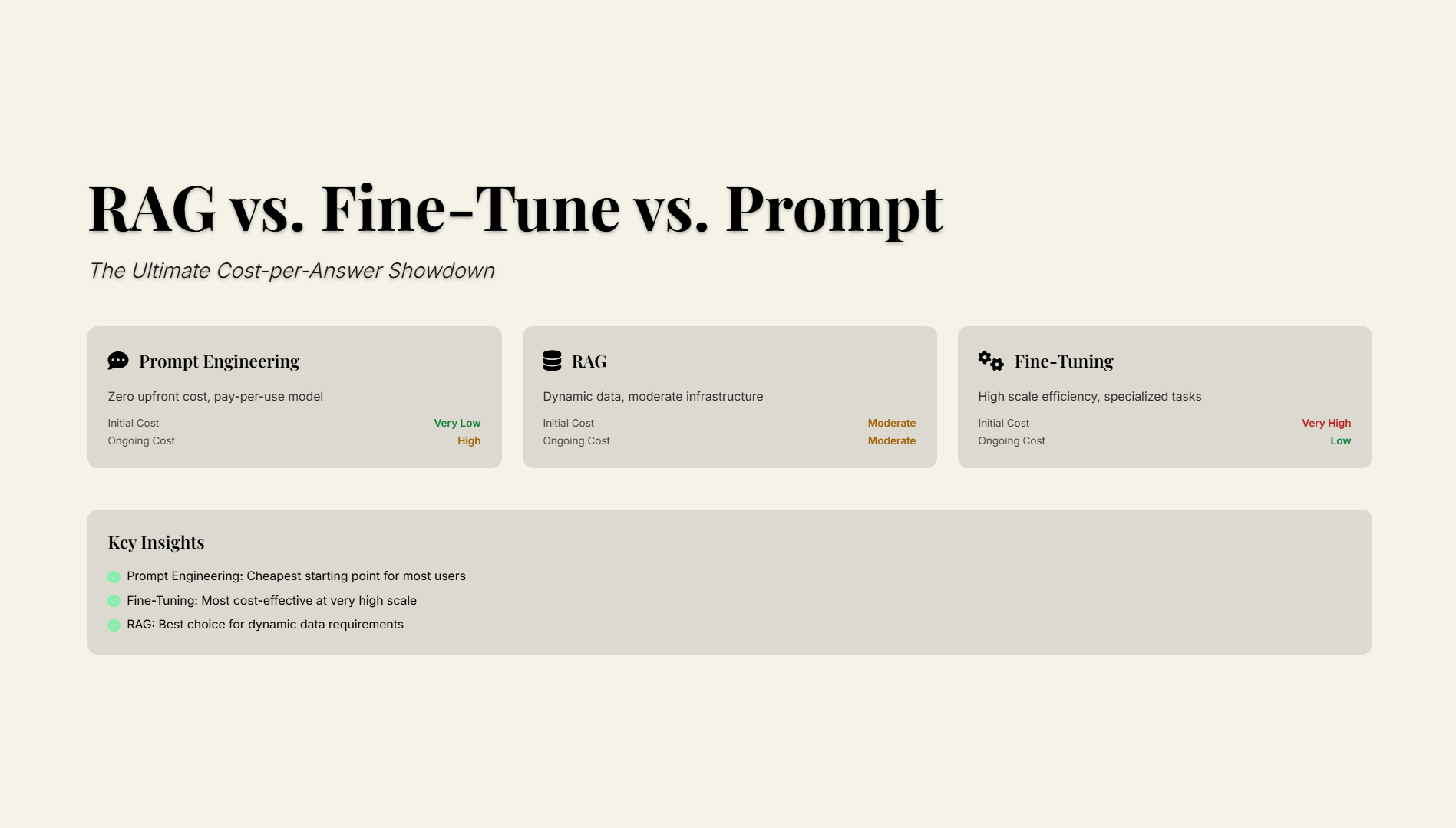
RAG vs. Fine-Tune vs. Prompt: The Ultimate Cost-per-Answer Showdown
Yash BaravaliyaNovember 20, 2025
Share this article


In the rapidly evolve landscape painting of artificial intelligence, business and developer be constantly seeking the nearly effective and cost-effective methods to leverage Large Language Models (LLMs). The fundamental question that frequently arises is which optimization strategy Prompt Engineering, Retrieval-Augmented Generation (RAG), or Fine-Tuning delivers the low cost-per-answer?
This be not merely an academic exercising but a vital business decision that impact everything from initial investment and in operation command overhead to long-run scalability and functioning. the answer, is non-straightforward.it depends on a complex interplay of factor, including the specific use case, data point requirement, query volume, and usable technological expertise. A method acting that be cheapest for a low-volume, observational project may go prohibitively expensive at an endeavour scale of measurement. a comprehensive analysis is required to make a motion beyond simplistic cost comparison and understand the genuine fiscal implications of each approach.
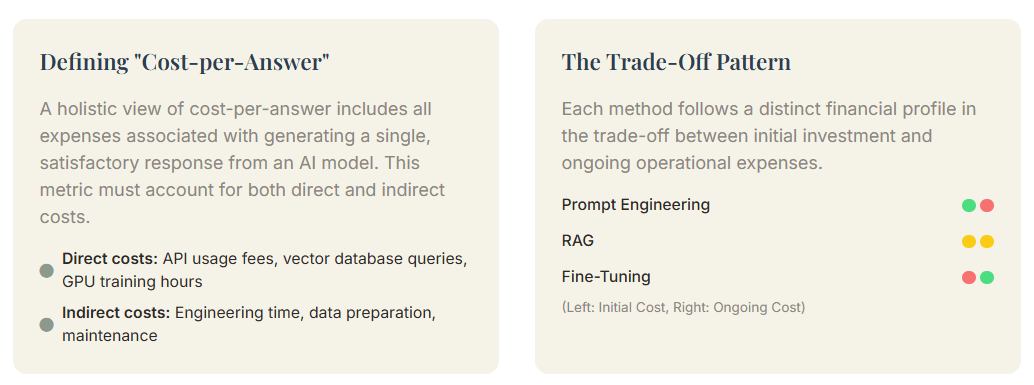
To accurately compare these three methods, we must first define what “cost-per-answer” entails. Additionally, It is to a greater extent than merely the cost of an API telephone call. Consequently, A holistic view of cost-per-answer includes all expense associated with generating a single, satisfactory response from an AI model.
This metric must account for both direct and indirect cost.
Therefore, a genuine cost-per-answer calculation must be a comprehensive total price of ownership (TCO) analysis, amortize over the telephone number of answers generated.
The quest for a single “cheapest” method acting is finally a motley fool be errand because the nearly cost-effective solution be highly contextual. A little business enterprise builds a simple-minded FAQ chatbot will discover prompt engineering incredibly cost-efficient. Additionally, A multinational corporation develop a sophisticated inner knowledge management system might need the domain-specific accuracy of a fine-tuned model to attain lower per-query expense at a monumental scale.
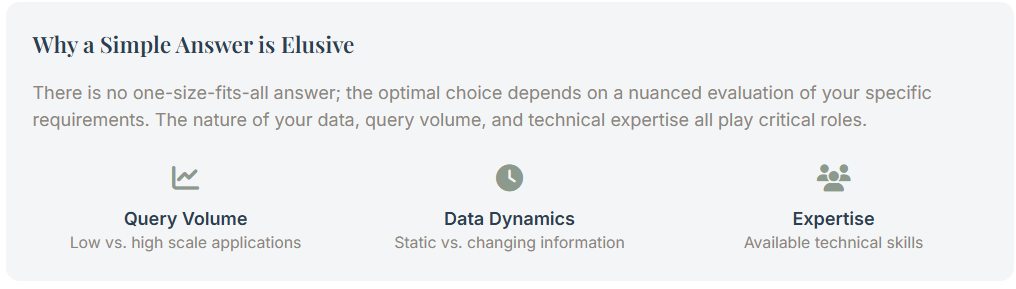
Furthermore, the nature of the data point plays a vital theatrical role. If your Access was need by application program to perpetually change information, RAG is the clear-cut victor because it allows for real-time knowledge base updates without costly model retrain. finally, the “cheapest” method be the one that good aligns with your specific use case, data point dynamic, scale of measurement, and internal resources.
Before we dive into the detailed cost analysis, let be briefly introduce the three primary methods for optimizing big Language Models.
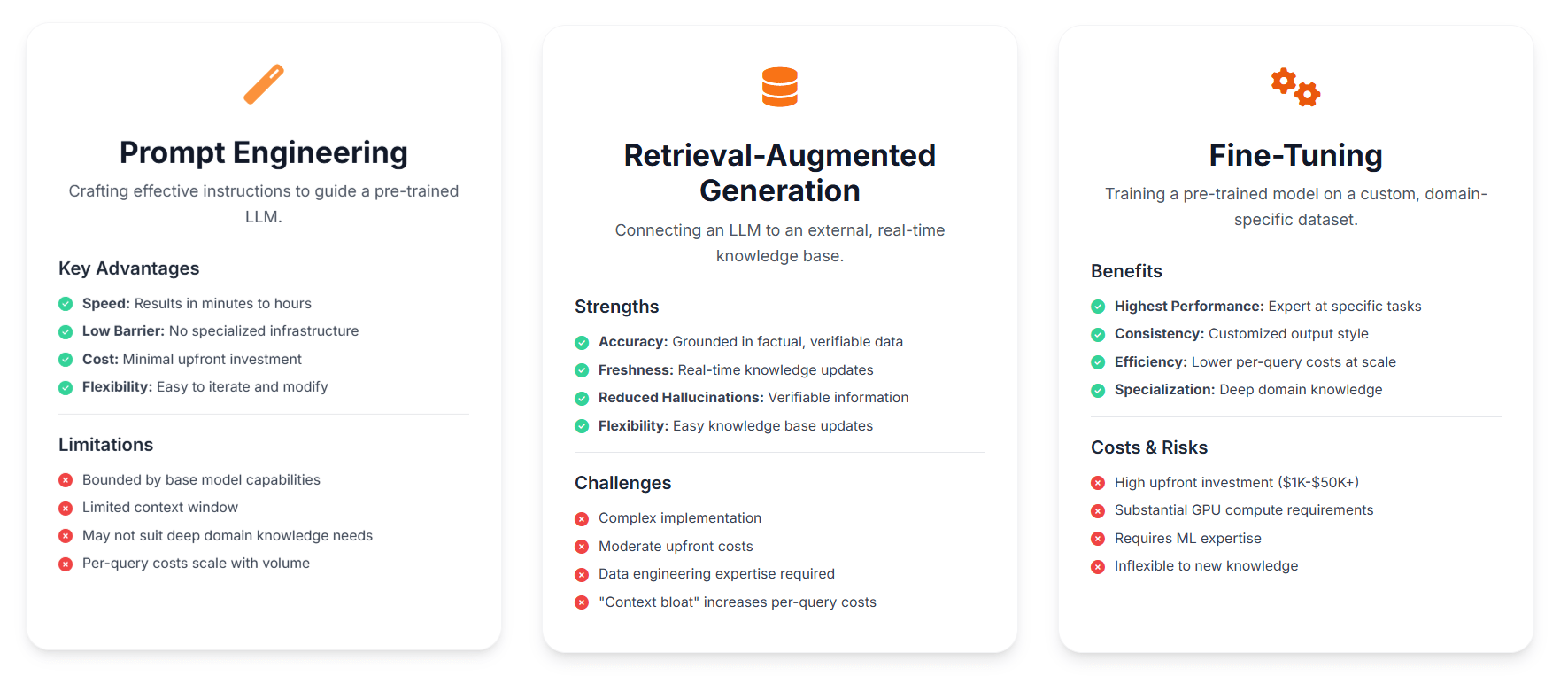
Prompt Engineering be the art of crafting efficient operating instructions (“prompts”) to guide on a pre-trained LLM toward a desired output signal. It is the nearly accessible method acting, require no change to the model itself. The principal advantage be its speed and low barrier to entry. A developer can see to it result in minutes to hours. The costs are minimum, limited to standard API fees, making it ideal for prototyping and application with limited budgets.
RAG enhances an LLM by connect it to an external knowledge base. A RAG system first retrieves relevant, up-to-date info from a database and then feeds this context of use to the LLM to generate a more accurate and informed answer. This approach path ground the model be response in factual, verifiable data, importantly reducing the danger of “hallucination”. Additionally, RAG is perfect for application need dynamic or proprietary information.
Fine-Tuning involves taking a pre-trained LLM and further educate it on a small, domain-specific dataset. Consequently, this process adjusts the model is inner parameters, create a custom-tuned model that excels at a specific task, such as piece of writing in a ship’s company be unique brand vocalisation. The principal welfare is it possible for the highest performance on a focussed job. However, this functioning come at a significant cost, requiring substantial GPU compute power, high-quality training data point, and considerable simple machine learning expertise.
While a elaborated analysis be necessary, we can allow a high-level summary of which method acting is generally most cost-efficient in different scenarios.
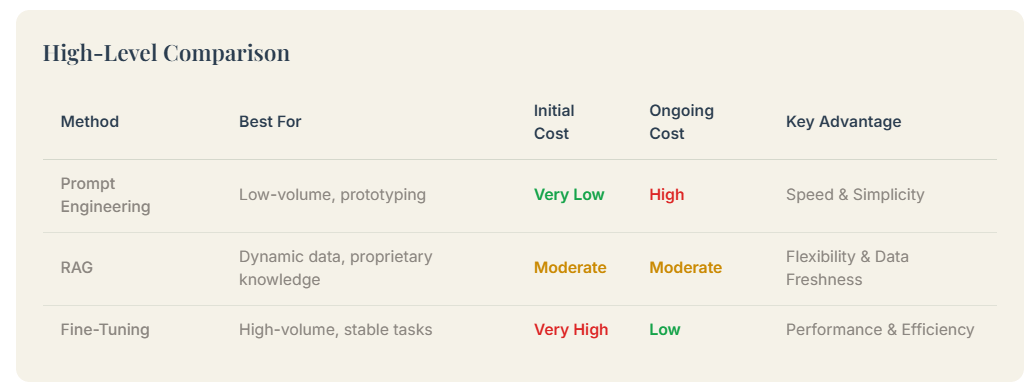
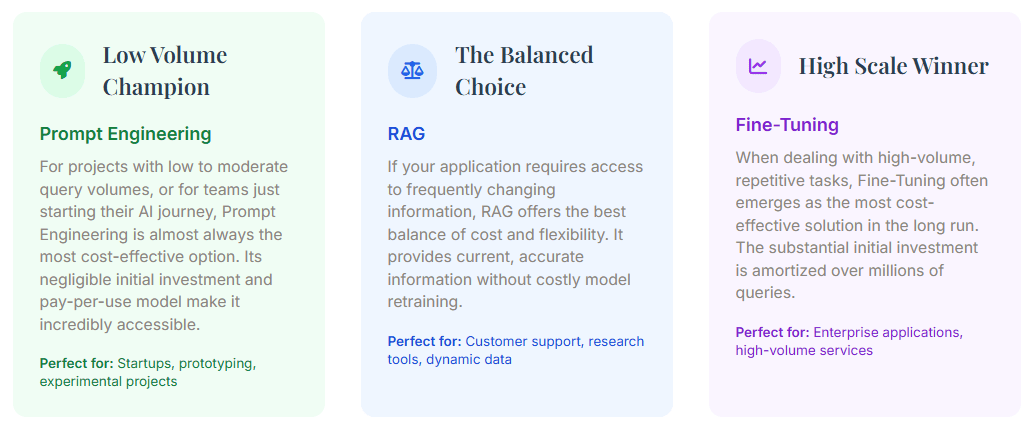
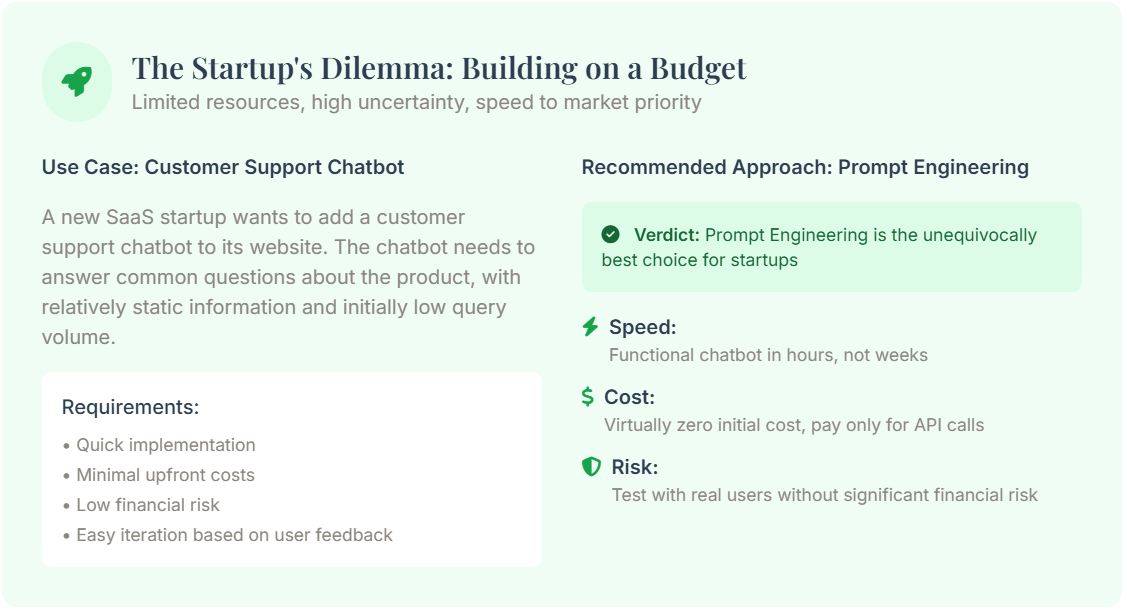
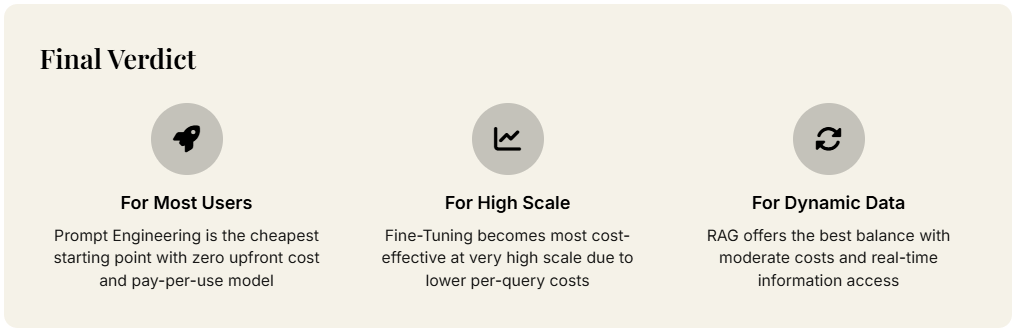
For project with lowly to moderate query volumes, Prompt Engineering is always the most cost-efficient option. its negligible initial investment and pay-per-use price body structure make up it a low-risk manner to test idea and build prototype.
For a start-up with a limited budget (e.g. under $ 10,000), prompt engineering be the clear starting full point.
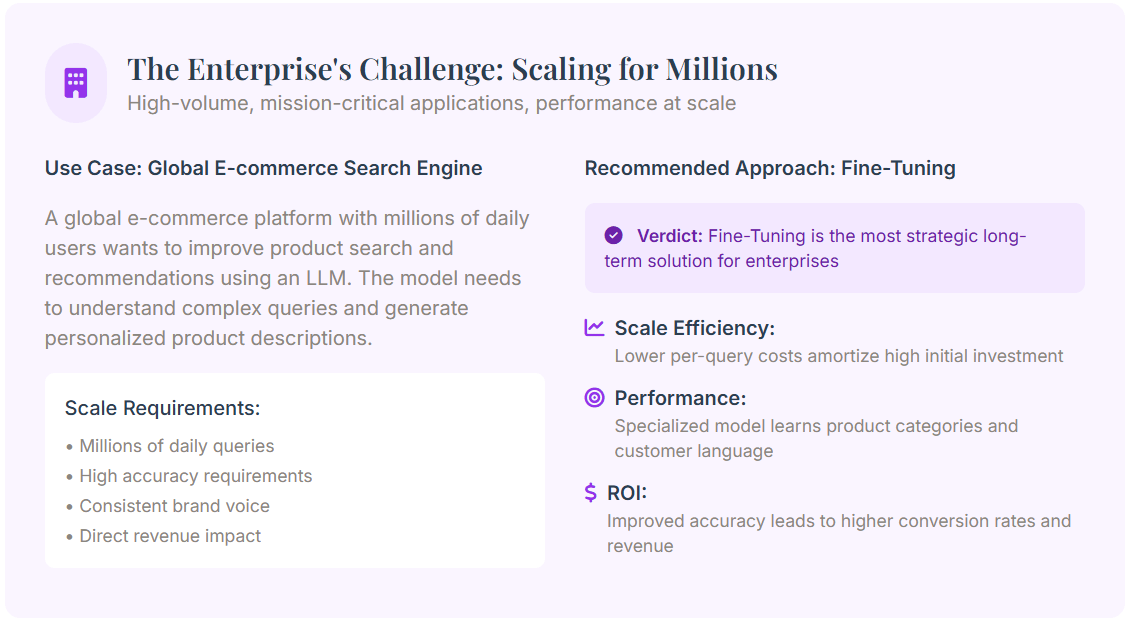
When dealing with high-volume, repetitive task, Fine-Tuning frequently emerge as the most cost-effective solution in the longsighted run. Although the initial investing is significant, this cost is amortizing over millions of queries.
For an endeavour with a stable, high-volume use case, the upfront cost of fine-tuning can be rapidly recouping through low operational expense.
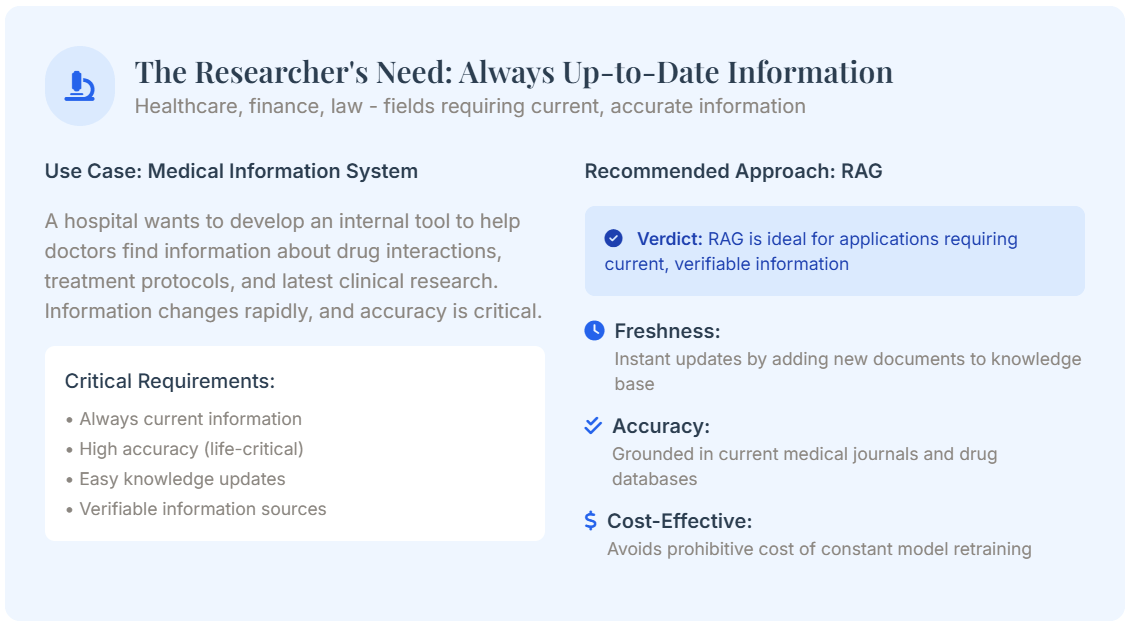
If your Access was required by application to information that change frequently, RAG offer the good balance of price and flexibility. Unlike fine-tuning, RAG systems can be updated instantly by adding or modify documents in the knowledge base.
For usage case where info freshness be paramount, RAG is the most practical and cost-effective approach.
Let is dissect the cost structures of each approach path to see the full cost of ownership.
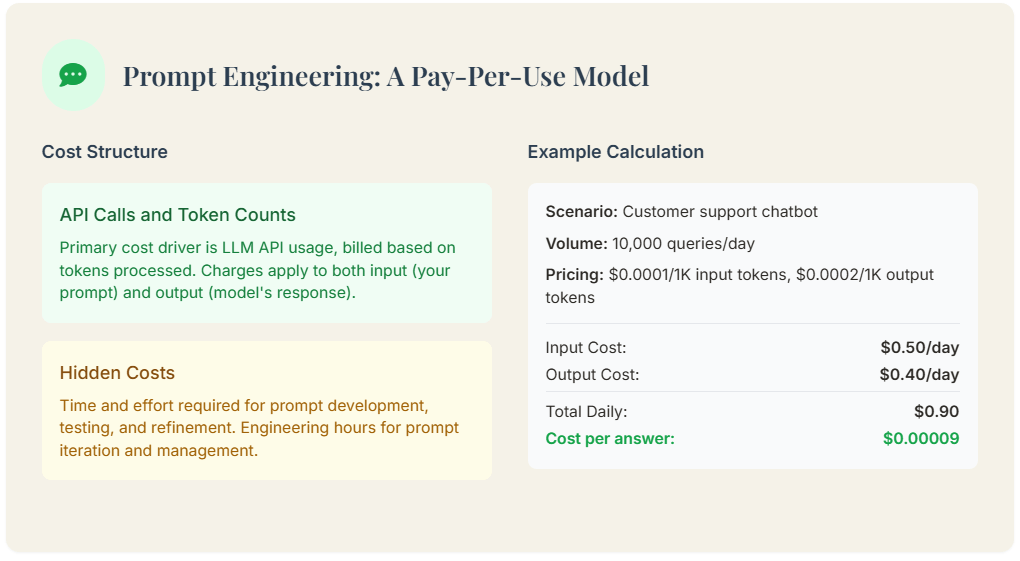
The primary price device driver be API use, charge based on the telephone number of tokens processed (both input signal and output). Consequently, longer prompts and more verbose answer incur high costs. The total cost be a direct mathematical function of query bulk and complexness, make it easy to forecast expense.
Let’s assume a hypothetical “GPT-5 Nano” model costs 0.0001 per 1,000 input tokens and 0.0002 per 1000 output tokens. For chatbot handling daily 10,000 output tokens. For a chatbot handling 10,000 daily queries with an average 500-token prompt and 200-token response:
The nearly significant secret cost be the clock time and effort required to develop, test, and refine effective prompts. Consequently, this iteration process consumes valuable engineering science hours, which translates directly into labour costs.
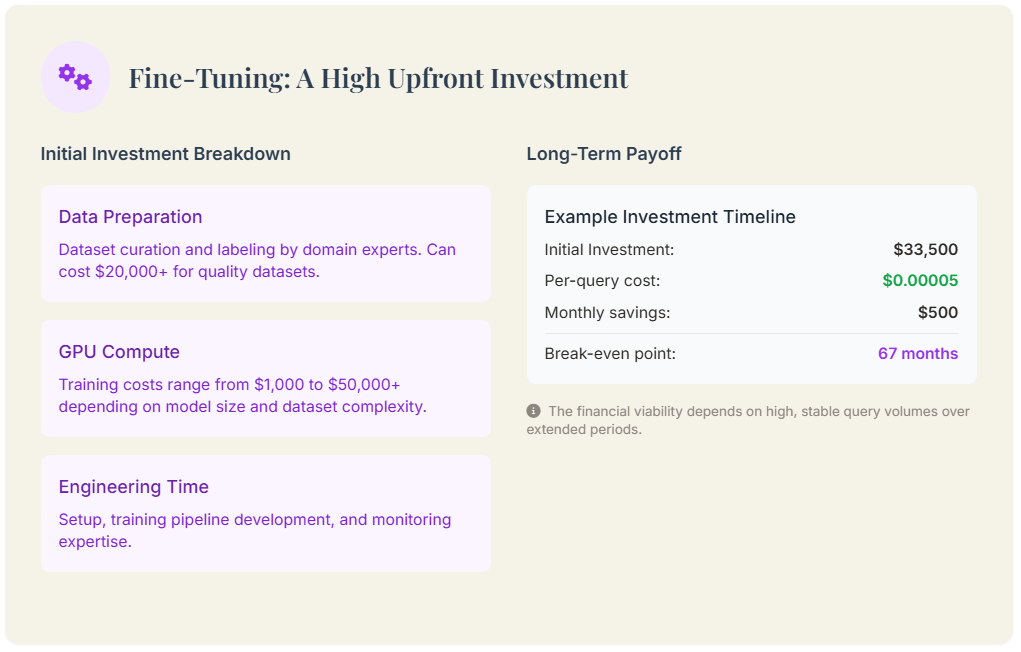
The cost of fine-tuning is dominate by the initial training phase, which include data preparation, compute resource (GPU hour), and engineering science effort. the cost of GPU hours solo can rate from $ 1,000 to over $ 50,000, depend on the model and dataset size.
Imagine an initial investment for a fine-tuned model:
If the result model cost $ 0.00005 per answer and handles 10 million queries/month, the monthly in operation price be $ 500. A prompt engineering solution at $ 0.0001 per answer would cost $ 1,000 per month. In this case, it would take in over 5.5 years for the $ 500 monthly savings to recuperate the initial investment.
The financial viability of fine-tuning hinges on a high query bulk. The “break-even point” is reach when the cumulative savings from lower per-query costs equalize the initial investing. For enterprise with monumental, predictable query volumes, this full point can be reached quickly.
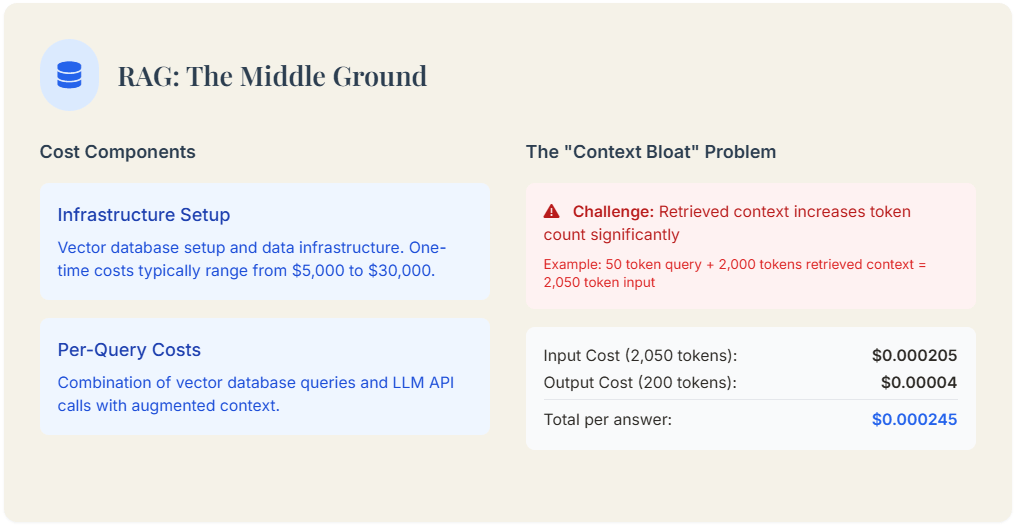
RAG costs be a hybrid. The initial investment involves setting up a vector database, typically range from $5,000 to $30,000. Ongoing variable quantity costs come from two sources: querying the database and the LLM API telephone call. The API call be frequently more expensive due to “context bloat” the retrieve text increases the number of input signal token.
If RAG retrieve five documents total 2,000 tokens to answer a 50-token user query, the command prompt sent to the LLM will be over 2,050 tokens long. Using the same pricing as before (0.0001 per 1 1,000 input tokens) the input token is 0.000205 this This is over four time the price of a simple-minded prompt, highlighting the primary trade-off of RAG: pay a per-query insurance premium for dynamical context.
RAG systems need data engineering expertness to build up and keep data point ingestion pipelines. optimize the retrieval physical process itself—choosing embedding model and tune up search parameters—also adds to the complexness and secret labour cost.
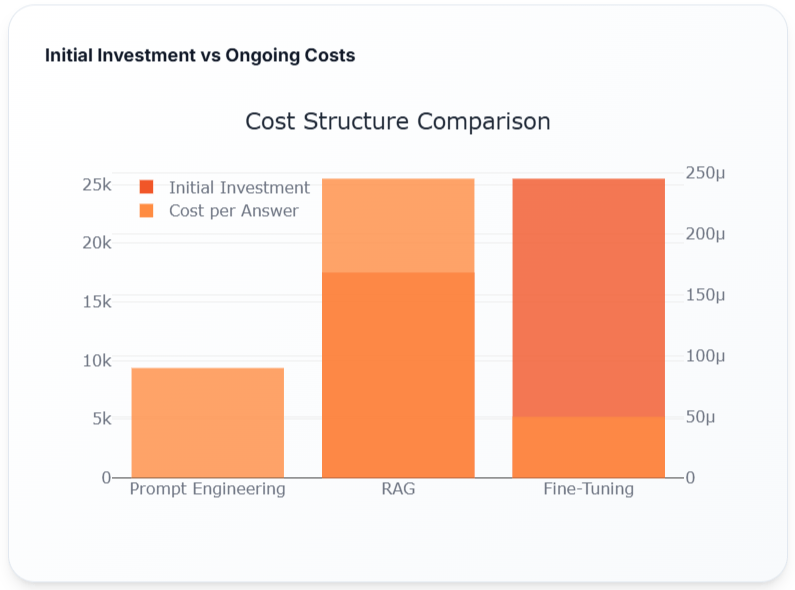
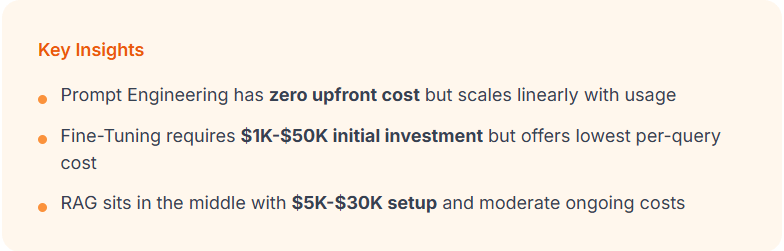
To make the cost comparison more concrete, allow is explore how these three methods playact away in real-world scenario. By examine specific use cases, we can see how the principles of cost-effectiveness translate into practical recommendation.
The most powerful solutions often involve combining these methods.
This potent hybrid involves first fine-tune a model to teach a specific fashion or format, and then connecting it to a RAG system to retrieve actual, up-to-date information. The fine-tuned Consistency be provided by model and fashion, while RAG ensure factual accuracy. This create a extremely robust system that can handle complex, knowledge-intensive tasks.
A hybrid approach is ideal when your use case requires both:
A hybrid approach path will have got a higher full price, combine the high upfront investing of fine-tuning with the infrastructure and operational costs of RAG. for high-stakes applications, the substantial improvement in performance and liableness can easy rationalize the additional expense.
Choosing the right AI optimization method is a critical decision. Use this framework to guide your choice.
The playing field of AI cost optimization is constantly evolving. Key trend to watch include to a greater extent effective models, improved fine-tuning techniques like LoRA, better RAG system, and the increasing adoption of hybrid architectures. By staying informed and cautiously evaluating your needs, you can build a cost-effective and successful AI application program.
 Yash Baravaliya
Yash Baravaliya specializes in exploring and building intelligent AI-driven systems, focusing on practical innovation and modern framework development. With a strong drive for experimentation and problem-solving, he turns complex AI concepts into clear, usable solutions.
We’re ISO/IEC 27001:2022 certified, ensuring your projects are executed with globally recognized security standards.

INDIA
 sales@nextgensoft.io
 +91 81284 66678