How AI is Transforming Modern Project Management?
Brijesh ShahJanuary 30, 2026
Share this article


Today, artificial intelligence is transforming project management by automating complex tasks such as rescheduling and strategy development. This shift allows project managers to focus on strategy and value rather than process-driven activities.
As a technology CEO and long-time Project Management Institute volunteer, I have seen AI accelerate the shift highlighted in the PMBOK® Guide (8th Edition): from process-focused management to value-focused leadership.
This change is inevitable.
Historically, project managers focused on deadlines, reporting, and coordination. With AI, their role is evolving from process management to creating meaningful business outcomes.
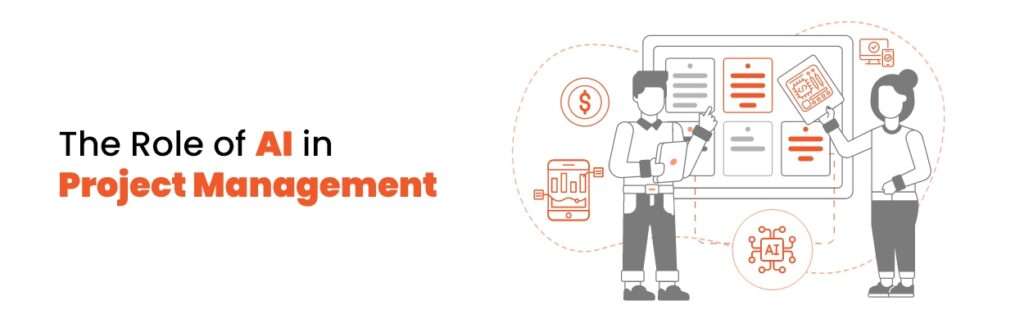
This strategic shift is essential, not optional. Organizations that fail to adapt risk losing market share and stalling innovation. Forward-thinking companies must embrace this transformation.
Future project managers will act as business value managers, prioritizing meaningful outcomes over task execution.
Read Also: NextGenSoft’s Generative AI Journey: From API Integration to Intelligent Agents
This shift enables project managers to assume higher-value responsibilities, including:
In the next decade, project managers will not be evaluated solely on timelines.
They will be measured by business impact, customer experience, and their ability to drive innovation. Ultimately, business outcomes and value will define a project manager’s success.
AI can analyse data, detect patterns, and support decision-making at scale.
No matter how advanced it becomes, AI cannot replicate essential human skills.
PMI consistently emphasizes that successful project outcomes depend on capabilities such as empathy, influence, leadership, and collaboration. These remain uniquely human.
AI cannot replace:

In my experience, the most effective project managers excel in:

These capabilities align with PMBOK’s Team, Stakeholder, and Leadership performance domains.
As a CEO, I do not rely on project managers for data, as AI delivers it faster and more accurately.
Instead, I rely on them for judgment, influence, and leadership under pressure.
From a leadership perspective, adopting AI in project management is more than a technology update. It is a transition from traditional methods to a new norm where AI shapes company culture and operations. This shift requires organizations to rethink stakeholder alignment, decision-making, and value delivery.
Organizations that succeed with AI approach three areas differently.
1. They Embed AI into Everyday Workflows
AI is treated as a co-pilot, not a standalone tool.
At NextGenSoft – leading legacy modernization company, we have embedded AI directly into our delivery workflows through capabilities such as:
2. They Invest in Capability Building
Successful organizations invest equally in developing people and implementing technology:
3. They Redefine the PM Role
Project managers are deliberately moved away from:
Instead, PMs focus on:
Organizations preparing for AI are not only training teams on tools. They are also transforming culture, building new capabilities, and developing adaptive leadership to succeed.
In an AI-enhanced environment, relevance depends on both mindset and skill set. There are four capabilities every modern project manager should cultivate:
🧠 Prompt Engineering
The ability to ask the right questions determines the quality of AI output. Prompting is becoming a core leadership skill.
📊 Data Literacy
Project managers do not need to be data scientists, but they must understand data, question insights, and translate information into decisions.
⚙️ Automation Mindset
Regularly asking, “Can this be automated?” creates more efficient workflows and frees time for creative, strategic work.
🤖 AI Tool Fluency
Project managers should be fluent with tools such as ChatGPT, Copilot, Gemini, Power BI, and automation platforms. The goal is effective application, not complete mastery.
From a CEO’s perspective, I look for project managers who:
Experience alone is no longer a differentiator.
The ability to learn, automate, and lead with AI is essential. Modern project managers must continually adapt and integrate AI to remain relevant.
At NextGenSoft, AI is integrated throughout our delivery lifecycle and is part of our culture, not just a tool.
One example is our AI Project Intelligence Engine.
Instead of project managers spending hours on reporting and risk identification, the system:
The result:
65–70% reduction in manual PM reporting effort.
More importantly, our project managers now focus on:
AI has not redefined the project manager’s role, but it has shifted how and where project managers create value.
By automating status updates, analysis, and forecasting, Artificial Intelligence services gives project managers the most valuable asset: time to think, lead, and deliver excellence. Automation enables project managers to maximize their unique value.

The future of project management is not about competing with AI.
It is about leading with it.
The project manager of tomorrow is not a task or timeline owner.
They are a value creator, decision leader, and outcome steward.
AI will handle execution.
Project managers will define success. In summary, they must shift from task management to value creation in an AI-powered future.
 Brijesh Shah
Brijesh is an IIM Ahmedabad alumnus with 22+ years of experience in software development and management. As the visionary leader of NextGenSoft, he drives the company toward becoming a global leader in software services and digital transformation. He also serves as Vice President of the PMI Gujarat Chapter.
We’re ISO/IEC 27001:2022 certified, ensuring your projects are executed with globally recognized security standards.

INDIA
 sales@nextgensoft.io
 +91 81284 66678