How Much Does AI Development Cost in 2026? A Practical Budget Guide
Niraj SalotNovember 5, 2026
Share this article


Let AI highlight what matters.
The AI development cost in 2026 is expected to vary between ₹15,00,000 (around $18,000) for a simple PoC to over ₹2,50,00,000 (more than $300,000) for complex systems that are of the corporate level or for highly customized LLM solutions.
It has to be remembered that these values do not reflect fixed prices in the market since they come from vendors.
At the same time, it is important to ask what functions your business needs the system to have.
A system that simply searches approved documents will have a different budget compared to the one that processes customer data and sends requests for fraud checks.
The total AI development costs consists of three components:
Purchasing language model access implies only 1 aspect of those works. You will still have to manage access permissions, validate outputs, mitigate unsuccessful operation and ensure reliable connection to business systems.
| Project type | Approximate budget | Main scope assumptions |
| Focused proof of concept | 10,000 – 25,000 | One task, sample data, limited users, and no production service commitment |
| AI feature added to an existing application | 20,000 – 60,000 | Existing interface and authentication, one workflow, and limited integrations |
| RAG knowledge assistant | 30,000 – 100,000 | Document ingestion, retrieval, access controls, citations, and evaluation |
| AI agent for a business workflow | 50,000 – 150,000+ | Several tool connections, approval steps, retries, and action logging |
| Custom predictive ML application | 50,000 – 200,000+ | Historical data preparation, model training, validation, and deployment |
| Enterprise AI platform | 150,000 – 400,000+ | Multiple workflows, complex integrations, governance, and operational support |
These ranges overlap because the project label does not determine the engineering effort. A document assistant with strict permissions across several departments can cost more than a narrowly scoped workflow agent.
A proof of concept answers a limited question: can this approach work on representative examples?
A production application must also handle:
A successful demo reduces technical uncertainty. It does not remove the remaining delivery work.
Data preparation can include removing duplicates, extracting text from scanned files, correcting labels, and connecting information across systems.
For artificial intelligence cost estimation, document:
There are several ways to build an AI application, and each creates a different cost structure.
| Approach | What it involves | Main budget consideration |
| Hosted model API | Calling a provider’s existing model | Lower infrastructure burden, with usage-based charges |
| Retrieval-augmented generation | Retrieving relevant information before generating an answer | Data pipelines, search infrastructure, and retrieval testing |
| Fine-tuning | Adapting an existing model using training examples | Dataset preparation, training runs, and evaluation |
| Self-hosted model | Running a model in your own environment | Compute capacity, deployment, scaling, and operational expertise |
RAG and fine-tuning solve different problems. RAG supplies external information at request time, while fine-tuning changes model behaviour through additional training. AWS’s guidance discusses these as distinct approaches that can also be combined. AWS Prescriptive Guidance
Reading information from a CRM is different from changing a customer record.
Actions include a need for extra safety measures: verification of permissions, validation of information, authorization of processes, and defence against repeated actions. An older technology might need a specific middleware or sequential processing as well.
NextGenSoft provides LLM integration services in areas like output validation, exception management, speed optimization, and cost efficiency. Such items present a budget impact while integrating language models into an existing product.
An agent can execute multiple calls to a model, seek some documents, perform various actions with outside tools, and repeat certain unsuccessful processes necessary to implement one action.
It is critical to introduce restrictions on the execution phases, the calling of outside tools, and the expenditures for each action. If restrictions are not established, the working demonstration of a process can lead to considerable costs in real job conditions.
Single sign-on, division of roles, maintaining a record of activities, and location of data must be taken into consideration to develop the product.
Testing must also reflect the application’s purpose. A support assistant needs tests for incorrect policy answers and failed handoffs. An invoice extraction system needs field-level accuracy checks and exception handling.
The following table of the $60,000 build budget shows how an estimate could be structured. It is not a NextGenSoft quotation.
| Workstream | Example budget | Share |
| Discovery and architecture | $6,000 | 10% |
| Data preparation and ingestion | $12,000 | 20% |
| Retrieval and model workflow | $15,000 | 25% |
| Interface and system integration | $12,000 | 20% |
| Evaluation and security testing | $9,000 | 15% |
| Deployment, documentation, and handover | $6,000 | 10% |
| Total | $60,000 | 100% |
Proper analysis should ensure that distribution factors in size. Poor quality documents increase data analysis while complicated authorization needs make testing and integration more difficult.
A good analysis of AI costs breaks down expenses according to deliverables. Saying “AI engineer: $30,000” is much less informative for the customer than mentioning integrations, workflows, tests, and acceptance criteria.
The ongoing artificial intelligence cost goes beyond the charges related to model API.
| Recurring expense | What drives it |
| Model inference | Input length, output length, model choice, and calls per task |
| Application hosting | Traffic, availability requirements, and deployment design |
| Retrieval infrastructure | Index size, search volume, embeddings, and document updates |
| Monitoring | Log volume, retention, tracing, and alerting |
| Maintenance | Dependency updates, bug fixes, model changes, and regression tests |
| Human review | Escalations, quality checks, and specialist approvals |
A cheaper model can become more expensive if it needs frequent retries or manual correction.
Track:
Cost per successful task = total operating cost ÷ successfully completed tasks.
If the monthly expenses amount to $3,000, and the application successfully accomplishes 10,000 tasks, the cost per approved task becomes $0.30.
Define “approved” in the business sense, such as approved answer or invoice processed correctly.
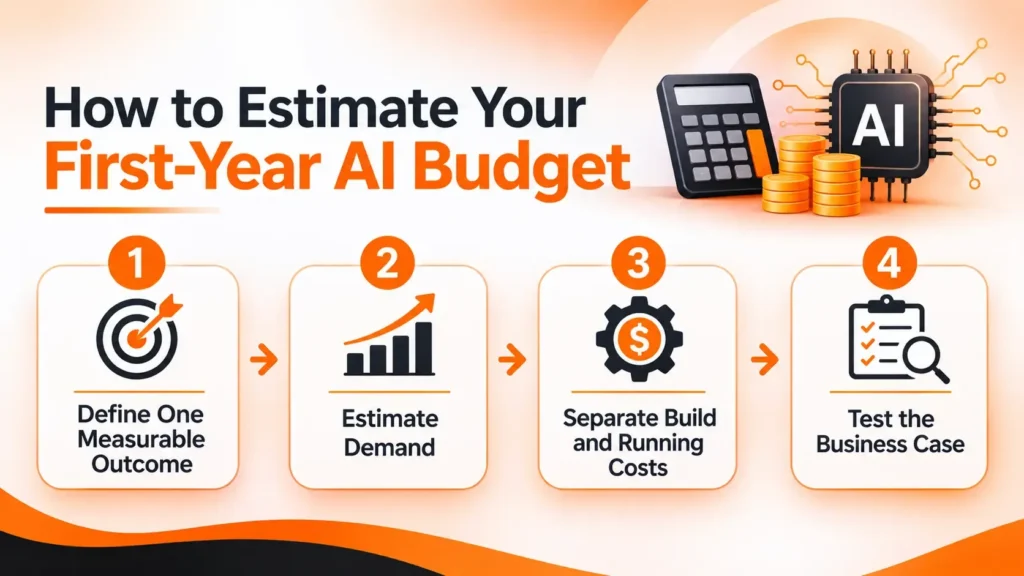
Before calculating costs, you have to define the characteristics of work and the amount of work done.
Decide on what result to be achieved, for example, saving time on document search or processing greater numbers of documents.
Find out how many tasks you have currently in your project so that you know where to start from.
Determine how many tasks you will need on a monthly basis, at peak periods and average loading of the document, the number of questions towards the model in each task, and the amount of cases that need checking by people.
Make a calculation for three possible scenarios.
Using the earlier example:
| Budget item | Illustrative amount |
| Initial development | $60,000 |
| Operations at $2,000 per month | $24,000 |
| Contingency equal to 15% of the build | $9,000 |
| First-year planning budget | $93,000 |
The 15% place-holder calculation applied in this case is hypothetical, and not required universally. Some projects that experience uncertain data flow or have legacy integrations may need to reserve some bigger contingency fund.
Assuming a workflow to be responsible for performing 5,000 tasks monthly while saving four minutes for each task.
It will translate into roughly 333 hours of capacity per month. If considering the labor costs to be $30 per hour, the total potential monetary value of this capacity will equal up to $10,000 per month.
However, capacity generation does not equal savings in cash. The final adjustments should be made based on adoption, review time and mistakes, and whether employees will use this time effectively.
Launch a useful process with a precise goal. It is much easier to conduct budgeting after real results are received rather than create multiple use cases with unknown situations.
Test models with low costs for simple extraction or classification processes. Use advanced models in case testing and evaluation show their significant effectiveness.
Sending whole collections of documents everywhere leads to more token usage. A right retrieval must exclude unnecessary information within the framework of permission matters.
NextGenSoft provides end-to-end RAG development services that includes all operations of document ingestion, embedding generation, a vector database design, and the building of retrieval pipeline. All these elements are essential to help the company’s knowledge be used for the generation of answers.
Self-hosting involves additional responsibilities for infrastructure and operations. Usage of hosted APIs presumes payment for the vendors and reliance on third parties. Make a comparison of the two options considering expected outcome, privacy requirements, and engineer skills.
Review identity, data access, system connections, and deployment boundaries before implementation. NextGenSoft’s enterprise architecture services include architecture assessment, technology selection, pilot planning, and implementation roadmaps.
Having an in-house team could be helpful when the project involves artificial intelligence technology as an ongoing business asset that will need to be constantly optimized. Do not forget about the cost of recruiting and maintenance, security of the building, and retention of specialists.
In contrast, a partner might be a better option in projects with definite objectives which require a variety of specialists involved in data engineering, application developing, testing of AI model life cycle, and implementation.
Before you agree to proceed with a project, ask the following questions:
NextGenSoft’s guide to choosing an AI agent development company provides a related checklist covering architecture, evaluation, ownership, security, and support.
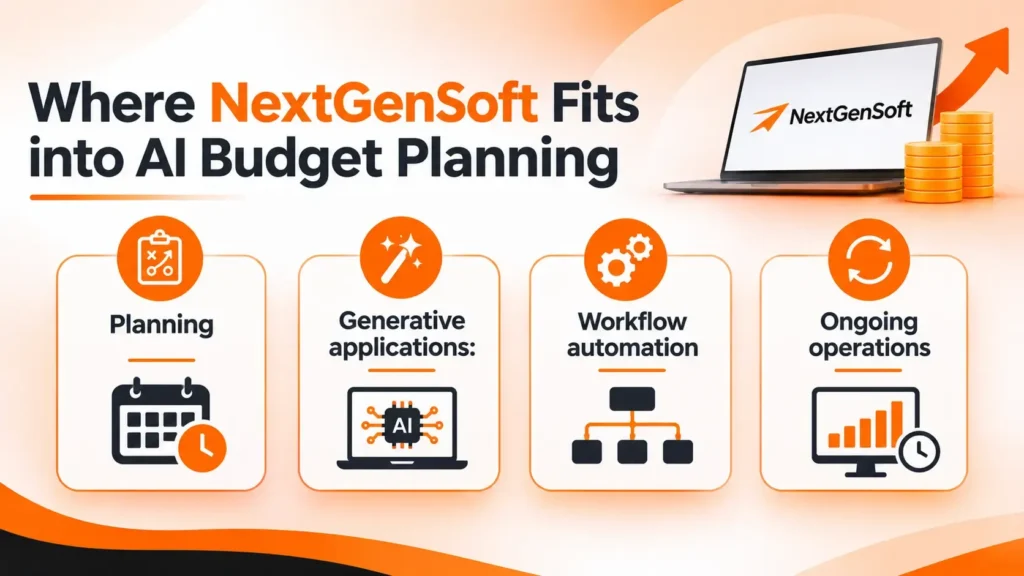
NextGenSoft’s service offerings span multiple phases that play a role in determining the project price.
For a reasonable quote, provide the workflow in question, sample data for the case, integrations needed, volume, and security specs.
Estimating the cost of AI development becomes easier once you get an explanation of what goes into the price. Data preparation, integration, testing, and maintenance of the system should be given the same attention as the specification of a model.
You should try a measurable case at first and test it with real data before you start implementing the system.
So, explore NextGenSoft’s artificial intelligence services and consult now to get a complete estimate covering development, deployment, and ongoing operations.
1. How much does it cost to build an AI application?
Answer: One can observe how apps that are made for niche purposes may cost tens of thousands of dollars whereas enterprise apps can cost hundreds of thousands.
2. What increases AI development cost the most?
Answer: Issues with data quality, complexity of integrations, security requirements, and customizations are some of the biggest contributors.
3. Is using an existing AI model cheaper than training one?
Answer: Using a pre-existing model certainly means that you do not spend much on creating your own one but companies will still have to pay for using it as well as for the integration costs.
4. Does AI require maintenance after launch?
Answer: Yes, AI applications require ceaseless monitoring, fixing of bugs, security updates, and testing if models, data, or the workflow gently change.
5. How can I get an accurate AI development estimate?
Answer: To derive the estimate, it’s important to provide a clear workflow, meaningful data, integration requirements, expected usage, and measurable acceptance criteria.
 Niraj Salot
, with 20+ years of expertise in software architecture, specializes in delivering robust enterprise applications. His cloud optimization skills help clients cut costs while maximizing performance. As a key leader at NextGenSoft, he drives scalable, efficient, and high-performing solutions.
We’re ISO/IEC 27001:2022 certified, ensuring your projects are executed with globally recognized security standards.

INDIA
 sales@nextgensoft.io
 +91 81284 66678


