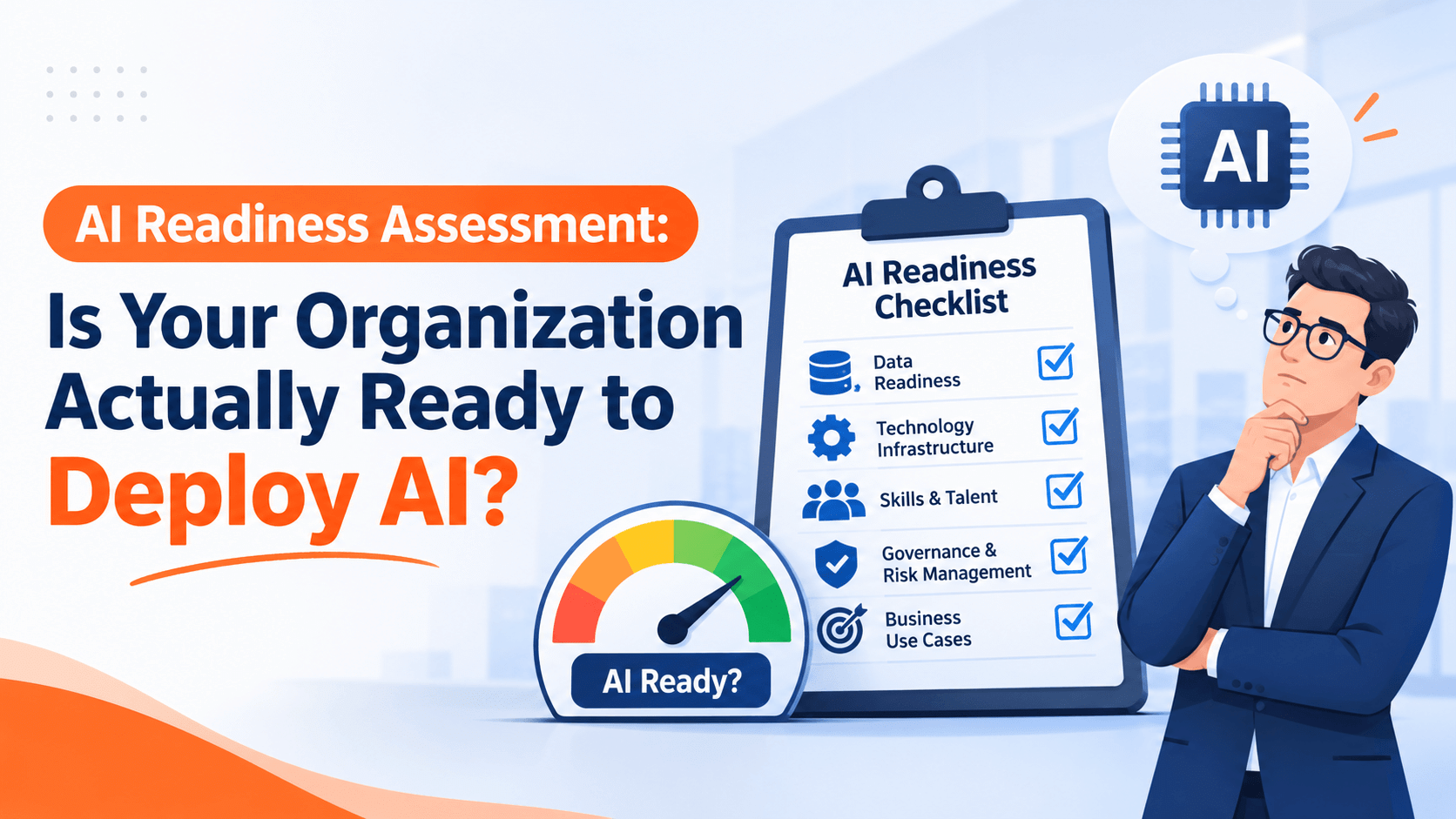
AI Readiness Assessment: A Practical Framework for Enterprise AI Adoption
Yash BaravaliyaNovember 2, 2026
Share this article


Let AI highlight what matters.
Core Focus: Explains why businesses should assess their AI readiness before investing in or implementing AI solutions.
AI Readiness Assessment: Evaluates whether an organization has the data, infrastructure, skills, governance, and business goals needed for successful AI adoption.
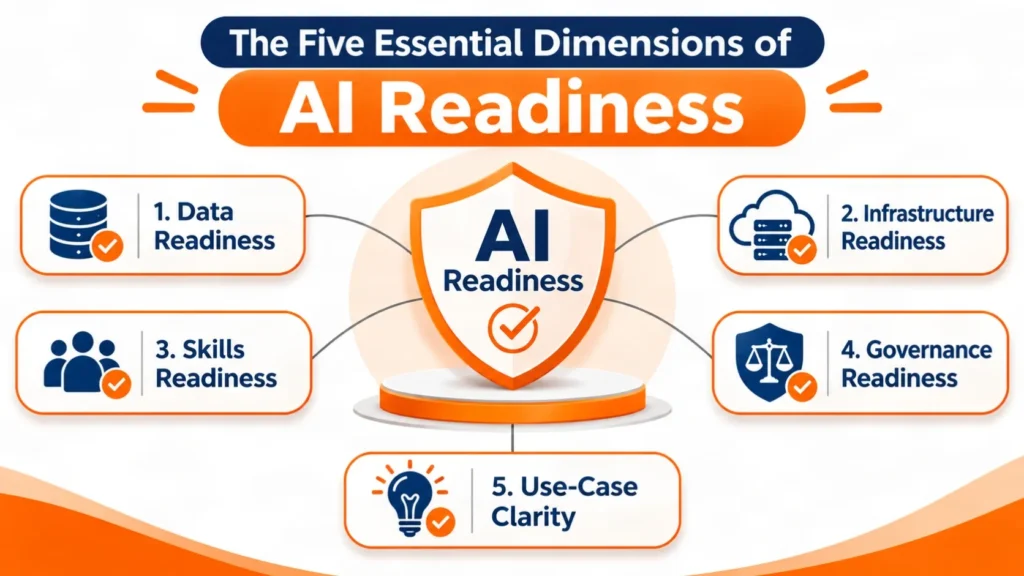
Five Key Dimensions: Covers data readiness, infrastructure readiness, workforce skills, AI governance, and use-case clarity.
Why It Matters: Helps prevent failed AI projects caused by unreliable data, outdated systems, skill gaps, security risks, and unclear business objectives.
Readiness Scorecard: Uses five dimensions, each scored from 1 to 5, to calculate an overall readiness score out of 25 and identify areas for improvement.
Common Misconceptions: A successful AI demo, management support, employee use of generative AI, or cloud infrastructure alone does not guarantee enterprise AI readiness.
30-Day Improvement Plan: Recommends reviewing data and use cases, evaluating infrastructure and skills, strengthening governance, and creating an implementation roadmap.
Key Takeaway: Assess before you invest. Identify organizational gaps, prioritize improvements, and build a practical roadmap before scaling AI across the business.
AI initiatives are often met with optimism. A business develops a chatbot, tries an automation application, or promotes an AI-backed workflow. The project is funded by the management, and the business prepares to go live.
However, just because there’s a demonstration does not imply that the organization is ready to implement the solution.
What if the AI works with incomplete customer data? Can the existing infrastructure support thousands of requests? And whom do we blame if the system provides the wrong information?
The answers to these questions will pave the way for either the success of an AI investment or its failure, turning it into an expensive trial.
According to McKinsey’s 2025 State of AI report, 88% of respondents said they had already implemented AI technology in one of their business operations, whereas only 7% reported full-scale implementation.
The difference stresses the importance of implementation beyond technology selection. An AI readiness assessment allows organizations to analyze their data, infrastructure, capabilities, governance, and business goals before making the investment.
Here we are going to discuss those five areas and include a practical scorecard to understand what your organization should improve first.
The AI readiness assessment entails a systematic evaluation of how well-prepared a business is to engage AI technology in use and management.
To get a complete understanding of the readiness of an organization to use and manage Artificial intelligence, it is necessary to take into account the availability of relevant data, technology, human capital, information protection tools, and important goals of the organization.
For example, a retailer developing an AI assistant in customer support has its chatbot successfully answering all client questions concerning different goods.
However, if the business has the order processing system updated on a daily basis only, the client might receive false information about the delivery date.
Thus, the chatbot performs well but the data from the business is erroneous.
In order to reveal such shortcomings before the introduction of the technology, the AI readiness assessment framework should be done beforehand to produce three outcomes:
The use of AI is rising rapidly, but financial success is not consistent. According to IBM’s 2025 CEO Study, only 25% of companies reported that their AI projects had provided the expected return on investment.
Multiple issues exist that can lead to disappointing results. These may be generated from incomplete datasets, old applications, lack of technology skills, and unclear responsibilities. Some groups of companies choose to invest in AI without defining business problems that can be solved by this technology.
The pilot project may also face challenges after implementation.
AI systems rely heavily on quality, available, and relevant data. Just because a company has years of experience does not mean it has good data. For example, a factory may keep its maintenance records in many different formats, including spreadsheets, ERP programs, and records on paper.
Before the implementation, analyze:
Start with one of the proposed AI projects and see what data it requires. Notice what data is missing, what duplicates exist, and if there are any access restrictions.
A prototype dealing with 50 requests is not the same as an enterprise application that handles 10,000 requests a day. The industrial AI has to have a robust infrastructure, safe integrations, monitoring, and enough computing power.
Check if your company has
Moreover, the infrastructure costs also need to be calculated accurately. Assume your application is processing 100,000 requests every month at an average direct processing cost of $0.02 per request. This means about $2,000 per month not including storage costs, engineering costs, monitoring costs, and other operating expenses.
Even a perfectly designed system may not work properly if the employees are not capable of using it properly. Different teams should have different capabilities. Developers should have the background in integration, model testing, and monitoring needs. Business end-users should understand how to review the output, detect mistakes, and process actions that need human approval.
You need to check whether:
AI governance refers to the established guidelines that govern the way automated systems process data, make decisions, and carry out activities. This can be illustrated with the help of an example of an AI-based platform in finance where getting invoice data is allowed but approving payments requires further consent.
Automation is capable of creating multiple issues surrounding finance, security, and compliance in case it is not properly managed. In that respect, the NIST AI Risk Management Framework mentions four issues of which AI governance consists of: govern, map out the use, evaluate the risks, and manage everything.
References to be made in the writing of the governance system are as follows:
Our AI governance framework guide explains how organizations can structure oversight and accountability.
An organization may possess perfect data, highly-skilled engineers, and new infrastructure and still apply AI mistakenly just because it didn’t take into account that AI needs to solve a business problem but not the other way around.
Every proposed use case should answer:
Use the following scorecard to assess your organization across all five dimensions. Assign each category a score between one and five.
| Score | Readiness level | Meaning |
| 1 | Not ready | Essential capabilities are missing |
| 2 | Early stage | Major improvements are required |
| 3 | Developing | Basic capabilities exist, but gaps remain |
| 4 | Nearly ready | Most requirements are established |
| 5 | Ready | Capabilities are tested and operational |
| Readiness dimension | Assessment question | Score |
| Data | Is business information reliable, accessible, and secure? | __ / 5 |
| Infrastructure | Can existing systems support AI integration and scaling? | __ / 5 |
| Skills | Can employees implement, operate, and evaluate AI? | __ / 5 |
| Governance | Are security, accountability, and oversight established? | __ / 5 |
| Use-case clarity | Does the project solve a measurable business problem? | __ / 5 |
| Total | __ / 25 |
Complete the assessment with representatives from IT, operations, security, and business leadership.
| Total score | Readiness status | Recommended next step |
| 5–9 | Foundational gaps | Improve essential data, systems, and controls |
| 10–15 | Developing readiness | Fix weaknesses before wider implementation |
| 16–20 | Conditional readiness | Consider a limited pilot after validating critical controls |
| 21–25 | Advanced readiness | Prepare deployment plans and complete production testing |
For instance, an organization with a total score of 21 in general terms and a score of 1 in government or political governance should avoid implementing AI for secure financial transactions.
It is important to conduct additional concerns before implementing AI in the cases where any parameter receives less than a score of three.
When comparing AI strategy consulting services or other implementation partners, ask how they evaluate risks, technical dependencies, and long-term operating costs.
Check out the four-week strategy that can help organizations cover their gaps and move towards a proper improvement plan.
| Timeline | Priority | Expected outcome |
| Week 1 | Review data and business use cases | Document information gaps and measurable objectives |
| Week 2 | Evaluate infrastructure and employee capabilities | Identify technical limitations and training requirements |
| Week 3 | Address critical governance and security gaps | Establish ownership, permissions, and risk controls |
| Week 4 | Reassess readiness and prioritize next steps | Produce an implementation roadmap |
Finishing this exercise is not a guarantee of production readiness in 30 days since its essence is to enable a well-informed decision regarding the next steps.
AI implementation is most effective when organizations know what they can do before trying to implement it.
NextGenSoft provides businesses with assistance in assessing technology needs, recognizing challenges in implementation, and coming up with pragmatic approaches to AI technology.
Our Artificial Intelligence services allow businesses to evaluate their AI readiness level, develop a solution, integrate it, and formulate the strategy for implementation.
Want to know whether your organization is ready for AI?
Fill in the scorecard above and get in touch with NextGenSoft to discuss your results, implementation issues, and subsequent steps.
1. What are the five dimensions of AI readiness?
Answer: Five dimensions comprise data, infrastructure, skill, governance, and use case clarity. They enable organizations to analyze their readiness with respect to the adoption of AI technology in their business processes.
2. How is an AI readiness score calculated?
Answer: Score each of the five dimensions from 1 to 5 and sum up the total score with a maximum of 25. Review any of the weak breakdowns with respect to the overall score.
3. How long does an AI readiness assessment take?
Answer: An initial internal assessment will take several sessions. An extensive enterprise assessment could take weeks, depending on the number of systems and business departments involved and the risks estimated.
4. Can small businesses assess AI readiness?
Answer: Yes. Small businesses may use the same framework for specific workflows, evaluate their capabilities in the current processes and determine cost-efficient improvements before they decide on the usage of AI technology.
5. What is the difference between AI readiness and AI maturity?
Answer: AI readiness measures whether companies are able to adopt AI technology, while AI maturity assesses whether companies use and develop its AI systems effectively.
 Yash Baravaliya
 specializes in exploring and building intelligent AI-driven systems, focusing on practical innovation and modern framework development. With a strong drive for experimentation and problem-solving, he turns complex AI concepts into clear, usable solutions.
We’re ISO/IEC 27001:2022 certified, ensuring your projects are executed with globally recognized security standards.

INDIA
 sales@nextgensoft.io
 +91 81284 66678


