RAG Pipeline: A Practical Enterprise Implementation Guide
Pranav LakhaniOctober 5, 2026
Share this article


Let AI highlight what matters.
A RAG pipeline connects an AI model to appropriate business data before it eventually answers a question. The initial steps of this process consist of extracting the necessary information, organizing it in a searchable manner, gathering the relevant evidence, and transferring it to the model.
When it comes to implementing RAG technologies by enterprises, the main challenge is to ensure the inclusion of the relevant information in the answer. It does not make any sense to produce a plausible answer if the information is outdated or brings up some important exceptions.
Let’s take the following example: an employee asks a question: “Is it possible to claim travel expenses during probation?” In this case, the system has to use the current travel expense policy, read the clause about probation procedures, and gather information on any regional rules applied in this matter. Therefore, finding information about business travel is not sufficient.
The main objective of this guideline is to explain how this process can be put in place, assessed for reliability, and expanded with the help of controlled implementation.
A retrieval-augmented generation, RAG pipeline combines information retrieval with text generation. Instead of relying entirely on a model’s training, it searches for an external knowledge source and supplies relevant material for the answer. AWS describes this approach as giving the model access to authoritative knowledge outside its training data.
When readers ask what a RAG pipeline in AI means, they should picture a machine working with a certified reference list.
The reference list changes without any need for machine retraining. However, ingested information should include changes.
That makes the RAG pipeline applicable to user manuals, internal regulations, technical support manuals, and other information that requires frequent updates.
Read Also: RAG vs Fine-Tuning: Which AI Approach Is Best for Enterprise LLM Applications?
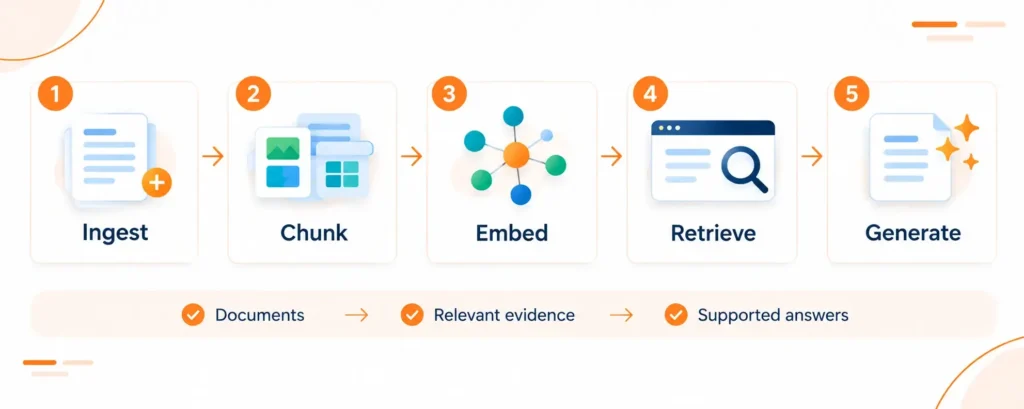
The process consists of two phases. First, the documents are converted into a searchable format. Second, when the user asks questions, they get answers.
During the ingestion stage, information comes from official sources. This can be PDFs, documentation sites, delivered files, etc.
It is essential to check what actually has been extracted. A PDF may look fine but may have serious problems in extracted content.
Keep useful metadata with each document:
Define how updates and deletions reach the index. Otherwise, an assistant may continue retrieving information that the business has already withdrawn.
Chunking divides documents into smaller sections that retrieval can find individually.
A useful section preserves enough context to answer a question. For a refund policy, that may mean keeping the eligibility rule beside its exceptions.
Microsoft recommends 512 tokens with 25% overlap, equivalent to 128 tokens, as an initial configuration for Azure AI Search. This is a starting point for experimentation, not a universal setting.
Test different approaches against real questions. A troubleshooting guide and a pricing table may need different boundaries.
An embedding model converts text into numerical vectors. These representations support searches based on meaning rather than exact wording.
For example, “reset my password” and “recover account access” may describe a related need despite using different words.
Store each vector with its original text and metadata. During vector retrieval, the question must use a compatible embedding model and configuration. AWS explains this document-and-query embedding process as part of the retrieval workflow.
Treat a model change as an index migration. Test it before switching production traffic.
Retrieval searches the prepared collection for material that can answer the question.
Semantic search helps with paraphrased requests. Keyword search helps with exact identifiers, such as error codes or product names. Hybrid search combines both approaches; Azure AI Search supports executing text and vector queries together and merging their results.
Apply permission filters before evidence reaches the model. Where needed, add a reranking step that reviews candidate passages and prioritises the most useful ones.
Generation passes the question and selected evidence to the language model.
The instructions should require the model to:
These instructions need testing. A citation beside an answer does not prove that the cited passage supports every claim.
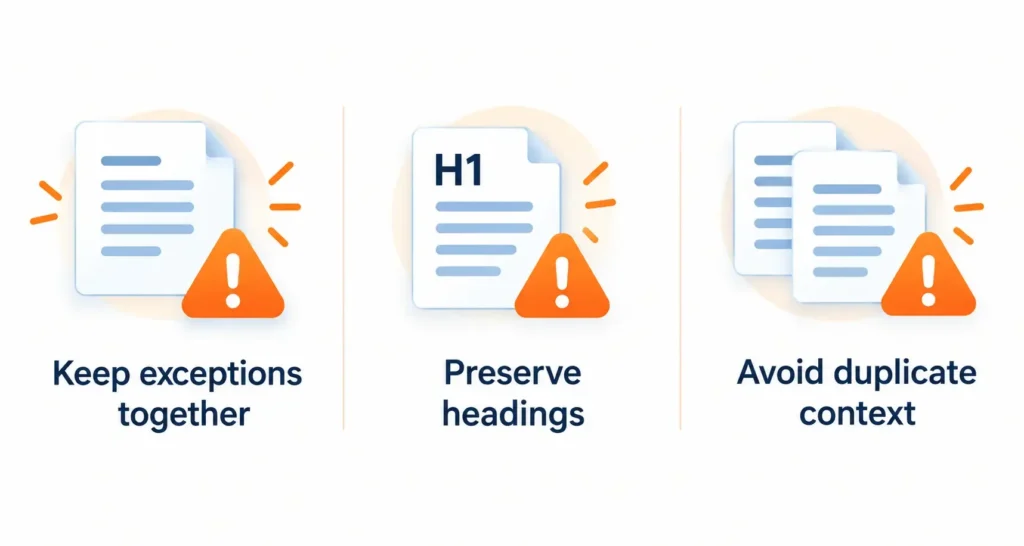
Chunking errors can leave the correct document in the index while making its answer difficult to retrieve.
Microsoft’s architecture guidance distinguishes several approaches, including fixed-size, sentence-based, and structure-aware splitting. It recommends experimenting according to document characteristics.
Four mistakes deserve particular attention.
For an illustrative test, suppose the system returns five passages, but four repeat the same introductory explanation. The answer may still lack the single exception the user needs.
More context is not automatically better. The Lost in the Middle study found that tested models could perform worse when relevant information appeared in the middle of long inputs. That finding supports testing evidence selection and ordering rather than continually adding passages.
Begin with a specific workflow and a manageable collection. A support assistant covering one product is easier to assess than an assistant covering every department.
The following phases are suggested implementation steps, not fixed delivery timelines.
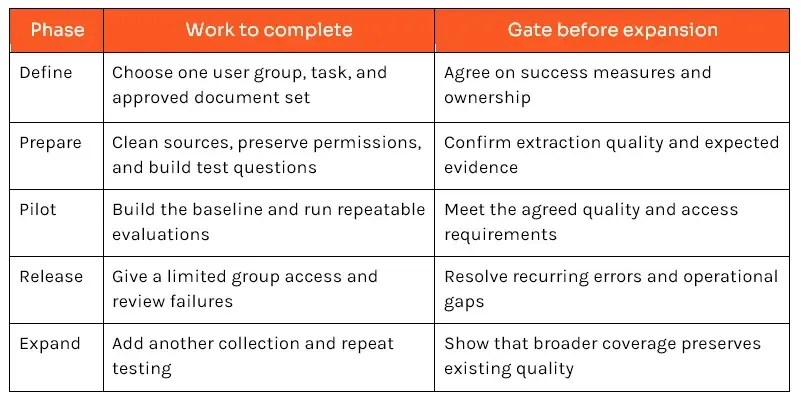
During preparation, create a small, reviewed evaluation set. Fifty to 100 questions can be a practical pilot starting point, although the appropriate size depends on risk and query variety.
Include ordinary questions, ambiguous requests, document conflicts, and questions the collection cannot answer.
Keep a separate set for final testing. Otherwise, repeated tuning may improve familiar examples while leaving unfamiliar requests unreliable.
Before expansion, assign responsibility for document freshness, incidents, failed answers, and index updates. These responsibilities become more important as collections multiply.
Read Also: Vector Database Comparison: Pinecone vs Weaviate vs pgvector for Enterprise RAG
A fluent answer can conceal weak evidence. Evaluate retrieval and generation separately so the team knows what needs fixing.
Start with questions reviewed by a subject expert. For each question, record the expected answer, supporting passages, and whether refusal or clarification is appropriate.
LangSmith’s evaluation guidance follows this pattern: create a dataset, run the application, and score retrieval quality and answer performance.
Track complementary measures:
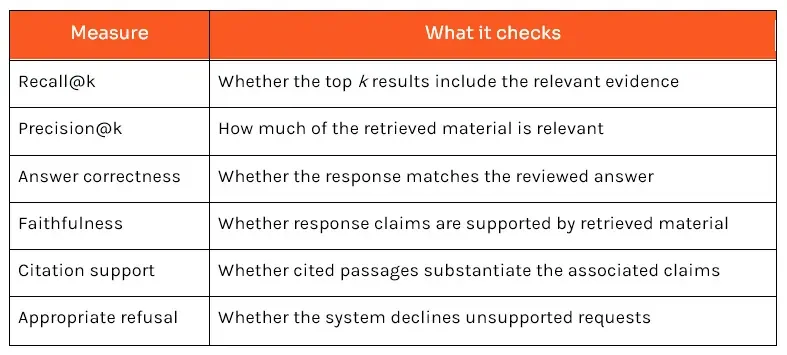
For a simple example, suppose reviewers identify four relevant passages. Retrieval returns five passages, including three of those four.
These are illustrative calculations, not expected production scores. The missing passage could contain a critical exception, so the percentages still need qualitative review.
For teams asking about the best tools for evaluating RAG pipeline accuracy, choose according to the evaluation job.
Automated scores need calibration against expert judgement. Ragas context metrics also should not be treated as interchangeable with the simple passage-based calculations above.
Set acceptance criteria for the business task. An internal documentation assistant and a customer-facing policy assistant may require different review standards.
Knowing how to monitor and debug RAG pipeline performance means tracing a poor answer back to its cause.
Capture document and chunk identifiers, retrieval rankings, applied filters, prompt versions, model versions, latency, and token usage. Protect sensitive information in logs.
Use the evidence to guide investigation:
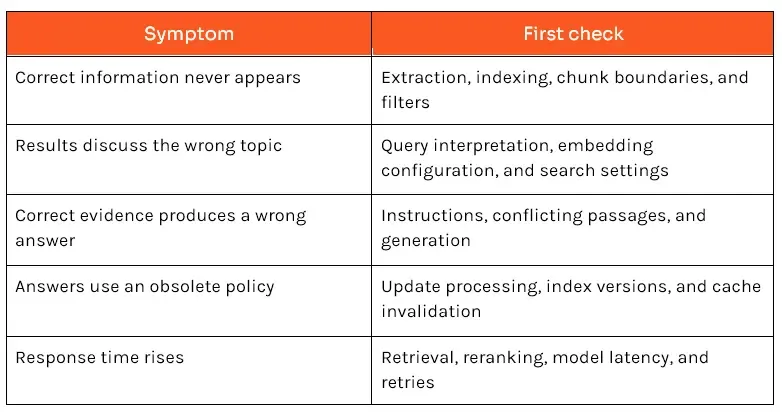
Monitor latency by percentile as well as average. P95 shows the response time at or below which 95% of measured requests fall, exposing slower experiences that an average can hide.
Track ingestion failures and document freshness alongside answer quality. Run the reviewed test set after material changes, including new chunking settings or embedding models.
A RAG pipeline for SaaS providers needs clear customer isolation when it searches tenant-specific information.
Use authenticated identity to apply access rules before retrieval. Do not rely on the model to decide which customer’s material it may reveal.
Test realistic boundary cases:
Also test permissions after new content is indexed. Correct access settings during the pilot do not establish that every later ingestion follows the same rules.
First, use only a single document collection and a simple workflow. Only after the system successfully retrieves the relevant evidence, addresses the missing pieces correctly, and stays maintainable enough can you move on to the next step.
Are you preparing your first pilot project or end up facing inaccuracies? Learn about RAG Development Services and talk about the documents that you are going to work with, requirements for retrieval, and priorities for roll-out.
1. What is a RAG pipeline?
Answer: A RAG pipeline is a mechanism for gathering source information to present it to an AI system for responding to questions.
2. What are the main stages of a RAG pipeline?
Answer: The key stages of the RAG pipeline are ingestion, chunking, embedding, retrieval, and generation.
3. How does chunking affect RAG pipeline quality?
Answer: If chunking is done improperly, the retrieval will fail to collect any needed context and lose important information.
4. How do you evaluate a RAG pipeline?
Answer: Evaluation of a RAG pipeline should be performed with the help of test questions that check retrieval performance, answer quality, source support, and refusals.
5. How should businesses start a RAG pipeline rollout?
Answer: Pilot one approved document set, test against agreed quality requirements, and expand after resolving recurring failures.
 Pranav Lakhani
Pranav brings over 20 years of expertise in software development and design, specializing in delivering enterprise-scale products. His unique ability to manage the entire product lifecycle ensures innovation and technical excellence across every project.
We’re ISO/IEC 27001:2022 certified, ensuring your projects are executed with globally recognized security standards.

INDIA
 sales@nextgensoft.io
 +91 81284 66678


