MCP Server: To Adopt or Not? Enterprise Decision Framework
Yash BaravaliyaSeptember 16, 2026
Share this article


Let AI highlight what matters.
A Practical Decision Framework for Enterprises
Model Context Protocol has gone from a niche spec to the topic every AI engineering team is arguing about. The “MCP Part I: To MCP or Not (MCP)” thread making the rounds on Substack captured something real: teams are standing up an MCP server before they’ve asked whether they need one, then discovering the operational tax later.
This isn’t an anti-MCP or pro-MCP piece. It’s a framework for making the call with your architecture, your data, and your team’s capacity in front of you, not a hype cycle on your broader generative AI roadmap.
MCP standardizes how an LLM application discovers and calls external tools, data sources, and systems. Instead of writing bespoke integration code for every API a model needs to reach, you expose those capabilities through a common protocol. Any MCP-compatible client, whether it is Claude, an internal agent, or a third-party assistant, can use them directly without requiring custom integration code for each connection.
That’s the pitch. Whether it’s worth adopting depends entirely on what you’re already doing and what you’re trying to scale.
Before reaching for an MCP server, run your use case through this sequence:
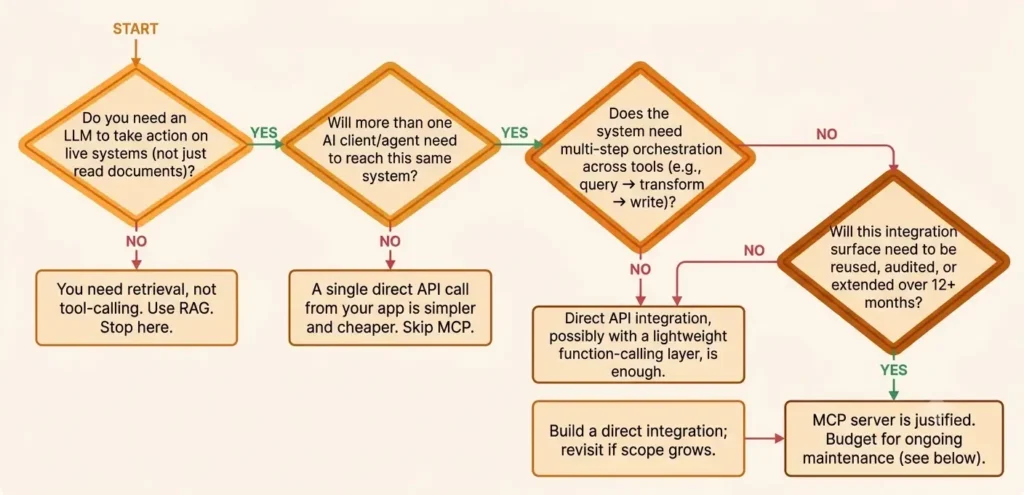 The pattern underneath this tree: MCP earns its complexity when you have multiple consumers, multiple tools, and a long reuse horizon. It’s a poor fit for a single agent calling a single well-documented API for a six-month pilot.
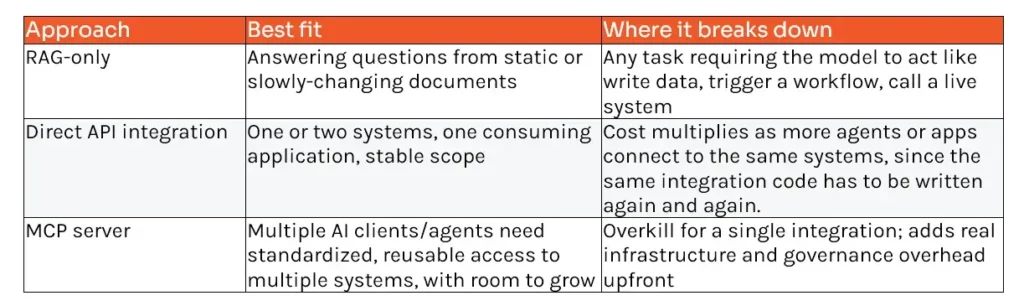
If your use case turns out to be retrieval-only, that’s the simpler build; see how we approach RAG development for grounding models in your own data without the tool-calling overhead.
A support-automation agent needs to pull order history, subscription status, and support tickets to answer customer questions or draft resolutions. If this is the only agent touching these systems, a direct API integration with careful auth scoping is often sufficient. MCP becomes the better call once you also want an internal analyst copilot, a QA agent, and a future sales-assist tool to query the same customer data, without three teams writing three different integration layers, each with its own auth and error-handling quirks.
The tradeoff here is less about technology and more about data governance: an MCP server sitting in front of customer data needs the same access controls, PII handling, and audit logging you’d require of any production data layer, arguably more, since it’s now serving multiple AI clients instead of one.
Think ticketing systems, deployment dashboards, internal wikis, and provisioning tools. This is where MCP tends to pay off fastest, because internal tools are exactly the kind of system multiple agents will eventually need to reach: a DevOps copilot today, an onboarding assistant next quarter, and a compliance-reporting agent after that. Standing up an MCP server once, with a clear tool schema, avoids the repeated cost of re-implementing auth and error handling for each new internal use case.
The catch: internal tools are often the least documented, least standardized systems in the company. The real cost of an MCP server here isn’t the protocol; it’s writing clean tool definitions for systems that were never designed to be called programmatically.
This is the strongest case for MCP: an agent that needs to query a CRM, cross-reference inventory data, and then write back to a fulfillment system in a single reasoning chain. Direct API calls can technically do this, but the orchestration logic, sequencing, error recovery, and retries across three different systems ends up being re-implemented inside your application code instead of standardized at the protocol layer. An MCP server lets you define each system as a discrete, well-scoped tool and let the model handle sequencing, which scales far better as you add a fourth or fifth system.
Adoption pieces rarely quantify the ongoing cost, so here’s the honest version:
Upfront build costs:
Ongoing maintenance costs:
Where teams underestimate the tax: a proof-of-concept MCP server built by one engineer in a sprint is not the same artifact as a production MCP server serving three internal teams with different SLAs. The gap between those two is usually where projects stall, not the initial build, but the governance and reliability work that shows up six months later.
If your reuse horizon is genuinely short, or you only have one consuming agent, that ongoing cost is not worth paying yet. If you’re already fielding the same integration request from a third team, it usually is.
Adopt MCP when you can answer “yes” to at least two of these:
If you’re answering “no” to most of these, a direct API integration or a RAG-only architecture will get you to production faster and cheaper; you can always migrate to MCP later once the reuse pattern is proven, rather than building for it speculatively.
The decision framework above gets you to a directionally correct answer. Getting the implementation right, like schema design, auth boundaries, monitoring, and knowing when direct integration genuinely beats MCP for your specific systems, is where most of the real engineering judgment lives.
If you’re weighing MCP against direct API integration for your own stack, our LLM integration team has built both patterns in production, including the RAG side of that comparison, and can help you scope the right one before you commit engineering time to either.
1. Is MCP always better than direct API integration?
Answer: No. Direct API integration is often simpler, cheaper, and faster to ship when only one application needs the access, and the integration scope is narrow and stable.
2. Does adopting MCP replace the need for RAG?
Answer: No, they solve different problems. RAG retrieves and grounds information from documents or knowledge bases. MCP standardizes how a model calls tools and takes action on live systems. Many production architectures use both.
3. How much engineering effort does standing up an MCP server take?
Answer: A proof-of-concept can be built quickly, but production-grade MCP servers require ongoing investment in schema versioning, auth, monitoring, and security review—budget for this as infrastructure ownership, not a one-time build.
4. What’s the biggest sign we don’t need MCP yet?
Answer: If only one agent or application needs the integration, and you don’t foresee other teams needing the same system access within the next year, direct API integration is the lower-cost path.
5. Can we migrate from direct API integrations to MCP later?
Answer: Yes, and it’s often the more sensible sequence: build direct integrations first through your app development work, and standardize on MCP once you can see a genuine reuse pattern across multiple agents or teams.
 Yash Baravaliya
Yash Baravaliya specializes in exploring and building intelligent AI-driven systems, focusing on practical innovation and modern framework development. With a strong drive for experimentation and problem-solving, he turns complex AI concepts into clear, usable solutions.
We’re ISO/IEC 27001:2022 certified, ensuring your projects are executed with globally recognized security standards.

INDIA
 sales@nextgensoft.io
 +91 81284 66678

 Brijesh Shah
CEO, NextGenSoft
Brijesh Shah
CEO, NextGenSoft


