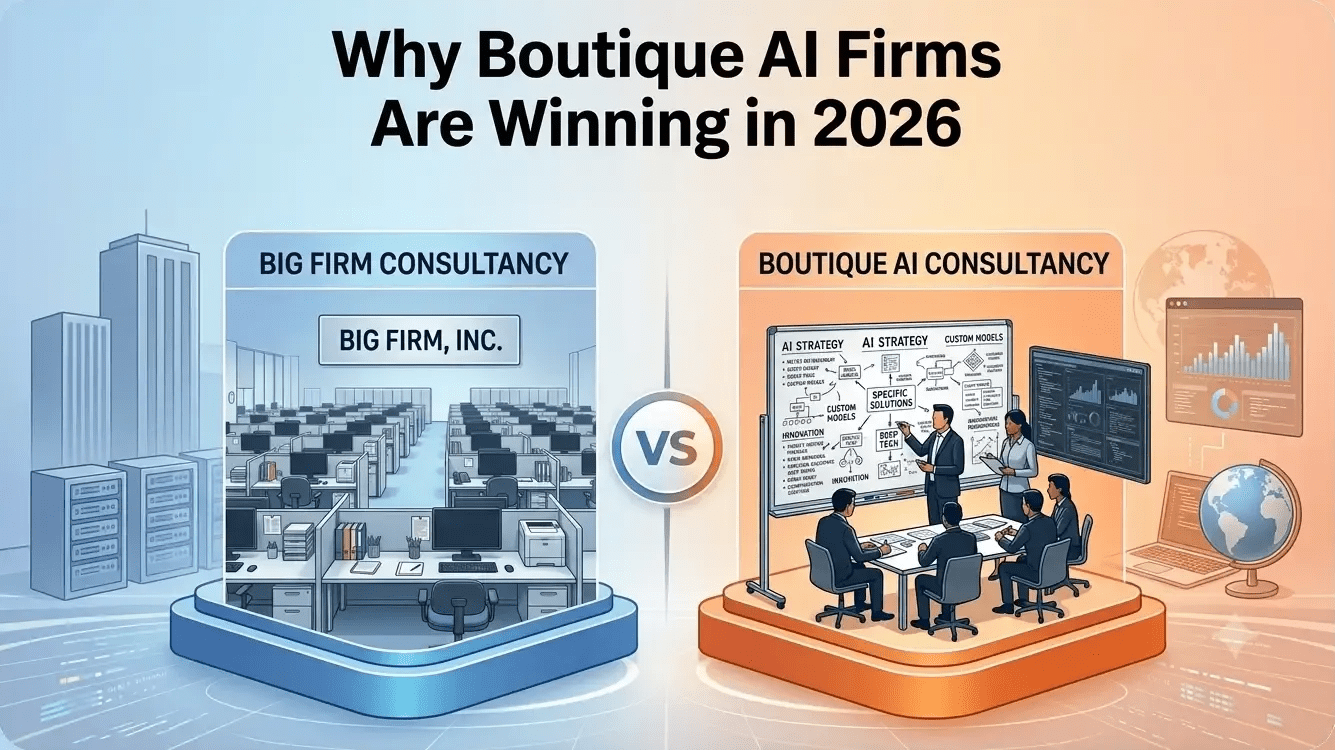
AI Consulting in 2026: Why Boutique Specialists Are Winning Over Big Firms
Niraj SalotSeptember 9, 2026
Share this article


Let AI highlight what matters.
If you’ve spent any time researching AI consulting firms this year, you’ve probably noticed two very different stories playing out at once. The household-name firms, the McKinseys, Accentures, and Big Four advisory arms, are announcing AI practice expansions, acquiring smaller AI shops, and rolling out proprietary AI “platforms” for clients. Meanwhile, a parallel conversation has been building across industry Substacks and business press: that the actual implementation work—the part where AI moves from slide deck to production system- is increasingly landing with smaller, specialized firms.
Both things are true, and understanding why matters if you’re the one who has to pick a partner and defend that choice to your leadership team.
The scale players have taken a familiar path: acquire capability rather than build it from scratch. Large consultancies have been buying AI-focused boutiques, machine learning studios, and data science shops at a steady clip, folding them into broader “AI transformation” practices sold alongside existing strategy, change management, and systems-integration work.
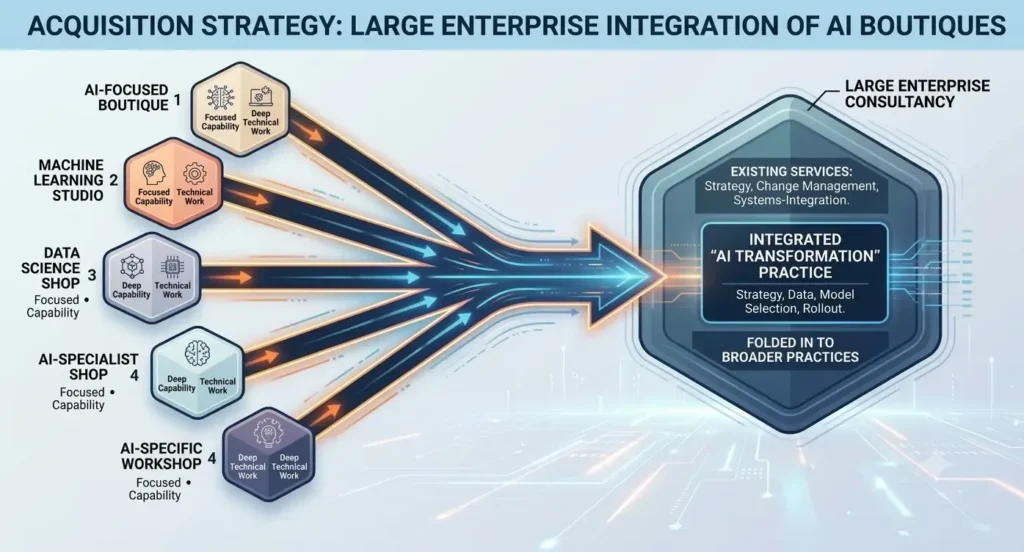
The logic is straightforward: enterprise clients already trust these firms with strategy and change management, so bolting on AI capability lets them sell a “one throat to choke” engagement, strategy, data, model selection, and rollout, all under one master services agreement. It’s an efficient sales motion. It also means the AI specialists doing the actual technical work are often several layers removed from client leadership, operating inside a much larger, more standardized delivery machine.
At the same time, a different narrative has been gaining traction: the idea that AI, as a technology category, is genuinely disruptive to how consulting itself gets delivered, and that scale is no longer the moat it used to be for implementation work specifically (as opposed to strategy or change management, where relationship depth and org-wide reach still matter).
That’s the tension worth understanding before you shortlist partners: bigger doesn’t automatically mean better-equipped for AI implementation. In some structural ways, it can mean the opposite.
“Bigger doesn’t automatically mean better-equipped for AI implementation. In some structural ways, it can mean the opposite.”
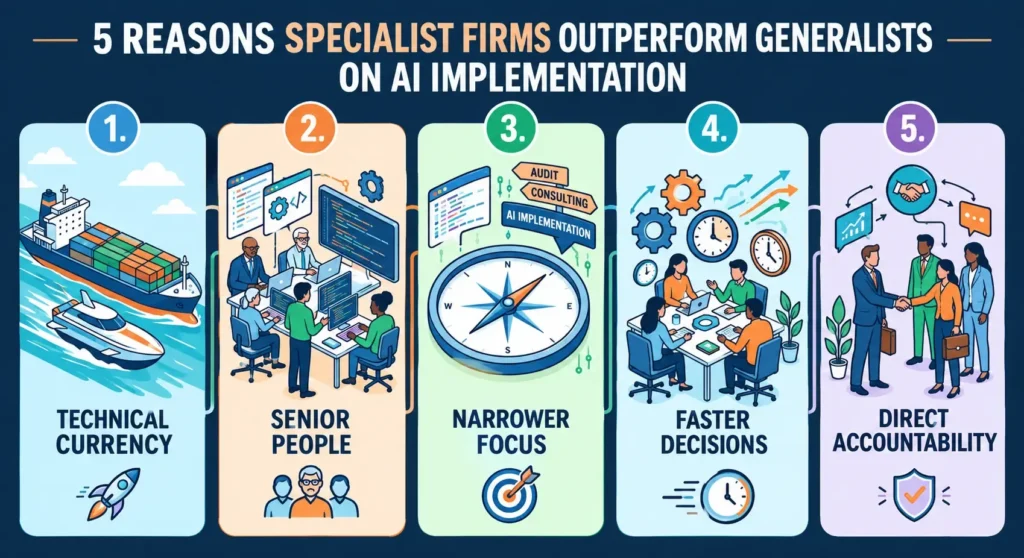
Strategy work rewards breadth. AI implementation rewards depth, speed, and technical currency, three things that don’t scale evenly inside large, standardized delivery organizations.
Model releases, API changes, and best-practice shifts in the AI space happen on a timescale of weeks, not the annual retraining cycles large firms use to keep thousands of consultants current. A small team working exclusively in AI implementation can absorb a new model capability into client work almost immediately. A large firm has to push that update through certification programs, internal playbooks, and staffing pools before it reaches your project.
At scale, the senior AI expert who impressed you in the sales pitch is rarely the person writing the integration code or tuning the model six weeks into the engagement—the pitch team and the delivery team are frequently different groups. At a boutique, there’s no room for that split; the people who scoped the problem are usually the people building it.
Inside a large firm, AI work often has to compete internally for staffing and priority against established, higher-margin practices (ERP, cloud migration, change management). A specialist firm has no competing practice line pulling attention away from your AI project.
Choosing between a fine-tuned open-weight model versus an API-based frontier model, or deciding how much of a workflow to automate versus keep human-in-the-loop, requires technical judgment calls made quickly and revisited often. Boutique teams typically have shorter internal approval chains, so technical direction can shift in days rather than being locked into a scope document for a quarter.
With a specialist partner, the people accountable for whether the model actually works in production are usually the same people you’re talking to. Large-firm engagements often route feedback through account managers and delivery leads before it reaches the engineers—a structure built for predictable, standardized delivery, not the iterative tuning AI implementation actually requires.
None of this means boutiques are automatically the right choice for every engagement—a multi-year, org-wide AI transformation with heavy change-management needs may still benefit from a large firm’s breadth. But for the specific work of building, integrating, and shipping an AI system, these structural advantages consistently favor specialists.
Read Also: How to Choose the Right AI Agent Development Company
Rather than defaulting to firm size or brand recognition, evaluate any prospective AI consulting firm, boutique or enterprise, against four questions:
Score any partner specialist or generalist against these four questions before you weigh brand name or firm size.
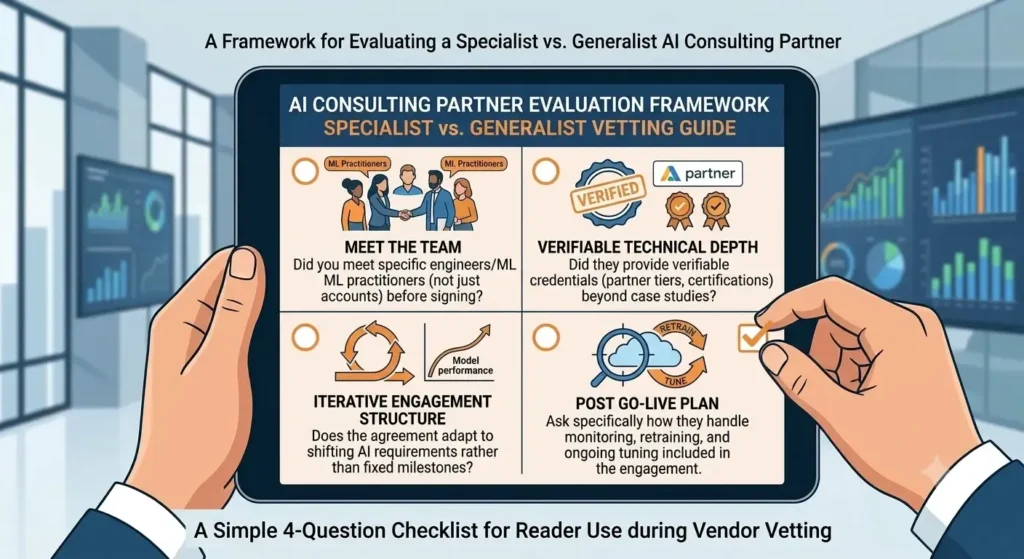
The evaluation framework above is designed to separate marketing claims from verifiable substance, and it’s worth applying that same standard to how we describe our own credentials.
NextGenSoft is an AWS Select Tier Partner and a registered Anthropic partner, both of which are third-party program affiliations rather than self-reported claims. For a client running the framework above, that means the “proof of technical depth” question has an actual answer: verifiable standing with two of the platforms; most AI implementation work runs on today, rather than a generic “AI expertise” assertion.
As a specialist firm, the structural advantages outlined earlier apply directly to how we work: the engineers scoping your project are the ones building it, technical direction can shift quickly as an implementation evolves, and there’s no competing practice line inside the firm pulling attention away from your AI work. See NextGenSoft’s AI implementation services.
If you’re currently running the specialist-vs-generalist evaluation for your own AI initiative, that’s the right place to see how the services map to a real engagement—and to talk directly with the team that would be doing the work.
1. Are boutique AI consulting firms cheaper than large consultancies?
Answer: Not necessarily; pricing depends on the scope and seniority of the team involved, not firm size alone. Boutiques often have lower overhead than large firms, but they may also price at a premium for scarce, highly specialized technical talent. Compare quotes on a like-for-like scope basis rather than assuming firm size predicts cost.
2. Is a large consulting firm ever the better choice for AI work?
Answer: Yes. For large, multi-year AI transformation programs that require extensive change management, cross-department coordination, and executive alignment across a large organization, a firm with broader institutional reach can be a better fit than a smaller specialist team.
3. What credentials should I actually verify before hiring an AI consulting partner?
Answer: Look for verifiable, third-party program affiliations—cloud-provider partner tiers (like AWS or Azure partner status) and AI-platform partner programs (like Anthropic’s or OpenAI’s partner programs), rather than firms’ own self-reported “AI expert” claims with no external validation.
4. How do I know if a firm’s AI case studies are legitimate?
Ask for outcomes you can verify independently, a named client reference you can contact directly, or measurable before/after metrics tied to a specific system, rather than anonymized case studies with unattributed results.
 Niraj Salot
Niraj Salot, with 20+ years of expertise in software architecture, specializes in delivering robust enterprise applications. His cloud optimization skills help clients cut costs while maximizing performance. As a key leader at NextGenSoft, he drives scalable, efficient, and high-performing solutions.
We’re ISO/IEC 27001:2022 certified, ensuring your projects are executed with globally recognized security standards.

INDIA
 sales@nextgensoft.io
 +91 81284 66678

 Brijesh Shah
CEO, NextGenSoft
Brijesh Shah
CEO, NextGenSoft
 Vrajlal Chhuchhar
Sr. BDM, NextGenSoft
Vrajlal Chhuchhar
Sr. BDM, NextGenSoft


