How to Choose the Right AI Agent Development Company (2026 Buyer’s Checklist)
Pranav LakhaniAugust 25, 2026
Share this article


Let AI highlight what matters.
The pilot looked great. A support agent that read tickets, checked order history, and drafted replies — all live in the demo. Three weeks after handoff, someone quietly turned it off. It had promised a refund policy that didn’t exist, nobody could trace why, and the vendor’s fix was “we’ll tweak the prompt.”
That story is the most common one I hear from teams that picked an AI agent development company based on a demo. This guide is the checklist I wish they’d had. Paste it into a doc, score three vendors, and you’ll know who to disqualify before the contract stage.
Two years ago, few firms claimed they could build agents. Now almost every dev shop does. The phrase is on every services page, which makes it useless as a filter.
The second change is more serious. Chatbots talk. Agents act. They read your CRM, call your APIs, move tickets, issue refunds. When a chatbot is wrong, a customer gets a bad answer. When an agent is wrong, your data changes. The blast radius is real.
So the first question isn’t “can you build agents?” It’s: are you an AI development agency that builds chat interfaces, or a firm that ships agentic AI solutions into systems that matter? Those are different skills, and very different risk profiles.
Real-world example: A logistics company I spoke with shortlisted four vendors. Three showed the same style of demo, a chat box over a PDF. The fourth opened with a trace view showing every tool call an agent made during a booking change. Guess which one understood the problem.
Before you compare vendors, know what you’re buying. Good AI agent development services cover the full lifecycle, not just the build:
An AI agent builder platform (no-code or low-code) is fine when the workflow is simple, the data is clean, and the actions are low-stakes; think internal FAQ answering or ticket tagging. Custom AI agents are the only option when the agent must touch multiple systems, handle edge cases that carry cost, or meet security and audit rules.
The scope you choose shapes the engagement. Some firms sell packaged AI agent development company services with a fixed deliverable list. Others sell a team. Neither is wrong, but you need to know which one you’re getting.
Real-world example: A SaaS company used a builder platform for a lead-qualifying agent, and it worked well for six months. It broke when they added a second CRM and needed role-based access. That’s the moment a platform stops being enough.
Here’s what goes wrong, mapped from symptom to root cause to cost.
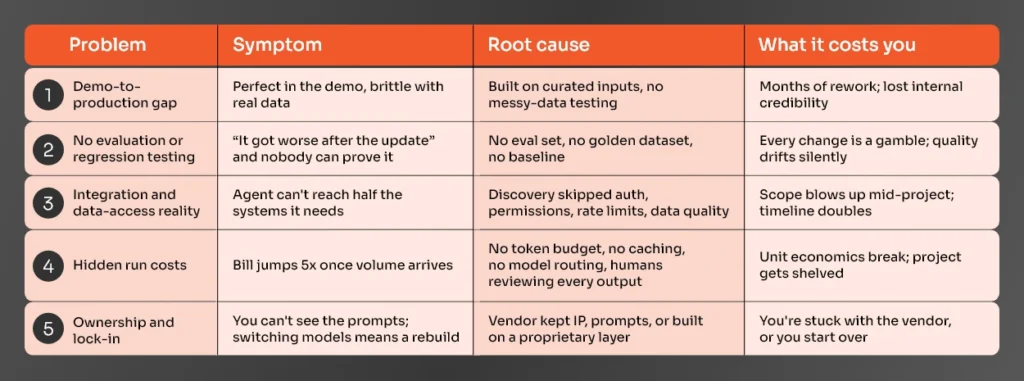
Notice that none of these is “picked the wrong model.” That’s the core point of this article: most AI agent projects fail on evaluation discipline, data access, and ownership — not on model choice. Any vendor whose pitch leads with “we use GPT” or “we use Claude” is telling you they’re a wrapper shop. The real ones lead with evals, guardrails, integration depth, observability, and cost control.
This is the centerpiece. Ten categories. For each one: what to verify, what to ask, and what strong and weak answers sound like.
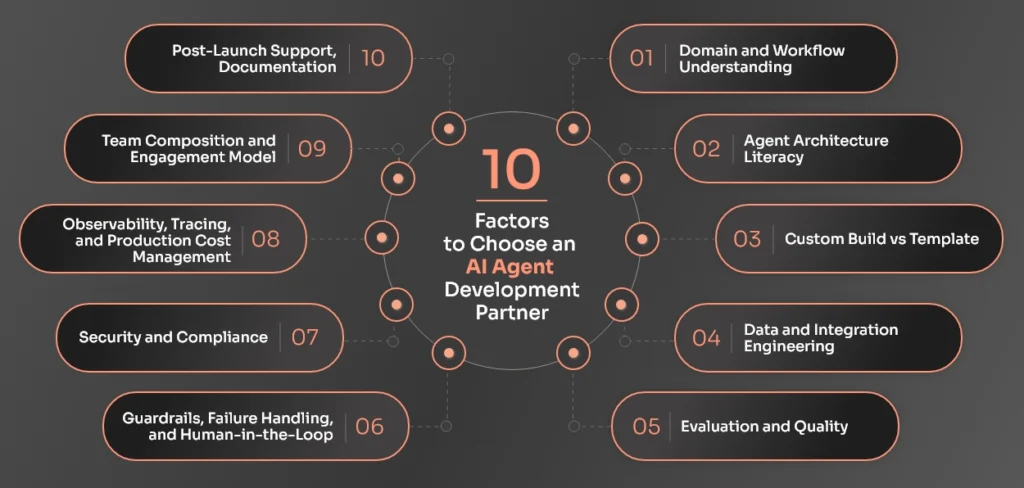
Verify: They can describe your workflow back to you, including the exceptions, before they describe their tech.
Ask them this:
Strong answer: They name the edge cases you didn’t mention and ask about the ones you did.
Red flag: They jump straight to architecture diagrams.
Verify: They understand tool use, orchestration, memory, and can explain single-agent vs multi-agent trade-offs without jargon.
Ask them this:
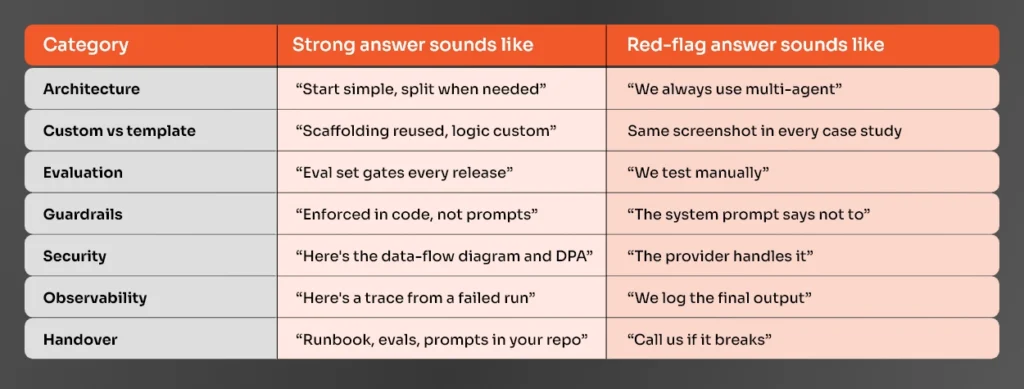
Strong answer: “Start with one agent and clear tools. Split only when the context window or the failure modes demand it.”
Red flag: “We always use a multi-agent framework.” Always is the tell.
Verify: Whether you’re talking to a custom AI agent development company or a shop reskinning the same demo for every client.
Ask them this:
Strong answer: Reusable scaffolding (tracing, eval harness, deployment) plus custom agent logic, tools, and prompts.
Red flag: Every case study has the same screenshot.
Verify: They treat integration as engineering work, not a config step.
Ask them this:
Strong answer: Idempotent actions, retries with limits, and a clear rollback story.
Red flag: “The framework handles that.”
This is the section that separates the best AI Agent Development Company from the merely competent. If they can’t show you an eval set, walk away.
Verify: They build a golden dataset with you, set an accuracy baseline, and run a regression suite on every change.
Ask them this:
Strong answer: “We write 50–200 test cases with your team, measure the baseline, and gate every release on it.”
Red flag: “We test it manually” or “the model is very accurate.”
Verify: Failure is designed, not hoped against. NextGenSoft evaluates guardrail design against the NIST AI Risk Management Framework as a baseline reference.
Ask them this:
Strong answer: Action tiers enforced in code, confidence thresholds, escalation to a named queue.
Red flag: “We tell it in the system prompt not to do that.”
Verify: They can meet SOC 2, GDPR, and India’s DPDP Act requirements if they apply to you, and they have a real answer for PII handling and data residency. Ask whether their engineering practices map to the OWASP Top 10 for LLM Applications.
Ask them this:
Strong answer: A data-flow diagram, a DPA ready for signing, and a clear stance on which model providers they’ll use in each region.
Red flag: “The model provider handles compliance.”
Verify: Every agent run produces a trace you can read, and cost is tracked per task.
Ask them this:
Strong answer: Per-step traces, cost per task on a dashboard, alerts on budget overruns.
Red flag: “We log the final output.”
Verify: Who actually does the work, and how you’ll interact with them.
Ask them this:
Strong answer: Named people, clear roles, a model that matches your maturity.
Red flag: The senior people you met vanish after the contract.
Verify: You can run the thing without them.
Ask them this:
Strong answer: A runbook, documented prompts in your repo, and a training session for your team.
Red flag: “Just call us if something breaks.”
If you’re buying at enterprise scale, the checklist above still holds, but the bar moves on several points.
An AI Agent Development Company for enterprises should volunteer these topics, not wait to be asked.
Real-world example: A financial services firm rejected a strong technical vendor because they couldn’t provide audit logs at the tool-call level. A less flashy competitor had it on day one and won the deal.
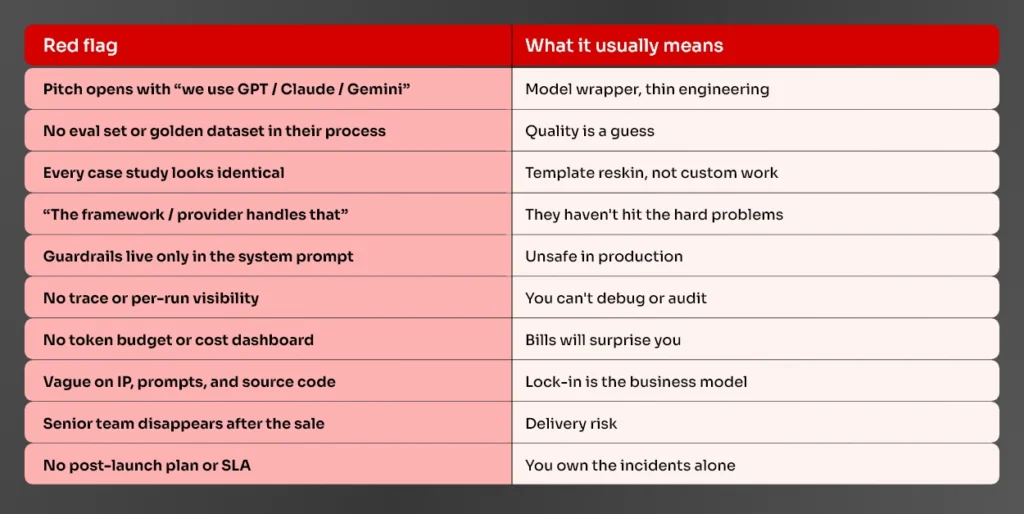
You can’t spot a top AI Agent Development Company from their website. You spot them during discovery. Here’s a process that takes 30 to 60 days and protects you from the expensive mistake.
Days 1–10: Shortlist. Send the checklist to 5–6 vendors. Cut to 3 based on written answers and one reference call each.
Days 10–25: Paid discovery. Pay each finalist (or your top two) for a short discovery sprint. You’ll learn more from two weeks of paid work than two months of sales calls. Watch who asks about data access, permissions, and failure modes first.
Days 25–55: Scoped pilot. Pick one vendor. Agree success metrics before the pilot starts — accuracy on the eval set, latency, cost per task, and an escalation rate. No metrics, no pilot.
Days 55–60: Contract. Terms to insist on:
Real-world example: A retail company ran paid discovery with two finalists. One delivered a data-flow diagram and a draft eval set. The other delivered a slide deck. The decision made itself.
Score each vendor 1–5 per category. Multiply by the weight. Adjust the weights to your situation — but don’t drop evaluation below 15%.
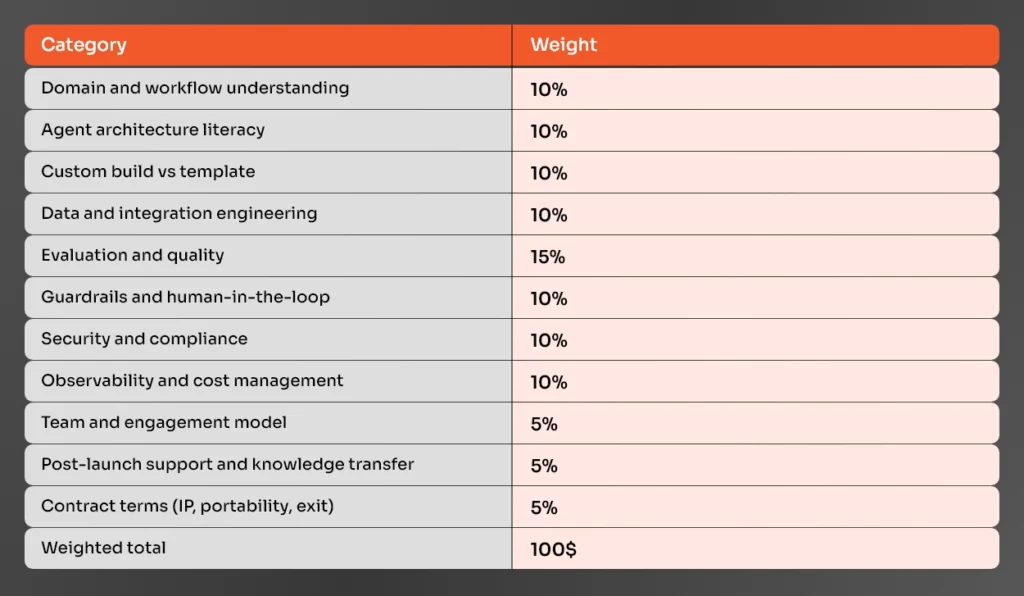
Most agent projects don’t fail on the model. They fail on evaluation, data access, and ownership. Use the checklist, run paid discovery, and make vendors show you a trace and an eval set before they show you a demo. That alone will disqualify most of the field.
If you’d like this checklist as a shareable doc, or want a 30-minute technical discovery call with NextGenSoft to pressure-test your use case, reach out. No pitch, just a working session. Choosing the right AI agent development company is mostly about asking the right questions, and now you have them.
1. How to choose an AI agent development company?
Answer: Score them on evaluation discipline, integration depth, guardrails, observability, and ownership, not on which model they use. Run a short paid discovery before committing, and insist on a pilot with pre-agreed metrics.
2. When should you hire an AI agent development company vs. build in-house?
Answer: Hire when you lack agent-specific experience (evals, tracing, tool design), need to ship in months not years, or the first use case is a proof point rather than core IP. Build in-house when agents are central to your product, and you can staff a team long-term. Many teams do both: hire to ship the first one, then bring it in-house with a proper knowledge transfer.
3. What should an AI agent development company for enterprises provide?
Answer: Beyond the build: SOC 2 evidence, a DPA, SSO and RBAC support, tool-call-level audit logs, data residency options, and a change-management plan for multi-team rollout.
4. What does AI agent development cost in 2026?
Answer: It varies widely by scope, so be cautious of any vendor quoting a number before discovery. Budget for three things: the build, the run cost (tokens, infra, human review), and post-launch iteration. The run cost is the one most buyers forget.
5. What does a good pilot look like?
Answer: Four to six weeks, one real workflow, real data, an eval set built before the pilot starts, and success defined as numbers- accuracy, cost per task, escalation rate- not as a demo that impresses the room.
 Pranav Lakhani
Pranav brings over 20 years of expertise in software development and design, specializing in delivering enterprise-scale products. His unique ability to manage the entire product lifecycle ensures innovation and technical excellence across every project.
We’re ISO/IEC 27001:2022 certified, ensuring your projects are executed with globally recognized security standards.

INDIA
 sales@nextgensoft.io
 +91 81284 66678


