RAG vs Fine-Tuning: Which AI Approach Is Best for Enterprise LLM Applications?
Pranav LakhaniJuly 3, 2026
Share this article


Let AI highlight what matters.
More enterprises are putting large language models into real workflows now — customer support, internal search, decision support. Once a team gets past the first proof of concept, one question comes up almost every time: do we build this with Retrieval-Augmented Generation (RAG), or do we fine-tune a model on our own data?
Both approaches work. They just solve different problems, and picking the wrong one for your situation is an expensive way to find that out. Here’s a full breakdown of how they differ, what each one actually costs to run, and how to decide between them without guessing.
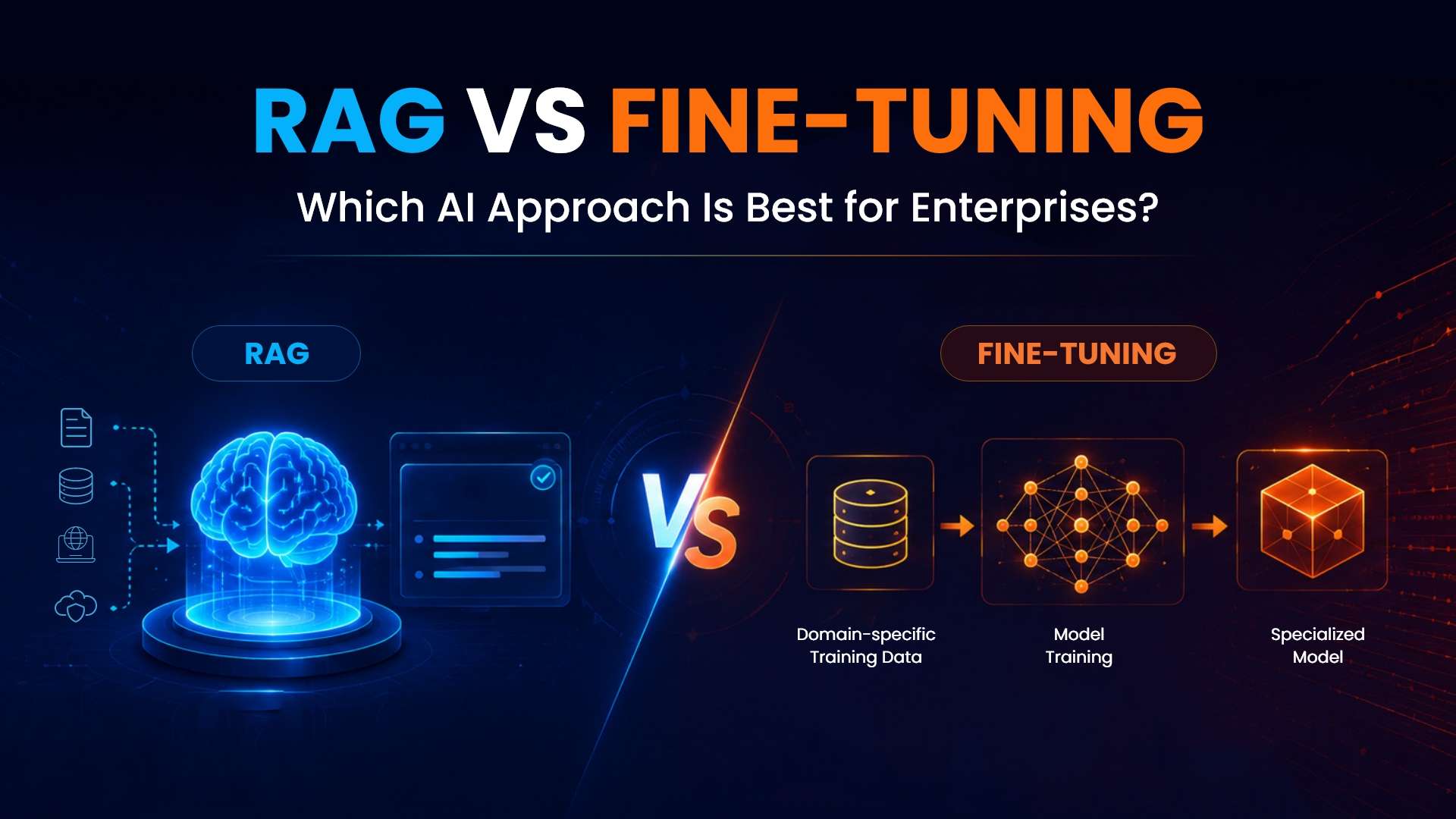
RAG pairs a large language model with direct access to your own data. Instead of relying only on what the model learned during training, RAG development adds a retrieval step: the system searches your internal documents, databases, or knowledge base first, then feeds the relevant results to the model as context before it generates an answer.
That grounding matters. Because the answer is built from your actual current data rather than the model’s memory, RAG systems tend to be more accurate and far less prone to hallucination, especially for questions about internal policies, product details, or anything that changes often. Companies use it heavily for internal assistants, customer support knowledge bases, and compliance-sensitive answers, precisely because you can point to the source document behind any given response.
Fine-tuning takes a general-purpose model and trains it further on your own data. The model doesn’t just reference your data at answer-time, it absorbs it: your industry’s terminology, your writing style, the specific tasks you care about.
Once fine-tuned, the model gets noticeably better at a narrow set of tasks. Teams reach for fine-tuning when they need consistent behavior on repetitive, well-defined work: contract analysis, structured technical support responses, content that has to match a specific brand voice every time.
| RAG | Fine-Tuning | |
|---|---|---|
| Setup time | Days to a few weeks — mostly retrieval pipeline and data indexing | Weeks to months — data curation, training runs, evaluation cycles |
| Data freshness | Update the knowledge base anytime, no retraining needed | Frozen at training time; new information means retraining |
| Upfront cost | Lower — mainly vector database and integration work | Higher — compute, data prep, and ML engineering time |
| Ongoing cost driver | Per-query retrieval plus larger prompts (more input tokens) | Amortized training cost; per-query cost can be very low at scale |
| Best for | Fast-changing or large knowledge bases, transparency, source citations | Stable, repetitive, high-volume tasks needing a specific tone or format |
| Hallucination risk | Lower — answers are grounded in retrieved source data | Depends on training data quality; no built-in grounding |
People often ask which approach is “cheaper,” and the honest answer is that it depends heavily on your query volume and how the numbers change with scale — so treat any vendor who hands you a precise dollar figure before understanding your use case with some skepticism. What’s true directionally, though, is worth understanding:
In practice: low volume favors prompting alone, high and predictable volume favors fine-tuning, and anything that needs to stay current favors RAG regardless of volume. Most enterprise systems end up mixing more than one of these once they’re past the prototype stage.
The two methods aren’t mutually exclusive, and in practice, some of the strongest enterprise LLM systems use both. Fine-tuning teaches the model a consistent voice, format, and domain vocabulary. RAG keeps that model’s answers grounded in whatever is true right now.
A common pattern: fine-tune a model to handle a company’s specific tone and task structure, then connect it to a RAG pipeline for anything that needs current facts, pricing, or policy details the model shouldn’t be expected to memorize. The fine-tuned layer handles “how we say things.” RAG handles “what’s actually true today.”
This hybrid setup costs more than either method alone, since you’re paying for both the training investment and the retrieval infrastructure. For applications where being wrong or stale is expensive, that added cost is usually easy to justify.
| Choose RAG when… | Choose Fine-Tuning when… |
|---|---|
| Your information changes often | Your task and data are stable |
| Data privacy and source transparency matter | You need a specific, consistent tone or format |
| You want a faster path to production | The task is repetitive and well-defined |
| Your knowledge base is large and dynamic | You have high, predictable query volume |
Customer support: RAG-powered systems let support teams surface the right answer from a knowledge base instantly. Fine-tuned models are valued for consistent-quality responses to the same categories of questions, over and over.
Knowledge management: Employees ask natural-language questions and get specific answers pulled from internal documents and policies, rather than searching through a wiki manually.
Content generation and compliance: Fine-tuned models generate reports and communications in a company’s preferred format, while RAG keeps those outputs aligned with current regulations by referencing the latest source documents rather than a frozen training snapshot.
Working with an experienced AI development company tends to shorten this list of mistakes considerably, mostly by catching the data-quality and scope problems before they become expensive.
NextGenSoft works with organizations on exactly this decision — RAG, fine-tuning, or a hybrid of both — as part of broader Generative AI and LLM implementation engagements. That includes custom LLM development, architecture guidance, and hands-on delivery support, built around what your data and use case actually need rather than a one-size-fits-all recommendation.
If you’d like help figuring out which approach fits your organization, or whether a hybrid setup makes sense for your LLM integration plans, reach out for a working conversation, not a sales pitch.
1. What is the primary difference between RAG and fine-tuning?
RAG retrieves relevant information from your data in real time and feeds it to the model at answer-time. Fine-tuning changes the model itself, permanently, by training it further on your data.
2. Which approach is right for most enterprises?
It depends on the use case. Many companies start with RAG for faster wins, then add fine-tuning for specific, repetitive tasks once those needs are clear. A combination of both is common as systems mature.
3. Which one is cheaper to run?
Neither wins outright — it depends on your query volume. Low-volume use cases usually favor RAG or prompting alone; high, predictable volume can make fine-tuning’s upfront cost pay off through a lower per-query cost over time.
4. Can small and mid-sized companies benefit from these approaches?
Yes. Both RAG and fine-tuning scale down reasonably well, and the tooling to implement either has gotten considerably more accessible, so this isn’t exclusively an enterprise-budget decision anymore.
5. Is it possible to combine RAG and fine-tuning for better results?
Yes — this is increasingly common for complex enterprise systems. Fine-tuning handles consistency and tone; RAG keeps answers grounded in current, accurate information.
6. How long does it take to see results from LLM customization?
Most teams see measurable improvement within four to eight weeks of implementation, with the fuller benefit showing up over three to six months depending on complexity and data quality.
 Pranav Lakhani
Pranav brings over 20 years of expertise in software development and design, specializing in delivering enterprise-scale products. His unique ability to manage the entire product lifecycle ensures innovation and technical excellence across every project.
We’re ISO/IEC 27001:2022 certified, ensuring your projects are executed with globally recognized security standards.

INDIA
 sales@nextgensoft.io
 +91 81284 66678


