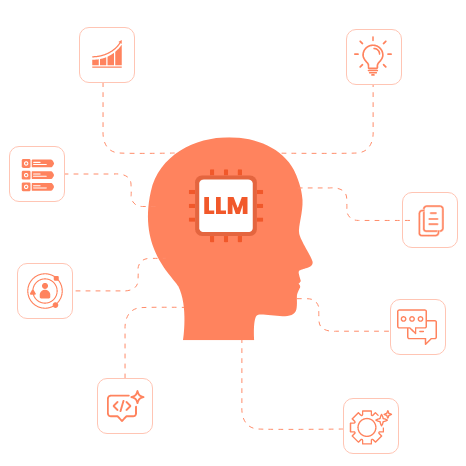
NextGenSoft is a trusted LLM development company that goes beyond basic API integration to deliver reliable, production-ready AI solutions. We connect large language models with your systems, data, and workflows, ensuring accuracy, scalability, and real-world performance.
Our LLM development services cover prompt engineering, output validation, cost optimization, latency tuning, and robust fallback handling. Whether it’s web apps, mobile platforms, or internal tools, we build AI integrations that are stable, efficient, and easy for your team to maintain.
We stay model-agnostic, evaluating OpenAI, Anthropic, Google, and open-source models, to recommend the best fit based on your needs, budget, and compliance requirements.
Integrating a proven LLM via API is dramatically faster than training a custom model. Your team gets production-grade language AI capabilities in weeks, not months or years of ML research.
A well-architected LLM integration abstracts the model provider behind a clean interface. This means you can switch between OpenAI, Anthropic, or open-source models as the market evolves, without rewriting your application logic.
Unchecked LLM API usage can create significant unexpected costs. We design prompt management, caching strategies, and model tiering (using cheaper models for simpler tasks) so your AI features scale without runaway API spend.
LLMs produce natural language by default. We implement structured output schemas, output parsing, and validation layers so your application receives consistent, machine-readable data it can act on, not free-form text that breaks your downstream systems.
Rate limits, API timeouts, model errors, and content policy rejections are everyday realities of LLM-powered applications. We build retry logic, fallback chains, and graceful degradation so your product stays functional even when the LLM API does not.
Getting it to behave predictably, cost-efficiently, and securely inside a production app is where most integration projects run into serious problems.
Without structured output schemas and robust prompt engineering, LLMs return responses in different formats, lengths, and tones depending on subtle input variations. Apps that depend on a consistent structure break silently in production.
Teams frequently underestimate token costs until the bill arrives. Without prompt optimisation, context window management, caching, and model tiering, LLM API costs can escalate 10x faster than expected as usage grows.
Naive RAG implementations retrieve too many chunks, make too many LLM calls, and return responses too slowly for real-world use. Production RAG requires careful reranking, caching, and retrieval budget management to stay fast and cost-efficient.
Applications built without fallback handling and graceful degradation become entirely non-functional when the model provider has an incident, impacting every user who depends on the AI feature.
We evaluate each LLM use case against a structured matrix, reasoning complexity, context window requirements, latency tolerance, cost per token, data residency constraints, and compliance requirements. The right model for a customer support feature is often not the right model for a complex reasoning pipeline.
We design prompts systematically, defining role, instructions, output format, constraints, and examples in a structured template. Prompts are version-controlled, tested against representative inputs, and documented as a first-class engineering artefact, not a post-it note in a config file.
We define Pydantic schemas or JSON schemas for every LLM output that feeds a downstream system. Output parsing and validation layers catch malformed responses before they reach your application logic, ensuring your product behaves correctly even when the LLM produces unexpected formatting.
We design context assembly strategies that prioritise the most relevant information within the model’s token limit, using techniques like retrieval, summarisation, and dynamic context pruning so the LLM always receives useful context without wasting tokens or exceeding limits.
We implement semantic caching for repeated queries, request queuing to manage rate limits, and model tiering to route simple requests to cheaper models. Cost management is a design requirement, not an afterthought we address when the invoice surprises you.
Every LLM development services call is instrumented with latency, token count, cost, and output quality metrics. We set up evaluation pipelines that track response quality over time, alerting your team when model updates or data drift cause performance degradation.
LLM integration is no longer a differentiator; it is becoming table stakes. Products that do not integrate language AI capabilities risk falling behind competitors who are shipping AI-powered search, writing assistance, data analysis, and customer interaction as standard features.
Leading engineering teams are routing different tasks to different models, using GPT-4o for complex reasoning, Claude for long-context document tasks, and smaller open-source models for high-volume, latency-sensitive operations.
Modern LLMs can call external functions, APIs, and databases directly, transforming them from text generators into active participants in business workflows. Structured tool use is now the foundational pattern for any LLM integration that needs to interact with the real world.
OpenAI's structured outputs API and similar capabilities from other providers are making it practical to guarantee that LLM responses conform to a predefined JSON schema, eliminating the parsing brittleness that made early LLM integrations unreliable in production.
Open-source models like Llama 3, Mistral, and Phi-3 are reaching quality levels that make on-premise deployment viable for many use cases, giving regulated enterprises a path to LLM integration that keeps sensitive data entirely within their own infrastructure.
Tools like LangSmith, Helicone, and Arize are maturing into enterprise observability platforms. Teams that instrument their LLM integrations from day one have a significant advantage in diagnosing quality issues, controlling costs, and demonstrating compliance.
We do not deliver a working integration and disappear. We write clean, documented, testable integration code, with prompt templates version-controlled, model configuration externalised, and observability built in. Your engineering team can extend, debug, and improve it independently.
We have hands-on production experience with OpenAI, Anthropic Claude, Azure OpenAI, Google Gemini, and Hugging Face open-source models. When we recommend a model for your use case, it is based on structured evaluation, accuracy benchmarks, & latency measurements.
We conduct a data handling review before any custom LLM integration development begins, identifying what data will be sent to external APIs, whether it requires redaction or anonymisation, and whether your compliance requirements call for on-premise model deployment instead.
We track token costs throughout development, model prompt efficiency against a defined cost budget, and deliver a cost projection for production usage before go-live. No surprises on your first full-scale invoice.
We begin by precisely defining what the LLM will do, what inputs it will receive, what outputs it must produce, and what happens when it fails. We assess whether an LLM is the right technology for your use case; sometimes, a simpler, cheaper solution is the correct answer.
We document every data flow the LLM will be involved in, identify any PII or sensitive data that requires handling controls, and evaluate model providers against your accuracy, latency, cost, and compliance requirements. We finalise the model recommendation before any integration work begins.
We design the prompt template, system instructions, few-shot examples, and output schema for every LLM interaction in the integration. Prompts are version-controlled from day one and tested against a representative set of inputs before development begins.
We build the integration — API connection, prompt management, structured output parsing, error handling, retry logic, and fallback behaviour. Every LLM call is covered by unit and integration tests with representative fixtures, not just happy-path scenarios.
Before production, we profile actual token usage against representative traffic patterns, model cost per request, and project monthly API spend at your expected scale. We implement caching, model tiering, and context optimisation to bring costs within target.
We deploy the integration with full observability — latency, token counts, error rates, and cost tracking in your monitoring platform of choice. We establish alerting thresholds and hand over a runbook so your team can operate and improve the integration independently.
Browse through the technical knowledge about latest trends and technologies our experienced team would like to share with you.
View all articlesIn the fast-evolving world of artificial intelligence, Agentic AI is rapidly emerging as the next transformative force, far beyond what generative AI has accomplished. While traditional AI models focus on reactive tasks and singular processes, Agentic AI introduces autonomy, adaptability, and intentional decision-making, fundamentally reshaping how businesses handle workflow automation. As companies seek more of […]
Artificial Intelligence (AI) is quickly evolving, and Agentic AI is the latest advancement disrupting the AI ecosystem. While traditional AI models are reactive and typically focused on specific tasks (i.e., a narrow assignment), Agentic AI systems are meant to act as agents that can take independent action, can exhibit initiative, and can responsibly and intentionally […]
Introduction The generative AI revolution of 2024-2025 didn’t happen overnight; it required vision, courage, and a willingness to explore uncharted territories. For NextGenSoft (NGS- A Leading AI Modernization Company), this generative AI journey began with a single API integration and evolved into a comprehensive suite of AI-powered solutions that are transforming how enterprises interact with […]
Our AI pillar practice covers the full spectrum of AI strategy, consulting, and engineering. Start here to understand how AI fits into your broader technology roadmap.
Give your AI agents access to your company's knowledge. We build retrieval-augmented generation pipelines that ground agent responses in your verified, up-to-date internal data.
Connect large language models to your existing applications, APIs, and data systems. We handle the engineering complexity of LLM integration so your product teams can focus on features.
We build AI copilots that work inside your existing tools — assisting your team with research, drafting, analysis, and decision support without replacing your current workflow.
From custom LLM fine-tuning to generative AI applications for content, code, and data — our generative AI practice covers the full engineering stack.