Microservices vs. Monolith: Making the Right Architectural Choice
Divyang GandhiApril 18, 2025
Share this article


Let AI highlight what matters.
In today’s software development landscape, choosing between Microservices vs Monolith is a critical decision that can significantly impact your project’s success. This article explores both approaches, their strengths and weaknesses, and provides guidance on making the right choice for your specific needs.
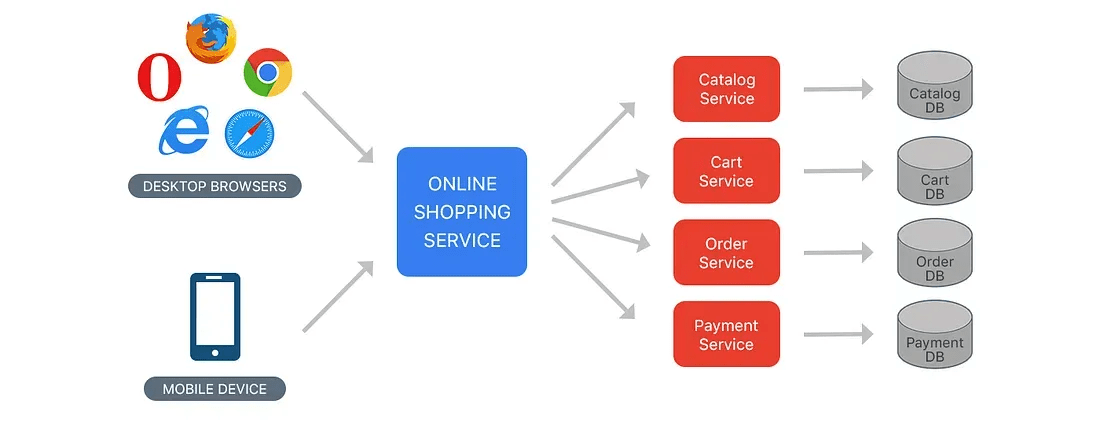
A microservice architecture breaks an application into small, loosely coupled, independently deployable services. Each service focuses on a specific business function and communicates with others via well-defined APIs. This model offers flexibility and scalability in managing complex systems.
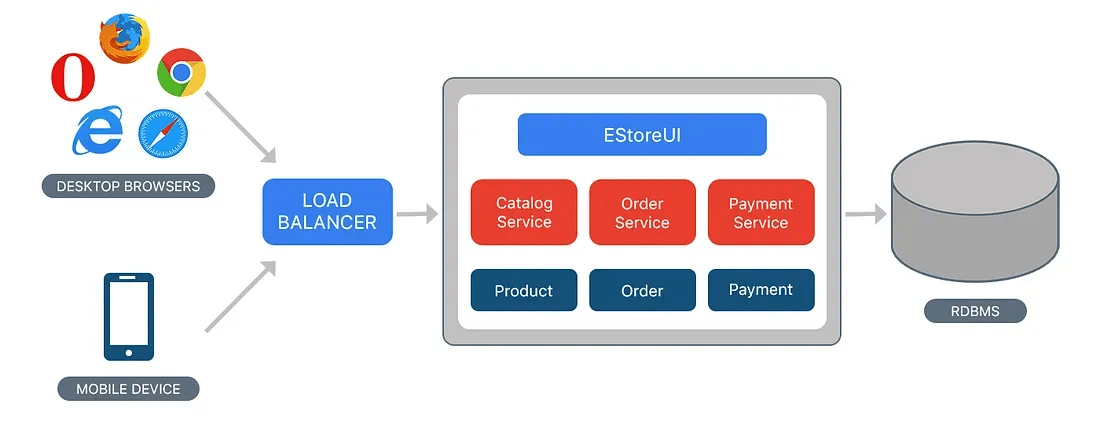
A monolithic architecture structures an application as a single, unified unit where all components are interconnected and share a single database. It’s simpler to develop initially but can become difficult to scale and maintain over time.
Figure 2: Monolithic applications contain all services within a single deployment unit. Desktop and mobile users interact with the same codebase, typically routed through a load balancer.
Figure 1: Microservices split each business function into individual services, each with its own database and scaling rules. A gateway directs traffic to the correct microservice.
The debate over Microservices vs Monolith isn’t about one being better than the other—it’s about what fits your context. Both architectures serve different needs and scales of development. Focus on what supports your team’s workflow and product vision. Start simple, think ahead, and evolve as your system grows.
 Divyang Gandhi
I'm Divyang Gandhi, a Senior Java Developer at NextGenSoft Pvt. Ltd. with over 6 years of experience in building scalable, enterprise-grade applications. I hold a Master of Science degree and specialize in Java and React, crafting robust backend systems and intuitive frontends. Passionate about clean architecture and practical innovation, I enjoy solving real-world problems through code—whether it's optimizing performance, integrating cloud services, or bringing GenAI into enterprise workflows.
We’re ISO/IEC 27001:2022 certified, ensuring your projects are executed with globally recognized security standards.

INDIA
 sales@nextgensoft.io
 +91 81284 66678


